
Outset
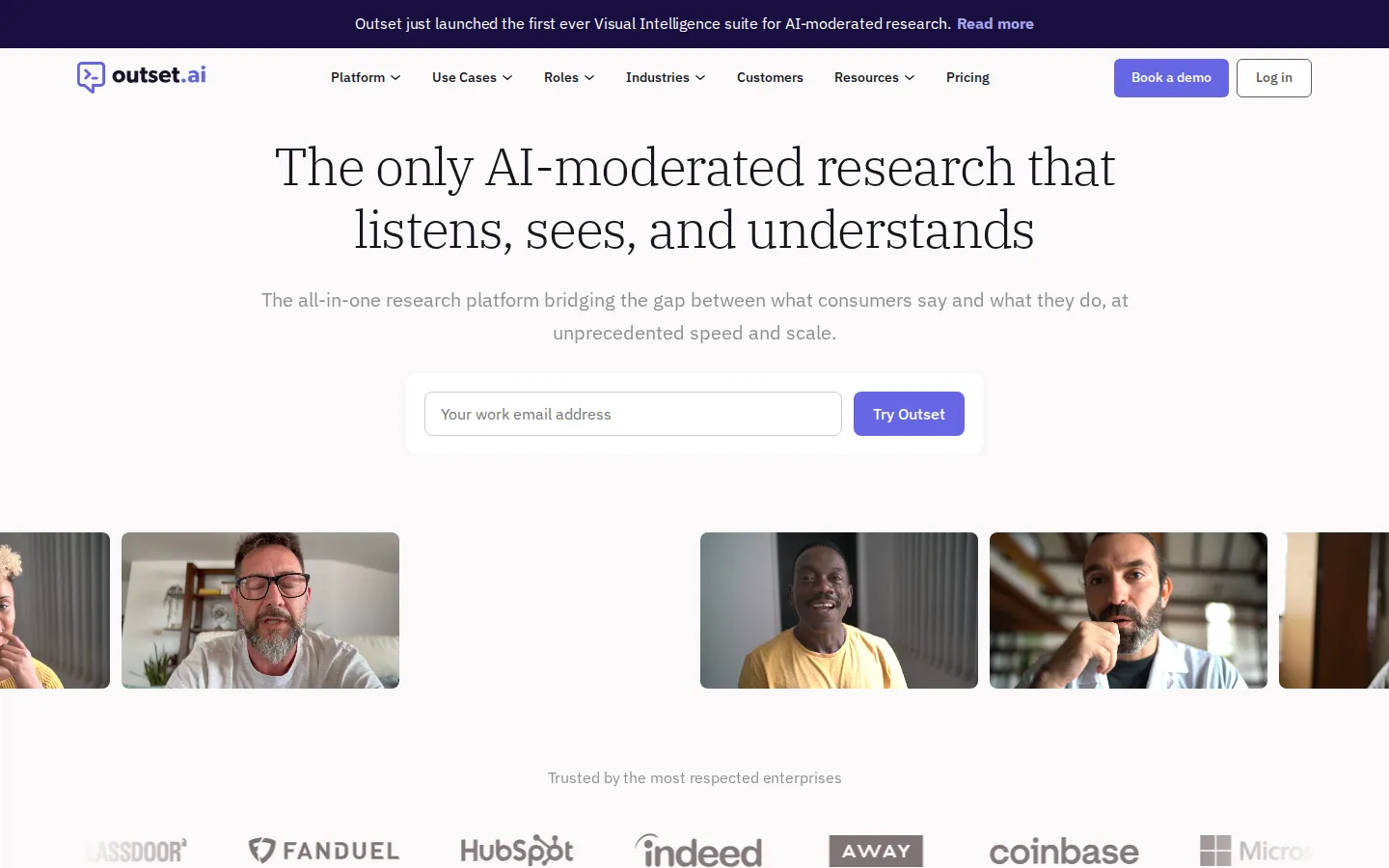
Outset is an AI-moderated research platform combining the depth of qualitative interviews with the speed and scale of surveys. Its AI moderator runs natural, adaptive conversations via video, voice, or text, dynamically probing for the 'why' behind answers, then synthesizes themes, quotes, and highlight reels instantly. Teams recruit participants, run hundreds of parallel interviews across 40+ languages, and share findings with stakeholders.
What is Outset?
Outset is an all-in-one AI-moderated research platform that spans the entire research lifecycle: guide setup, participant recruitment, AI-moderated interviews, instant synthesis and analysis, and stakeholder share-out. It claims to be the only AI-moderated research that 'listens, sees, and understands,' bridging the gap between what consumers say and what they do. The AI moderator conducts hundreds of interviews simultaneously via video, voice, or text, in 40+ languages, and dynamically probes based on audio and visual cues to reveal the 'why' behind answers. Workflows start with automated guide setup, where AI builds an interview guide from research goals, including qualitative and quantitative questions, advanced probing guidelines, and intelligent skipping logic. Outset's recently launched Visual Intelligence suite adds digital intelligence (monitoring participant screens during usability studies to capture clicks, hovers, and friction), emotional intelligence (reading facial expressions and tone changes in real time), and physical intelligence (analyzing real-world interactions such as shopalongs, unboxing, and in-home tests). The platform includes AI-driven synthesis with themes, powerful quotes, auto-tagged transcripts, highlight reels, custom reports, chat-with-your-data exploration, and PowerPoint export; recruitment via 25+ native panel integrations (Prolific, User Interviews, and others), shareable links, or synthetic AI users; automatic fraud detection with 99%+ accuracy and tagging of incomplete answers; and enterprise security with SOC 2 Type II and ISO 42001 certification, GDPR, HIPAA, and CCPA compliance, Azure infrastructure, data-segregated workspaces, SSO, white-labeling, and data never used to train external models. For sharing and analysis, teams get shareable report links, full interview playback, the ability to upload researcher-led interviews for analysis, and integration with Dovetail for broader qualitative workflows. Enterprise workspaces add observer seats, team collaboration, custom interviewer branding, and white-labeling so agencies can present interviews as their own product. Outset reports 500K+ hours of interviews conducted, 10K+ studies run, and 1.1B+ possible participants from 85+ countries, with customers citing faster, deeper research and even 1/20 the cost of parallel manual studies.
Outset Core Features
AI-moderated interviews via video, voice, or text with dynamic probing
Visual Intelligence suite capturing digital, emotional, and physical context
Instant synthesis with themes, quotes, and auto-tagged transcripts
Participant recruitment via 25+ native panel integrations or shared links
Multilingual interviews and insight translation in 40+ languages
Automatic fraud detection with 99%+ accuracy and incomplete-answer tagging
Custom AI-generated reports, highlight reels, and PowerPoint share-outs
Enterprise security
SOC 2 Type II, ISO 42001, GDPR, HIPAA, CCPA compliant
Who is Outset for?
Outset is built for research teams driving business strategy: UX researchers, market researchers, consumer insights professionals, agencies, and cross-functional product teams at enterprises. The site highlights customers such as Microsoft, HubSpot, Away, and Nestle, and names Michael Widenmeyer (Consumer Insights Sr. Manager), Wil Readinger (Head of UX Research), and Chris Monnier (Principal UX Researcher) as active users. Typical scenarios include discovery interviews, persona development, brand research, concept testing, usability testing, UX evaluations of AI-generated experiences, creative testing, and market strategy. Teams that are under-resourced for manual 1:1 interviewing use Outset to run 50 or more interviews while doing other work, replacing hours of scheduling, moderating, and tagging. The platform also serves enterprise research organizations that need high-volume studies across products, markets, and languages, with data-segregated workspaces, observer seats, SSO, white-labeling, and dedicated customer success support. Industries listed include healthcare, enterprise software, consulting, consumer technology, retail and e-commerce, consumer packaged goods, financial services, travel and hospitality, and media and entertainment. Because the AI moderator can probe based on audio and visual cues, the platform also suits teams studying real-world behavior such as in-home tests, shopalongs, and unboxing, plus those needing to test with synthetic users before launching a live study, and researchers who want to share findings easily with non-research stakeholders.
Outset Use Cases
Market strategy — explore new markets and uncover customer segments worth pursuing
Persona research — build robust, up-to-date personas from customer psychology
Concept testing — validate product ideas and concepts before you build
Usability testing — catch usability issues and design problems at scale
UX evaluations — evaluate non-deterministic, AI-generated user experiences
Brand research — learn what your brand really means to customers
Creative testing — test creative components and get feedback instantly
In-home tests and shopalongs analyzed with physical visual intelligence
Outset Pros and Cons
Pros
- Runs hundreds of AI-moderated interviews in parallel, delivering qualitative depth at survey scale
- Visual Intelligence observes screens, emotions, and real-world behavior, not just what participants say
- Instant synthesis with highlight reels, custom reports, and PowerPoint decks accelerates share-outs
- Global reach via 40+ languages, 25+ recruitment panels, and 1.1B+ possible participants
- Enterprise-grade security and fraud detection protect data quality and compliance
Cons
- No public pricing — plans are custom-quoted based on team needs after a consultation
- No self-serve free tier or trial; getting started requires booking a demo with the sales team
- No public developer API documented for programmatic integrations or custom workflows
FAQ About Outset
Outset Pricing
Outset does not publish pricing publicly; it offers flexible, custom-quoted subscription plans tailored to each research team's needs, with add-ons for recruitment, support, and enterprise features.
Check official pricingCustom
Flexible subscription plan priced per team after consultation; add-ons include recruitment, dedicated project management, white-labeling, and advanced support.
Outset Alternatives
Metaso
Metaso (秘塔AI搜索) is an AI search engine built for research-grade answers rather than link lists. It searches the open web, document libraries, and academic indexes such as PubMed, SCIE, EI, and JCR, then writes a structured, cited answer. Extra modes produce mind maps, slides, interactive web pages, and deep-research reports, and a paid Search API exposes the same index to developers.

Trooly
Trooly is an AI-native qualitative research platform. It writes the research plan, screens and recruits participants, moderates one-on-one multimodal voice interviews, and synthesizes transcripts into themed reports. Product and research teams can bring their own users at $10 per interview, or let Trooly recruit from a network of 180M+ respondents, with every interview quality-checked before delivery.
QwQ AI
Search the live web, research complex topics, and make sense of financial data with traceable sources.