OpenRead
OpenRead is an AI-powered research platform offering paper search, deep research, notes taking, and an AI agent called Oat. Users can search academic papers and the web, generate paper summaries, compare multiple papers, ask questions about content, and build structured notes. Free and Basic plans cover casual researchers, while Premium unlocks unlimited usage, top-tier models, and advanced Oat capabilities including image upload, search, and drawing.
What is OpenRead?
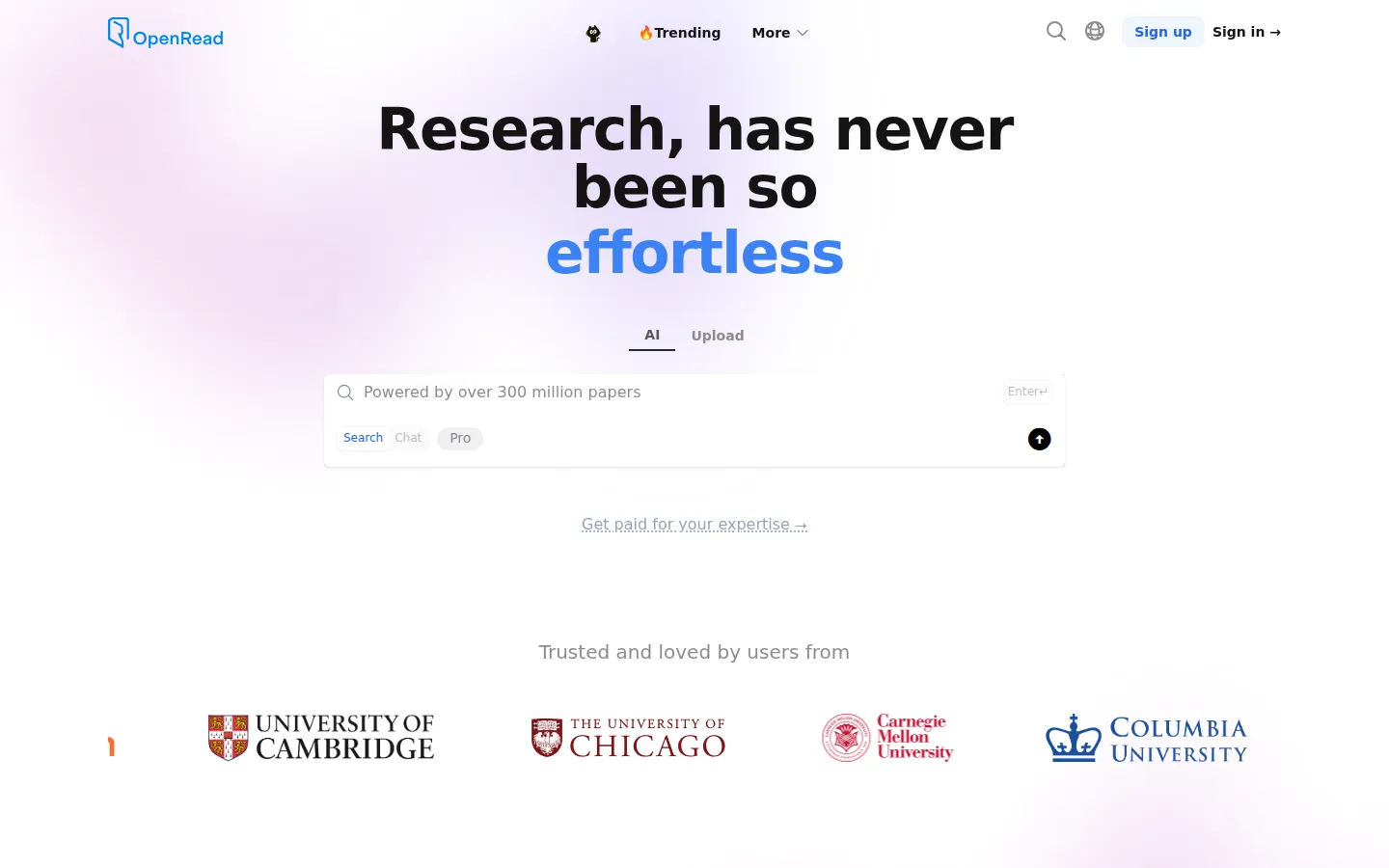
OpenRead is an AI research platform that combines paper search, deep research, note-taking, and an AI research agent into one workflow. It positions itself as research intelligence for everyone, with a search box that covers academic papers, industry reports, and the internet. The platform indexes fresh papers every five minutes from more than 20,000 journals, so users can find the latest research rather than waiting for monthly updates. Its reading and note-taking suite includes Paper Espresso for fast paper summaries, Paper Q&A for asking questions about documents, Related Paper Graph for mapping connections between studies, Paper Compare for identifying contradictions and shared findings across multiple papers, and Notes Taking for building a personal knowledge base. The AI search and deep research module offers paper search, web search, and a Pro Search mode that surfaces precise, context-aware results. At the center of the platform sits Oat, the OpenRead AI Technology agent, which can chat across top-tier models, access the web, draw diagrams, edit images, and even help with homework. Oat can draft summaries, extract key insights, and guide deep dives into any topic, choosing the best model for each task from a lineup that includes models such as Gemini, Claude, GPT, and Grok generations. A Trending section surfaces popular research papers that the community is reading. OpenRead also includes a feature that lets experts get paid for their knowledge, connecting domain specialists with users who need answers. The platform is used by students and professionals at leading universities and institutions, and it offers a free plan with limited monthly usage, a Basic plan for heavier use, a Premium plan with unlimited features, and standalone Oat Credits for pay-as-you-go access to top models. The platform's deep research mode is designed for complex questions that require synthesizing information across multiple sources, and the resulting answers can be saved into the notes workspace alongside paper summaries. For team workflows, OpenRead supports organization-level deployments where administrators manage licenses and usage through a dashboard, and single sign-on keeps access secure. The team behind the platform continues to expand the model lineup available to Oat, so users gain access to new frontier models as they are integrated. This combination of literature search, document intelligence, and agentic chat positions OpenRead as an end-to-end research workspace rather than a single-purpose paper tool.
OpenRead Core Features
AI paper search
Search academic papers and the web with fresh papers indexed every 5 minutes from 20,000+ journals.
Paper Espresso
Generate fast, structured summaries of research papers for quick understanding.
Paper Q&A
Ask questions directly about papers and get grounded answers from the content.
Paper Compare
Compare multiple papers to spot contradictions, shared findings, and the bigger picture.
Related Paper Graph
Visualize how papers connect to discover related research and literature paths.
Oat AI agent
Chat with a research agent that can access top-tier models, search the web, draw diagrams, and edit images.
Notes taking
Build structured notes from your reading and research directly in the platform.
Pro Search and deep research
Get precise, context-aware results for complex research questions.
Who is OpenRead for?
OpenRead is designed for anyone who regularly reads, analyzes, or synthesizes academic literature. University students use it to search papers, generate summaries, and clarify difficult concepts through Paper Q&A and Oat chat, reducing the time spent on assigned readings. Graduate students and postdocs rely on Paper Compare, Related Paper Graph, and deep research to survey literature and position their work within a field. Academic researchers and professors use the platform to stay current with fresh papers from more than 20,000 journals, which are indexed every five minutes. Industry R&D teams and analysts use OpenRead to extract insights from technical reports and industry papers for competitive intelligence and technical research. Librarians and information professionals can guide patrons toward faster literature discovery workflows. Journalists and technical writers use AI search and summaries to build accurate background on scientific topics. University and enterprise subscribers get admin dashboards, SSO, and priority support for organization-wide deployment. In short, OpenRead serves the full research lifecycle, from discovering papers to reading, comparing, noting, and discussing them, with tools scaled to fit students, professionals, and institutions. Thesis writers use the notes workspace to organize sources and draft outlines from extracted insights, while grant applicants rely on deep research to identify gaps and related work. Product researchers in tech companies use OpenRead to track academic developments relevant to their domains, and consultants use Paper Q&A to interrogate dense industry reports quickly. The pay-as-you-go Oat Credits also suit occasional users who want top-tier model access without committing to a monthly subscription, making the platform flexible for both regular and intermittent research needs.
OpenRead Use Cases
Search the latest literature across 20,000+ journals to stay current with new papers in your field.
Summarize long research papers with Paper Espresso to extract key findings in minutes.
Compare multiple studies with Paper Compare to identify contradictions and consensus across sources.
Ask Oat to explain difficult concepts, draw diagrams, or help draft research outlines.
Build a structured notes base from papers, industry reports, and web research for your thesis.
Use Pro Search for deep research on a topic before writing a literature review.
Explore Related Paper Graphs to discover connected studies and citation paths for your research.
OpenRead Pros and Cons
Pros
- Fresh paper indexing from 20,000+ journals every 5 minutes keeps research current.
- Oat agent combines multiple top-tier models, web search, image editing, and diagram drawing in one chat.
- Clear free, Basic, and Premium tiers plus pay-as-you-go credits suit different usage levels.
- Includes notes, paper comparison, and related-paper graphs that cover the whole research workflow.
Cons
- Free plan limits each tool to 5 uses per month, which is restrictive for active researchers.
- Premium model usage consumes credits beyond the monthly allocation for heavy users.
- The platform is web-based and research-focused, so it is less suited to non-academic workflows.
FAQ About OpenRead
OpenRead Pricing
Freemium: Free plan with 5 uses per tool monthly; Basic $5/mo; Premium $20/mo unlimited; Oat Credits $10; University/Enterprise $200/seat/year.
Check official pricingFree
5 Paper Espresso, Paper Q&A, Oat chats, Pro Searches, and graphs per month; unlimited PDF uploads up to 2MB.
Basic
100-300 uses per tool monthly, Paper Compare up to 30x, unlimited PDF uploads.
Premium
Unlimited usage of all research tools, top-tier model access with 10M free credits monthly.
Oat Credits
100 million standalone credits for Oat and top-tier models, never expire.
OpenRead Alternatives
Metaso
Metaso (秘塔AI搜索) is an AI search engine built for research-grade answers rather than link lists. It searches the open web, document libraries, and academic indexes such as PubMed, SCIE, EI, and JCR, then writes a structured, cited answer. Extra modes produce mind maps, slides, interactive web pages, and deep-research reports, and a paid Search API exposes the same index to developers.
Trooly
Trooly is an AI-native qualitative research platform. It writes the research plan, screens and recruits participants, moderates one-on-one multimodal voice interviews, and synthesizes transcripts into themed reports. Product and research teams can bring their own users at $10 per interview, or let Trooly recruit from a network of 180M+ respondents, with every interview quality-checked before delivery.
QwQ AI
Search the live web, research complex topics, and make sense of financial data with traceable sources.