
Ollama
Ollama is a developer tool for running open-weight large language models locally, with a CLI, desktop app, and a library of downloadable models. Its local server exposes an OpenAI-compatible API that plugs into coding agents, editors, and scripts. Ollama Cloud adds hosted capacity and larger frontier models, so teams can mix private local inference with pay-as-you-go cloud usage.
What is Ollama?
Ollama is a local-first tool for running open large language models, launched around 2023 and now trusted by more than nine million developers. It ships as a command-line interface, a desktop application, and a searchable model library, so you can pull a quantized model with one command and start generating text, code, or embeddings without sending prompts to a third party. The same open weights that power hosted frontier models run on your laptop, workstation, or server hardware. Everything executed locally stays on your machine and remains free and unlimited.
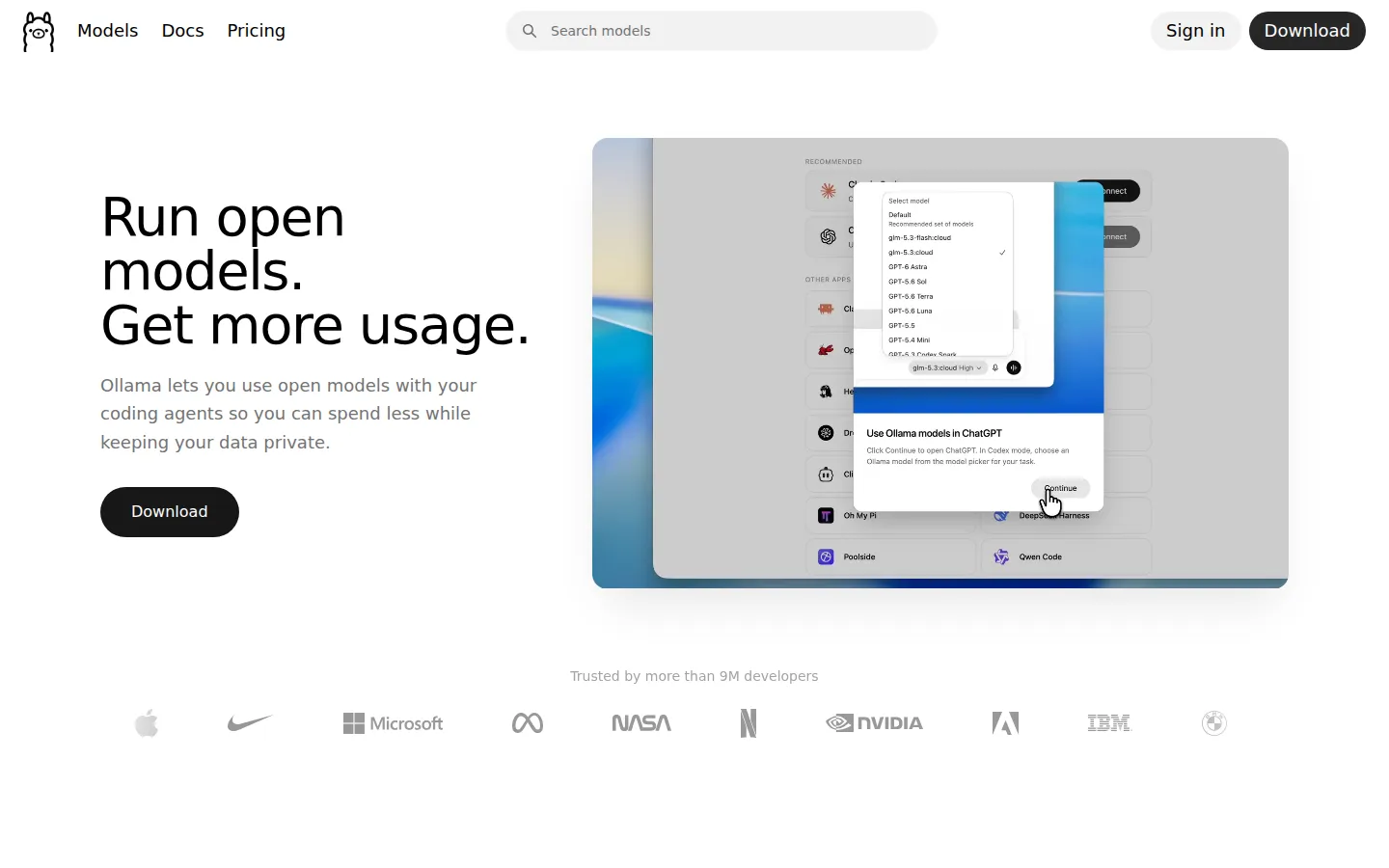
Under the hood, Ollama manages model weights, GPU acceleration, and serving for you. A single local server listens on your machine and exposes both a native REST interface and an OpenAI-compatible endpoint at /v1, which means existing SDKs, agent frameworks, and scripts can point at Ollama by changing one base URL. Supported integrations listed on the site include Claude Code, Codex, OpenCode, Hermes Agent, OpenClaw, VS Code, Pi, and n8n, so agentic coding workflows can switch between models without being rewritten.
Ollama Cloud extends the same workflow to hosted capacity. Paid tiers bundle monthly usage credits, unlock larger and newer models, and raise concurrency so several agents can run at once. Ollama states its cloud models are hosted in the United States, Europe, and Singapore, that prompts and responses are never logged or trained on, and that it partners with NVIDIA Cloud Providers under no-logging, zero-retention policies. That combination gives you privacy-grade local options plus hosted power when your hardware is not enough.
What you get out of Ollama is concrete: downloadable open-weight models such as gemma4, gpt-oss, glm-5.3, kimi-k2.7-code, and deepseek-v4.1-flash through the cloud library; a local endpoint for chat completions, embeddings, and tool calling; and usage dashboards that show credits consumed and reset dates. Pricing is deliberately predictable, with no service fees on the free tier and a published per-million-token table for every hosted model.
The main tradeoffs are hardware and scope. Local quality depends on the memory and GPU you own, so very large models still need serious machines, and the cloud catalog is smaller than what the biggest closed-model APIs offer. Ollama is also fundamentally a runtime and model-distribution layer rather than a full application platform: it gives you the models, the server, and the agent hooks, then leaves orchestration and product design to you.
Ollama Core Features
One-command model runs
Pull and launch open-weight models such as gemma4, gpt-oss, or kimi-k2.7-code from the built-in library.
OpenAI-compatible local server
A bundled endpoint at /v1 lets existing SDKs, editors, and agent frameworks talk to local models.
Desktop app and CLI
Manage models, chat, and inspect the running service from either a native app or the terminal.
Agent integrations
Launch Claude Code, Codex, OpenCode, Hermes Agent, OpenClaw, VS Code, Pi, or n8n against Ollama.
Ollama Cloud models
Reach larger hosted models like gpt-oss:120b and deepseek-v4-pro using pay-as-you-go usage credits.
Concurrency controls
Free allows one concurrent request, Pro three, and Max or Team ten, with queuing beyond that.
Privacy guardrails
Cloud prompts are never logged or trained on, and anything run locally never leaves your machine.
Predictable usage billing
Published per-million-token rates, monthly credit allowances, and off-peak discounts on supported models.
Who is Ollama for?
Ollama targets people who need open models running under their own control, and its audience splits along a few clear lines. Software developers and engineering teams are the core audience. The site positions Ollama as a way to launch Claude Code, Codex, OpenCode, or Hermes Agent with one command, so engineers already using agentic coding tools can swap in open models without changing their workflow. Privacy- and compliance-driven organizations come next. Teams in healthcare, finance, legal, and defense work under rules that make sending prompts to a third-party API difficult; running weights locally, or using cloud models with no logging and zero retention, is often the reason they adopt Ollama at all. AI engineers and applied researchers use it as a fast experimentation layer. Pulling a quantized build, comparing two models on the same prompt, or wiring tool calling into an evaluation harness takes minutes instead of a procurement cycle. Self-hosters and enthusiasts with a gaming GPU or a modern Mac use Ollama as the least painful way to run open models at home, keeping hobby projects free and offline. Startups and cost-conscious platform teams adopt it to reduce inference spend. The pitch is explicit: frontier-class open models at a fraction of closed-model cost, with pay-as-you-go credits instead of seats. Infrastructure and MLOps engineers value the OpenAI-compatible endpoint, which lets CI pipelines, test suites, and internal tooling point at a local server rather than a paid provider. Data scientists building retrieval and RAG pipelines use the local server for embeddings and batch jobs where per-token costs add up quickly. It is a poor fit for people who want a polished end-user chatbot, or for teams with no GPU or Mac capable of running modern models and no appetite for cloud credits.
Ollama Use Cases
Run a private coding assistant over your own repository without sending source code to a vendor.
Compare two open models on the same prompt before committing one to production.
Cut inference spend by routing routine agent tasks locally and hard tasks to cloud.
Build retrieval-augmented pipelines using locally generated embeddings and a local chat model.
Serve an OpenAI-compatible endpoint for tests, demos, or air-gapped internal tools.
Prototype tool-calling agents locally, then scale them with Ollama Cloud concurrency.
Keep regulated customer data inside your own network while still using LLMs.
Spin up a self-hosted assistant on a workstation GPU for offline or travel work.
Ollama Pros and Cons
Pros
- Free and unlimited local inference: running models on your own hardware is always free, and the cloud tier charges no service fees.
- Broad platform coverage with official downloads for macOS 14 Sonoma or later, Windows, and Linux.
- Open source and open weights: the runtime is public on GitHub and the models are provider-released open weights.
- Written privacy commitments: no logging or training on prompts, zero-retention hosting partners, and infrastructure limited to the US, Europe, and Singapore.
- Usage transparency: a published per-million-token price table, credit tracking, and a 90% usage email reminder on paid plans.
Cons
- Local performance depends entirely on your hardware, and large frontier models can exceed the memory of typical laptops.
- Cloud credits and concurrency are capped per tier, so heavy multi-agent use can burn through Pro's $60 monthly allowance.
- The hosted catalog is narrower than the largest closed-model API lineups, and some advertised features such as fast mode are still coming soon.
FAQ About Ollama
Ollama Pricing
Local Ollama is free and unlimited, the Free cloud tier includes starter credits at $0, Pro costs $20/mo (or $200/yr), Max $100/mo, and Team $500/mo with usage credits bundled in, while Enterprise is custom-priced.
Check official pricingFree
Run models locally, starter usage credits, access to starter models, add credits to unlock all models, no service fees.
Pro
$60 of monthly usage credits, access to larger pro models, run multiple models concurrently; $200 per year billed annually.
Max
$300 of monthly usage credits, early access to the newest models, and 10 concurrent requests.
Team
Unlimited users, $1,000 of shared monthly usage credits, centralized billing and administration, priority support.
Enterprise
Model access controls, cost budgets for users and API keys, private Slack support channel, custom security questionnaires.
Ollama Alternatives

FastRouter
FastRouter is a unified LLM gateway that gives developers one OpenAI-compatible API for 200+ models from providers such as OpenAI, Anthropic, Google, and xAI. It adds automatic model routing, fallbacks, caching, spend caps, role-based access, guardrails, and per-request observability, while passing provider token prices through with no markup on any plan, including the free tier.

Cindy
Cindy is an open-source desktop AI agent from XD Inc. that unifies Claude Code, Codex and Pi harnesses with 20+ tools, persistent memory and reusable skills. Use it free with your own API key or existing Coding Plan, or pay for the optional managed model service that works the moment you sign in. No setup project required.

MyToolster
MyToolster packs 41 free utilities into one browser-based site, sorted into Audio & Video, Text, Data, Web, Color, QR Code and Image. Beyond the usual encoders, formatters and generators it runs OpenAI Whisper transcription, AI text and image detection, background removal and subtitle export locally, with no uploads, account or installation, and every tool page does its work client-side.