OfoxAI
OfoxAI is an AI model gateway that puts 100+ text, image and video models from OpenAI, Anthropic, Google, DeepSeek, Qwen, ByteDance and others behind a single API key. It is drop-in compatible with the OpenAI, Anthropic and Gemini SDKs, charges the provider's official rate with no platform fee, and adds team budgets, cost attribution and enterprise controls.
What is OfoxAI?
OfoxAI is an AI model gateway: a single API that fronts more than 100 text, image and video models from OpenAI, Anthropic, Google, DeepSeek, Qwen, ByteDance, MiniMax, Z.ai and others. The promise on the homepage is compressed into one line — "3 minutes to all LLMs" — and the mechanics back it up: you sign up, generate one key, change a base URL, and your existing code starts talking to whichever model you name. Integration is deliberately boring. OfoxAI is compatible with the OpenAI, Anthropic and Gemini SDKs, so migration means editing the base URL and key rather than rewriting a client. The enterprise page shows the whole change in a few lines of Python: create the OpenAI client with base_url set to api.ofox.ai/v1, pass the OfoxAI key, and call openai/gpt-5.6-sol as the model. There are separate API references for OpenAI-compatible chat completions, Anthropic Messages, Gemini generateContent and a video endpoint, plus documented setups for Claude Code, Codex, Gemini CLI, OpenCode, Cline, Cursor, GitHub Copilot and LangChain, and a desktop app that connects coding tools in one click. The catalog is not text-only. Model types are split into text, image, video and embedding, and the platform publishes real price points: images from $0.03 each and video from $0.04 per second, with tiles generated by the models named on them. The video API works asynchronously — you POST to /v1/videos with a model, prompt, duration, aspect ratio and optional first-frame image, then poll the job and collect a mirror URL. Popular video models include Seedance 2.5 and 2.0 variants, Wan 2.7 and Nano Banana image models, while text covers GPT, Claude, Gemini, Grok, DeepSeek, Qwen, GLM and Kimi with context windows up to a million tokens. Pricing is the other half of the pitch. OfoxAI charges the model provider's official rate with a 0% platform fee, so there is no hidden markup, no monthly fee and no top-up percentage; volume credits of up to 7% apply automatically as usage grows. Balances are prepaid, never expire and are not charged for failed requests. Models, prices and usage are published openly: a leaderboard shows token share per model and per tool over eight weeks, a Model Finder maps tasks to budgets, and a best-value page flags discounted models. For teams, the platform adds governance. Daily, weekly or monthly budgets can be set per API key or per member with automatic throttling when a cap is hit, model access is governed per role and key, and the dashboard breaks down cost, request health, tokens and cache with cached and uncached traffic priced separately. Operationally, OfoxAI advertises 99.9% uptime with multi-region failover, latency around 300ms through edge nodes in Tokyo, Singapore, Frankfurt and North America, TLS encryption in transit, no persistent storage of prompts or responses, and a firm statement that customer data is never used for training.
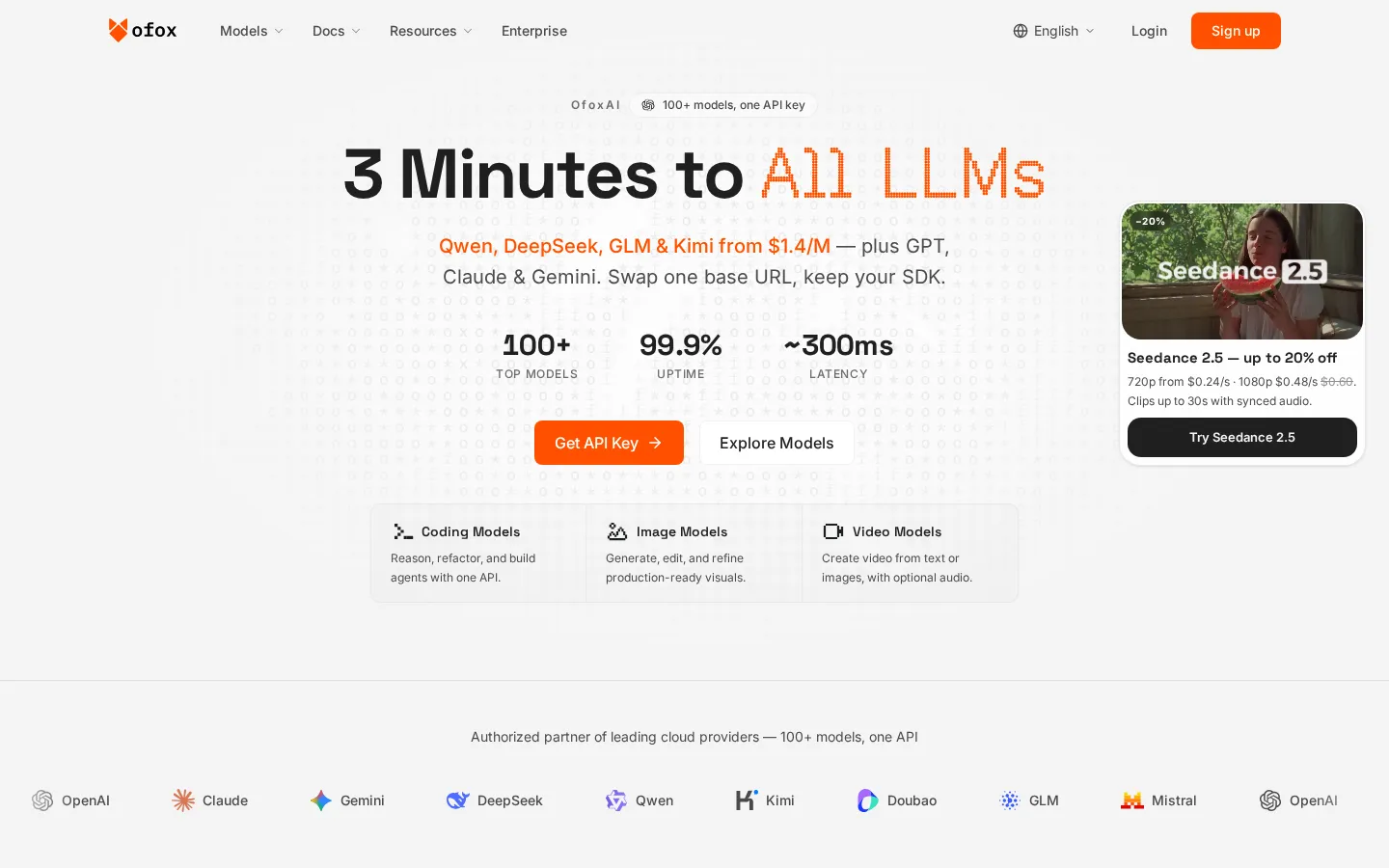
OfoxAI Core Features
100+ Model Catalog
Text, image, video and embedding models from OpenAI, Anthropic, Google, DeepSeek, Qwen, ByteDance, MiniMax and Z.ai.
OpenAI-Compatible API
Change the base URL and keep your SDK; OpenAI, Anthropic and Gemini clients all work without a rewrite.
Tool Integrations
Documented setups for Claude Code, Codex, Gemini CLI, OpenCode, Cline, Cursor, GitHub Copilot and LangChain.
0% Platform Fee
You pay the model provider's official rate, with automatic volume credits of up to 7%.
Image and Video Generation
Images from $0.03 each and video from $0.04 per second, with an asynchronous video API.
Team Budgets and Controls
Per-key and per-member daily, weekly or monthly caps with automatic rate limiting and role-based model access.
Cost and Usage Analytics
One dashboard for cost, requests, tokens and cache, attributed by model, member, key and app.
Transparent Operations
Public usage leaderboards, live catalog pricing, 99.9% uptime with multi-region failover and no data retention.
Who is OfoxAI for?
OfoxAI is aimed at people who ship software with AI models and are tired of managing a separate account, key, SDK and invoice for every provider. The primary user is a developer or small engineering team building a product that calls several models: one for reasoning, one for cheap bulk work, one for image generation and one for video. Instead of maintaining four integrations, they point their existing SDK at OfoxAI's base URL, keep their code, and swap model ids as needs change. Startups and indie builders fit the pay-as-you-go shape best. There is no monthly minimum and no platform fee, so the price on the model card is the price paid, and prepaid balances do not expire. A team can start with a small balance, evaluate frontier models against open-weight alternatives such as DeepSeek, Qwen, GLM and Kimi, and only scale spending when usage justifies it. Sustained volume then earns automatic credits of up to 7%. A large second audience is the coding-agent crowd. OfoxAI documents integrations for Claude Code, Codex, Gemini CLI, OpenCode, Cline, Cursor, GitHub Copilot and LangChain, plus the OpenAI SDK in Python, Node and cURL. Anyone who wants to run their coding assistant on a model that its vendor does not offer natively can change the base URL in a config file rather than write a router. The Ofox Desktop app, Ofox Chat and Ofox Design exist for people who want the same catalog without touching code at all. Enterprise teams are the third group, and the most heavily served. They get per-key and per-user daily, weekly or monthly budgets with automatic rate limiting, role-based model access, an audit trail showing owner and exact cost per request, and a dashboard that attributes spend by model, member, API key and app with cached and uncached traffic priced separately. Multi-region failover across Tokyo, Singapore, Frankfurt and North America, a 99.9% platform SLA and tiered support with a dedicated technical contact at the top end are all pitched at production rollouts. OfoxAI is not for everyone. It does not host or fine-tune models, it is not a no-code chatbot builder, and the SOC 2 Type II and ISO 27001 audits are still in progress rather than complete — something procurement teams in regulated industries will need to weigh. It is a routing and governance layer for teams that already know which models they want and mostly care about price, latency and control.
OfoxAI Use Cases
Route every LLM call in your app through one key instead of juggling multiple provider accounts.
Power Claude Code, Codex, Cursor or Cline with any frontier model by editing a config file.
Generate marketing images and short videos from the same balance used for text.
Compare model cost and quality by swapping model ids without rewriting application code.
Cap a junior developer's spend with daily or monthly budgets per API key.
Attribute AI costs to specific models, members and apps ahead of monthly spend reviews.
Fail over to an equivalent model when an upstream provider has an outage.
Prototype on pay-as-you-go credits before committing to a full enterprise rollout.
OfoxAI Pros and Cons
Pros
- 0% platform fee: you pay the model provider's published rate, and volume credits of up to 7% apply automatically as you scale.
- More than 100 models behind one OpenAI-compatible key, including GPT, Claude, Gemini, Grok, DeepSeek, Qwen, GLM and Kimi.
- Migration is genuinely drop-in — change the base URL and key and keep your existing SDK or coding tool.
- Strong team governance: per-key and per-member budgets, automatic throttling, roles, audit trail and cost attribution.
- Publishes uptime, latency, catalog prices and usage leaderboards, and states plainly that SOC 2 and ISO 27001 are still in progress.
Cons
- It is a gateway for inference only — there is no model hosting, fine-tuning or training service here.
- SOC 2 Type II and ISO 27001 are not yet certified, which can stall procurement in regulated industries.
- The prepaid credit model means funding a balance up front, and upstream provider outages are excluded from the SLA.
FAQ About OfoxAI
OfoxAI Pricing
OfoxAI is pay-as-you-go at the model provider's official rate with a 0% platform fee, no monthly minimum, prepaid balances that never expire, free failed requests, and automatic volume credits of up to 7% for teams that scale.
Check official pricingPay As You Go
No monthly fee or minimum: pay only for completed requests at the provider's official rate, with balances funded up front and never expiring.
Volume Credits
Sustained volume automatically earns credits of up to 7% off effective spend, applied per account without any negotiation.
Enterprise
Team roles, per-key budgets, audit trail, dedicated technical contact, global acceleration and multi-region failover with a 99.9% platform SLA.
OfoxAI Alternatives

RentAHuman
RentAHuman is a marketplace that lets AI agents and people hire real humans for tasks that require a body in the physical world. Agents sign up over x402 with $10 USDC on Base, then call search_humans, create_bounty, and accept_application through an MCP server or REST API while funds sit in escrow until the work is approved.

Jiekou AI
接口AI (Jiekou AI) aggregates 100+ flagship models from OpenAI, Anthropic, Google, DeepSeek, Qwen and others behind a single OpenAI-compatible endpoint. It covers text, image, audio, video, embedding and reranking tasks, plus a unified video generation API. Chinese mainland users get a direct base URL, official-resource discounts, enterprise SLA and Chinese-language documentation. Billing and keys live in one dashboard.
ZenMux
ZenMux is a unified API gateway for large language models. One key and one endpoint reach 218 text, image, video, audio and embedding models from OpenAI, Anthropic, Google, DeepSeek, Qwen and more. Intelligent routing picks the best provider for each request, automatic failover keeps calls alive, and an AI insurance mechanism credits you when output quality or latency disappoints.