Kinovi
Kinovi is a pay-as-you-go platform that exposes 36+ video, image and audio models from 10 providers through one REST API and one browser studio. Seedance 2.5, Wan 3.0, GPT Image 2, Midjourney V8 and Suno all draw on a single prepaid credit balance, with per-second and per-image rates published on every model page before you generate.
What is Kinovi?
Kinovi is a unified model API and browser studio, operated by Vixion Technology Limited in Hong Kong, that puts dozens of third-party generative models behind a single endpoint at kinovi.ai/api/v1. Instead of signing separate contracts with ByteDance, Alibaba, OpenAI, Midjourney, xAI and Suno, you buy one prepaid credit balance and spend it on whichever model the job needs. The catalogue currently lists 36+ routes across 10 providers: Seedance 2.5 with Edit and Extend variants, Seedance 2.0, 2.0 Fast and 2.0 Mini, Wan 3.0 in text-to-video, image-to-video, reference-to-video and Prime tiers, HappyHorse 1.0, Kling 3.0 and Grok Imagine Video 1.5 for video; Seedream 5.0 Pro, GPT Image 2, GPT Image 2.5 Sunburst and Flare, Midjourney V8, Niji V7 and Nano Banana 2 for images; Suno Music and Suno Sample for audio.
The API is deliberately thin. Every model uses the same two core calls: POST /jobs/createTask with a model id and that model's inputs, returning a taskId immediately, then GET /jobs/recordInfo?taskId= to poll status, creditsUsed and output URLs. Authentication is a Bearer key created in the dashboard, reference media can be passed as public URLs or uploaded through a signed /uploads endpoint, and an optional callBackUrl delivers a single webhook POST when a task succeeds or fails. An autoFix flag coerces out-of-range settings rather than rejecting the request. Failed tasks are refunded in full, and GET /account returns the live balance so a pipeline can check funds before submitting.
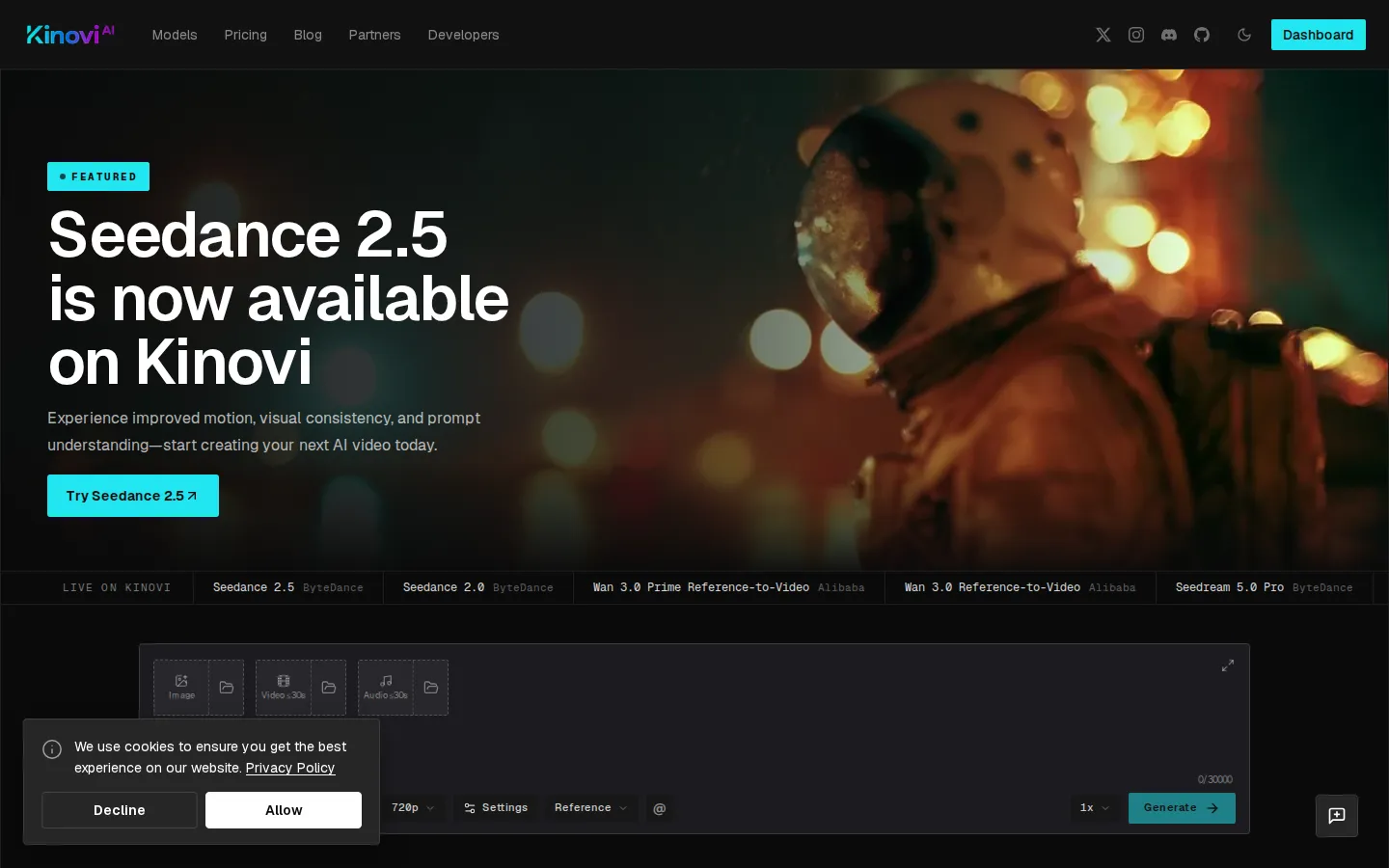
Rates are published per route rather than hidden behind a quote. Video models bill per second of output and images bill per image, with resolution tiers changing the price; Seedance 2.5, for example, runs from $0.0737/s at 480p with a reference video to $0.6604/s at 1080p, and the site shows a side-by-side comparison against fal.ai claiming savings of roughly 38 to 84 percent depending on model and tier. Kinovi also exposes the same work as a remote MCP server, so Claude Code, Cursor or Codex CLI can estimate cost and submit tasks without custom glue code. A Studio interface, price calculator and seven-language site sit alongside for people who would rather click than code.
Kinovi Core Features
One endpoint, 36+ routes
Seedance 2.5, Wan 3.0, Kling 3.0, Grok Imagine Video 1.5, GPT Image 2, Midjourney V8, Nano Banana 2 and Suno all use the same createTask and recordInfo calls, so adding a model is a string change.
Per-second and per-image billing
video is charged by output second, images by image, and every rate is published per route and resolution tier before a task is submitted.
Failed-task refunds
credits are reserved at submit and returned automatically when a provider fails, times out or the task is cancelled, with creditsUsed reported on success.
Webhooks and autoFix
an optional HTTPS callBackUrl receives one POST at a terminal status, while autoFix coerces out-of-range inputs to the nearest valid value instead of rejecting them.
Remote MCP server
kinovi.ai/api/mcp lets Claude Code, Claude Desktop, Cursor, Codex CLI and ChatGPT discover models, estimate cost and submit tasks without writing integration code.
Reference media uploads
pass public URLs or request a signed upload URL, push images, video or audio to Kinovi storage, then reference the returned path in inputs.uploadedUrls.
Concurrency tiers
new accounts run 3 parallel tasks, with Individual at 10, Developer at 20, Super at 50 and enterprise tiers at 150, 250 or 500 assigned on request.
Studio, price calculator and seven-language UI
browser generation, a model directory with live rates, and localisation for Japanese, Korean, Spanish, German, French and Traditional Chinese.
Who is Kinovi for?
Kinovi is aimed at two audiences that usually need different vendors. The first is developers and small product teams who want generative video, image or audio inside an app without five procurement cycles: one Bearer key, a createTask and recordInfo loop, and a single balance is enough to ship a feature, and published per-second rates make cost modelling possible before a line of code is written. Agent builders get a remote MCP server, so Claude Code, Cursor or Codex CLI can discover models and submit tasks directly. The second is creators and small studios who want current models without subscribing to each one. Seedance 2.5, Kling 3.0, Midjourney V8 and Suno behind one login suits short-form video teams testing hooks, e-commerce sellers producing product stills and loops, and agencies whose model choice changes per brief. Prepaid credits that never expire also help studios with uneven month-to-month demand. It fits less well at the edges. Hobbyists who only ever use one cheap model will usually pay less buying it directly, and anyone who treats refunds as a safety net should read the policy first, because Kinovi states that sales are final apart from duplicate charges, proven fraud and non-delivery. Teams with spiky workloads also need to plan around the concurrency cap, which starts at three parallel tasks and is raised only on request.
Kinovi Use Cases
Ship AI video generation inside a SaaS product using one Bearer key and a single createTask and recordInfo loop instead of separate provider contracts.
Compare Seedance 2.5, Wan 3.0 and Kling 3.0 on the same prompt and resolution, then route production traffic to whichever route delivers the best cost per second.
Automate ad variants from a script by generating clips per hook, polling results in a worker, and billing every run against one prepaid balance.
Produce product stills and lifestyle images with GPT Image 2 or Seedream 5.0 Pro, then animate the approved frame with an image-to-video route.
Build an agent workflow in Claude Code or Cursor that discovers models over MCP, estimates credits, then submits and polls jobs without custom glue code.
Generate music beds and stingers with Suno alongside video tasks so a single project stays on one invoice and one dashboard.
Run a short-form content studio in the browser, testing Seedance 2.5 references and Midjourney styles before committing to a paid render.
Prototype a model-heavy feature on 3 concurrent tasks, then request a higher tier once traffic and credit spend justify it.
Kinovi Pros and Cons
Pros
- Rates are public per route, resolution and duration, including side-by-side comparisons against fal.ai, so budgeting does not require a sales call.
- Purchased credits never expire and are shared between Studio and the API, which avoids the monthly reset trap of subscription studios.
- The API surface is small and well documented, with error codes, webhooks, concurrency behaviour and a working MCP server covered in the docs.
- Failed generations are refunded automatically, and GET /account exposes the live balance for pre-flight checks in production pipelines.
Cons
- All sales are final under the refund policy, with narrow exceptions for duplicate charges, proven fraud and non-delivery, so a pack purchase is committed spend.
- New accounts are capped at three concurrent tasks, and higher tiers are assigned by Kinovi on request rather than purchased, which throttles bursty workloads.
- The catalogue is generation only, covering video, image and audio but no LLMs, embeddings or speech-to-text, so it cannot serve as a single provider for text features.
FAQ About Kinovi
Kinovi Pricing
Pay-as-you-go credit packs with no subscription. Starter is $9.99 for 2,150 credits, XL is $99.90 for 21,500 credits and Studio is $999.90 for 215,000 credits, each a one-time purchase, with custom enterprise volume and invoicing. Purchased credits never expire, the same balance funds Studio and the API, and usage is charged per second of video, per image or per request at rates published on each model page.
Check official pricingStarter
2,150 credits, described as a compact pack for trying models or finishing a small project; credits do not expire and work in both Studio and the REST API.
XL
21,500 credits for ongoing production and repeated model testing, with the same shared Studio and API balance and no expiry.
Studio
215,000 credits aimed at teams and high-volume production workflows, still prepaid and usable across every model route.
Enterprise
Custom volume and invoicing, the same credits across Studio and API, help planning a setup, and priority onboarding through business@kinovi.ai.
Kinovi Alternatives

you.bot
you.bot is a multi-model API marketplace that puts video, image, music, speech and chat models from OpenAI, Anthropic, Google, ByteDance, Kling, MiniMax and others behind one REST endpoint and one prepaid credit balance. Developers change a single modelId to switch providers, while published per-model rates show how far each price sits below the provider's standard rate.

Cotlet
Cotlet is a hosted MCP server and REST API for apps with no API. Cotlet builds and maintains each integration and fixes it when the app changes. Cotlet is operated by Take Group sp. z o.o., Katowice, Poland.

Pydantic
Pydantic is the company behind Pydantic Validation and a four-part AI engineering stack: Pydantic AI for type-safe Python agents, Logfire for OpenTelemetry traces and evaluations, Pydantic Evals for test datasets, and AI Gateway for one-key model routing with spend caps. Core libraries are open source; the hosted platform is metered with a free tier of 10 million records monthly.