
MasterGo
MasterGo is a collaborative design platform for digital interface production, widely used by Chinese product, design, and engineering teams. MasterGo AI generates UI from natural language or reference images, applies enterprise design systems, converts designs into production React, Vue, and mini-program code, and connects AI coding agents to the canvas through MCP. A free Startup edition is available with team and enterprise plans per seat.
What is MasterGo?
MasterGo is a professional collaborative design platform for digital interface production, widely used across Chinese product, design, and development teams as the country's alternative to tools like Figma, and it has evolved into an AI production platform. The platform itself supports team libraries, design systems, component properties, prototyping, and real-time collaboration, and its AI suite, MasterGo AI, targets production-grade output rather than one-off creative generation. AI Quick Build generates complete UI screens, components, and page frameworks from natural language, reference images, or design.md documents, and the generated UI can be inserted into the canvas as editable vector layers and components for further refinement. The AI Design Assistant understands and applies an enterprise's existing design system, including styles, components, and icons, so generated pages comply with team standards, and it also handles image generation and editing such as stylization, background removal, and outpainting, plus copywriting, translation, chart and icon generation, and design-spec checking. The D2C Pro module converts design files into high-quality production code for React, Vue, and mini-program frameworks using a unified AST engine that has generated more than 500 million lines of code over three years of iteration, with precise layout and component recognition and support for design tokens and internal component libraries. MasterGo also supports the MCP protocol, which lets AI coding tools such as Cursor and Codex send instructions to create layers, modify attributes, and adjust layouts directly on the canvas, closing the loop between design and engineering. The platform emphasizes compliance with China's domestic technology standards, including domestic operating systems, databases, and browsers, plus enterprise-grade security with SAML SSO, permission management, and private deployment options. Pricing is offered in yuan: a free Startup edition, a Team edition from 768 yuan per designer seat per year, an Enterprise edition from 2,304 yuan per seat, and private deployment with custom quotes. More than one hundred leading enterprises use MasterGo AI workflows. The platform's collaboration foundation mirrors the workflow of modern product teams: designers work in shared files with team libraries, developers inspect specs and export assets, and product managers review prototypes in context, all inside one tool rather than scattered across plugins. MasterGo AI layers on top of that foundation, so generated pages inherit real team tokens and component libraries instead of producing lookalike screens that require manual rework. The D2C engine's three years of production iteration and hundreds of millions of generated lines of code give engineering teams evidence that exported code will integrate with their existing React or Vue component systems. For organizations with strict requirements, the platform documents domestic-technology compliance across operating systems, databases, and browsers, plus SAML SSO and private deployment options, which positions it as the enterprise-safe choice in its market. Customer testimonials from product, design, aviation, education, and financial services teams illustrate the breadth of production AI workflows already running on the platform.
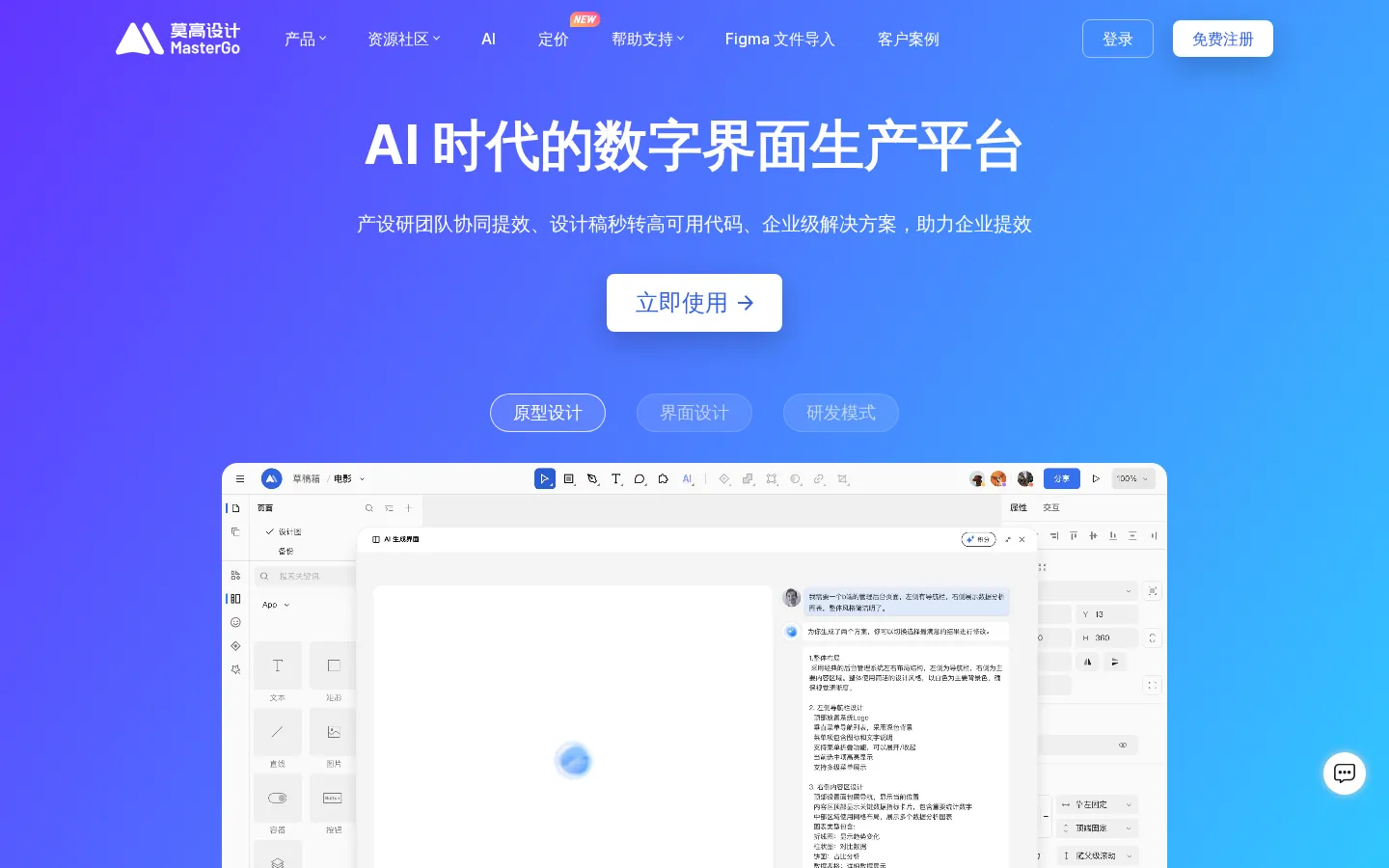
MasterGo Core Features
AI Quick Build
Generates complete UI screens, components, and frameworks from natural language, reference images, or design.md.
Editable canvas output
Generated UI lands in the canvas as vector layers and components for deep refinement, not flat images.
Design-system-aware generation
AI applies your enterprise design system, including styles, components, and icons, so output is compliant by default.
D2C Pro code generation
Converts designs into production React, Vue, and mini-program code via a unified AST engine.
MCP protocol support
Lets AI coding agents like Cursor and Codex create and edit layers directly on the MasterGo canvas.
Image tools
Generates images and performs stylization, background removal, and outpainting on selected assets.
Content automation
Rewrites copy, translates into multiple languages, and generates charts and icon resources.
Enterprise governance
Design-spec checking, SAML SSO, permission control, domestic technology stack compliance, and private deployment.
Who is MasterGo for?
MasterGo serves product, design, and engineering teams that need design-to-production workflows with strong governance. Product managers use AI Quick Build to turn ideas into high-fidelity prototypes in minutes for reviews. UI and UX designers work on real design files with team libraries while delegating repetitive page production to the AI design assistant. Frontend engineers convert finished designs into React, Vue, or mini-program code that matches internal component libraries. Enterprise platform teams value design-system governance, SAML SSO, and private deployment options. Agencies and in-house creative teams produce consistent multi-page UI at scale, while universities use the platform to teach interaction and UI design with AI assistance. Because content is largely Chinese-first, it primarily serves teams operating in China or with Chinese toolchains. Enterprises running regulated design pipelines choose the private deployment and compliance story over tools hosted abroad. Design-system teams use AI generation to expand their libraries into full product surfaces at consistent quality. Frontend engineers who previously spent days on page assembly use D2C Pro to convert approved designs into code that matches internal component conventions. Educational institutions adopting AI-assisted design teaching use the platform's governance to keep student work aligned with a shared design system. The tool also serves independent designers freelancing for Chinese clients who must work inside the local ecosystem and deliver in Chinese toolchains.
MasterGo Use Cases
Turn a product manager's feature description into a high-fidelity interactive prototype for a review meeting in minutes.
Generate a full onboarding flow that automatically follows the company design system's components and tokens.
Convert an approved marketing landing page design into clean React code for the engineering team.
Let a Cursor-based agent adjust spacing and layout on the canvas through MCP while the designer reviews changes.
Remove the background from product shots and outpaint them into campaign banners inside the design file.
Generate a translated Chinese-English version of interface copy in one pass for an overseas release.
Train students on interaction design with AI-generated UI inspiration while enforcing a shared course design system.
MasterGo Pros and Cons
Pros
- AI output is production-oriented: generated UI is editable vector work and D2C code is designed for real deployment.
- Design-system governance means generated pages match team standards instead of requiring rework.
- MCP support connects design work directly to AI coding agents such as Cursor and Codex.
- Free Startup edition plus per-seat team pricing makes entry low; enterprise options cover security and compliance.
Cons
- Interface and marketing content are primarily in Chinese, which limits accessibility for non-Chinese teams.
- Feature depth assumes a design-system-driven workflow, which small ad-hoc teams may not have set up.
- Pricing is listed in yuan per seat per year, and Western-market credit card billing is not the primary flow.
FAQ About MasterGo
MasterGo Pricing
Freemium in CNY: Startup edition free (1 design seat, 3 files); Team from ¥768/seat/yr (design) and ¥448 (dev); Enterprise from ¥2304/seat/yr; private deployment custom quote. New purchases 20% off promotional pricing.
Check official pricingStartup
Unlimited draft files and team members, 1 design seat, 3 files, 1 preset team library, partial preset fonts.
Team
From 768 yuan per design seat per year (developer seats from 448 yuan). Unlimited seats and files, full libraries and fonts, component properties, MCP support.
Enterprise
From 2,304 yuan per design seat per year; product seats from 1,024 and developer seats from 864. Adds SAML SSO, REST API, enterprise libraries, and data statistics.
Private Deployment
Private deployment with customized REST API, security access control, monitoring, and optional network isolation. Contact for quote.
MasterGo Alternatives

Lummi
Lummi is a stock library where AI-generated photos, illustrations, and 3D models sit next to editing tools that work on the asset you just picked. Search by category, color, or mood, then reframe, restyle, or remove the background before downloading. The free tier covers standard-resolution personal and commercial use; Pro adds watermark-free files, ultra resolution, and generation credits.
GetLayers
GetLayers is Textura's library of design foundations for AI coding workflows. Browse templates, motion sections, 3D scenes, backgrounds, and gradients, then copy structured prompts into your preferred assistant. Paid plans include commercial licensing, while Full Stack adds source files and private Discord support. Full Stack Lifetime also connects the library directly to compatible assistants through MCP.

Locofy.ai
Locofy.ai converts Figma, Penpot and Adobe XD designs into developer-friendly frontend code for React, Next.js, Gatsby, Vue, Angular, HTML/CSS, Flutter and React Native. It imports existing design systems, generates reusable components with LocoAI, and plugs into Cursor, GitHub Copilot, Windsurf and Claude through MCP, giving product teams an enterprise-grade frontend baseline that AI coding agents can then extend.