
Lummi
Lummi is a stock library where AI-generated photos, illustrations, and 3D models sit next to editing tools that work on the asset you just picked. Search by category, color, or mood, then reframe, restyle, or remove the background before downloading. The free tier covers standard-resolution personal and commercial use; Pro adds watermark-free files, ultra resolution, and generation credits.
What is Lummi?
Lummi is a stock image library built around AI-generated visuals: photographs, illustration-style artwork, and 3D models contributed by a community of creators and sorted into browsable categories. Its homepage promise is “no more boring design”, and the catalogue leans toward the clean, softly lit, editorial look that shows up in SaaS landing pages, pitch decks, and brand blogs. Assets download under a royalty-free licence that permits personal and commercial use without attribution, which is the main reason designers try Lummi instead of a traditional stock subscription.
What separates Lummi from a plain download site is that the editing tools live on the asset page. Reframe moves an image's focal point and zooms in or out, so one picture can be cropped for a square social post and a wide hero banner without losing the subject. Restyle re-renders a chosen image in a different visual style. Background removal produces a transparent cutout. A create-similar action generates variations of an image you like, while paid plans add ultra-resolution downloads and bulk selection from the grid.
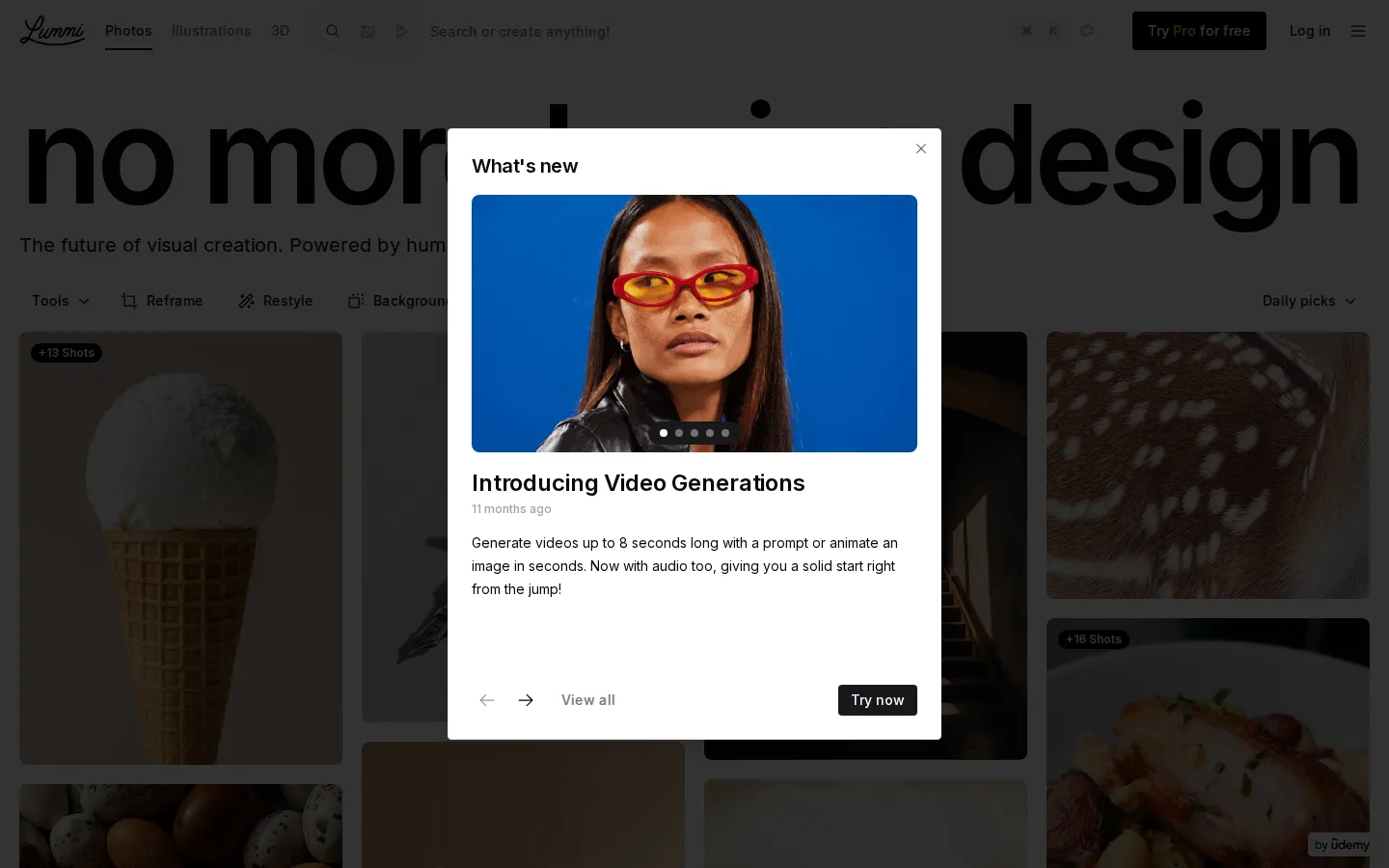
The library also covers motion. Paid users can generate clips of up to eight seconds from a prompt, animate a still image, and add audio, which suits short social loops and animated banners rather than production footage. 3D assets open in an interactive viewer where you can rotate the model, pick a camera angle, change the backdrop colour, and export a .gltf file for design tools, games, or interactive prototypes.
Access runs on subscriptions. The free tier allows browsing and standard-resolution downloads, while Pro removes watermarks across the library, unlocks ultra resolution, and adds AI credits on a seven-day trial. Max raises the fast-generation allowance and makes video generation unlimited. Credits stay simple: one credit equals one fast generation, and the fast allowance refreshes hourly instead of accumulating into a large bank.
For teams that want the catalogue inside their own product, Lummi publishes a REST API at api.lummi.ai with bearer-token authentication and endpoints for searching and retrieving images, including metadata such as attribution URL, colour palette, orientation, and focal coordinates. Udemy acquired Lummi in 2025, and the site now carries Udemy's privacy and cookie policies next to its own licence terms.
Lummi Core Features
Curated AI stock library
Photos, illustrations, and 3D models sorted by category, colour, and mood, with daily picks, creator pages, and grouped shoots for coherent sets.
Reframe 2.0
Move an image's focal point and zoom in on details or out to the full scene, so a single asset fits square, portrait, and wide placements.
Restyle
Re-render an existing image in a different visual style while keeping the subject and composition you already chose.
Background removal
Cut the subject out of a library image and download a transparent PNG for layouts, thumbnails, and product mockups.
Image and video generation
Credits produce new images or clips of up to eight seconds, including audio and animating a still image.
3D viewer and export
Rotate a model, choose a camera angle, change the background colour, or download the asset as .gltf.
Ultra resolution and bulk download
Paid plans unlock larger files and let you select several images in the grid and download them at once.
Developer API
A documented REST API with bearer-key authentication and search endpoints, returning metadata such as tags, palette, and focal coordinates.
Who is Lummi for?
Lummi suits designers and marketers who need good-looking imagery quickly and do not want to manage a stock subscription with per-seat pricing. Product designers use it for landing pages, empty states, and feature illustrations where a consistent visual style matters more than photographic realism. Social and content teams use Reframe to get one image into feed, story, and banner formats without hunting for a second shot. Agencies and freelance designers like the licence: client work is allowed, credit is optional, and the only real restrictions are reselling the images or building a competing stock service. Course creators and educators benefit from the illustration and 3D catalogue for lesson slides and thumbnails, which fits Lummi's ownership by Udemy and its use inside course material at scale. Marketing teams running paid campaigns also use it for ad variants, since one licensed image can be adapted to several formats without extra licensing or a second shoot. Developers and technical founders are a less obvious audience but a real one, because the API exposes search and metadata that many stock providers keep behind enterprise contracts. Small teams that cannot justify a full stock subscription, and bloggers or newsletter writers publishing weekly, get the most from the free tier plus a month of Pro when a project needs watermark-free or ultra-resolution files. It is a weaker fit for editorial work that needs real events, identifiable public figures, or documentary photography, and for regulated advertising that requires signed model or property releases for every subject.
Lummi Use Cases
Build landing pages and marketing sites with imagery that does not read as generic stock.
Produce social posts and ad creative in several aspect ratios with Reframe instead of sourcing extra shots.
Create transparent cutouts for decks, thumbnails, and e-commerce mockups with background removal.
Illustrate course lessons, blog posts, and newsletters with royalty-free visuals and no attribution burden.
Generate short video loops or animate a still for reels and hero banners.
Add image search to your own app, CMS, or design tool through the Lummi API.
Prototype UI and editorial layouts quickly with 3D objects and illustration sets.
Collect brand reference sets in collections and shoots before a content sprint.
Lummi Pros and Cons
Pros
- The free tier is usable for real work, and the licence allows commercial use without attribution.
- Editing tools sit on the asset page, so reframing and background removal do not require a second app.
- The catalogue has a consistent look across photos, illustrations, and 3D, and shoots supply matching sets.
- Pro is inexpensive at $10 per month billed yearly, and the API plus .gltf exports add range beyond downloads.
Cons
- Watermark-free access to the entire library and ultra resolution sit behind Pro, so free downloads are limited.
- Generation quotas, five fast credits per hour on Pro, slow down heavy iteration compared with unlimited tools.
- AI-generated coverage is thin for real events, identifiable people, and subjects that need signed releases.
FAQ About Lummi
Lummi Pricing
Free tier with standard-resolution downloads; Pro at $15/month or $10/month billed yearly ($120/year); Max at $48/month or $32/month billed yearly. A seven-day Pro trial is offered, and paid plans include monthly AI credits.
Check official pricingLummi Alternatives

Sartoris
Sartoris is a browser-based AI creative studio that generates premium still images and cinematic video from text prompts, with optional start and end frames plus image, video, and audio references. It runs on purchased credits rather than a subscription, keeps one library for both media types, and deletes finished generations twelve hours after they are created.

Reelina AI
Reelina AI is a web studio for generating video, images, voice and music with several hundred third-party and in-house models on a single coin balance. Weekly and monthly plans include coins that never expire, and coin packs can be added at any time. Generation costs appear before you run anything, so you can compare models without separate subscriptions.

ANI
ANI (anicomic.ai) turns a single selfie into a four-panel manga, manhwa, or comic strip in roughly 30 seconds. Choose from seven hand-tuned art styles, add dialogue and a beginning-middle-end story, then download, print, or share the result. It runs in the browser and as an iOS and Android app, with 1.8M+ comics created and a 4.9 App Store rating.