
Loopa
Loopa turns a plain-language request into a finished deliverable instead of a chat reply. Its agents plan multi-step work, read your files, call skills such as slides, Excel, image and video generation, then hand back downloadable output. Free accounts get 600 credits a day, while paid plans add every model tier, more storage, scheduled tasks and custom agents.
What is Loopa?
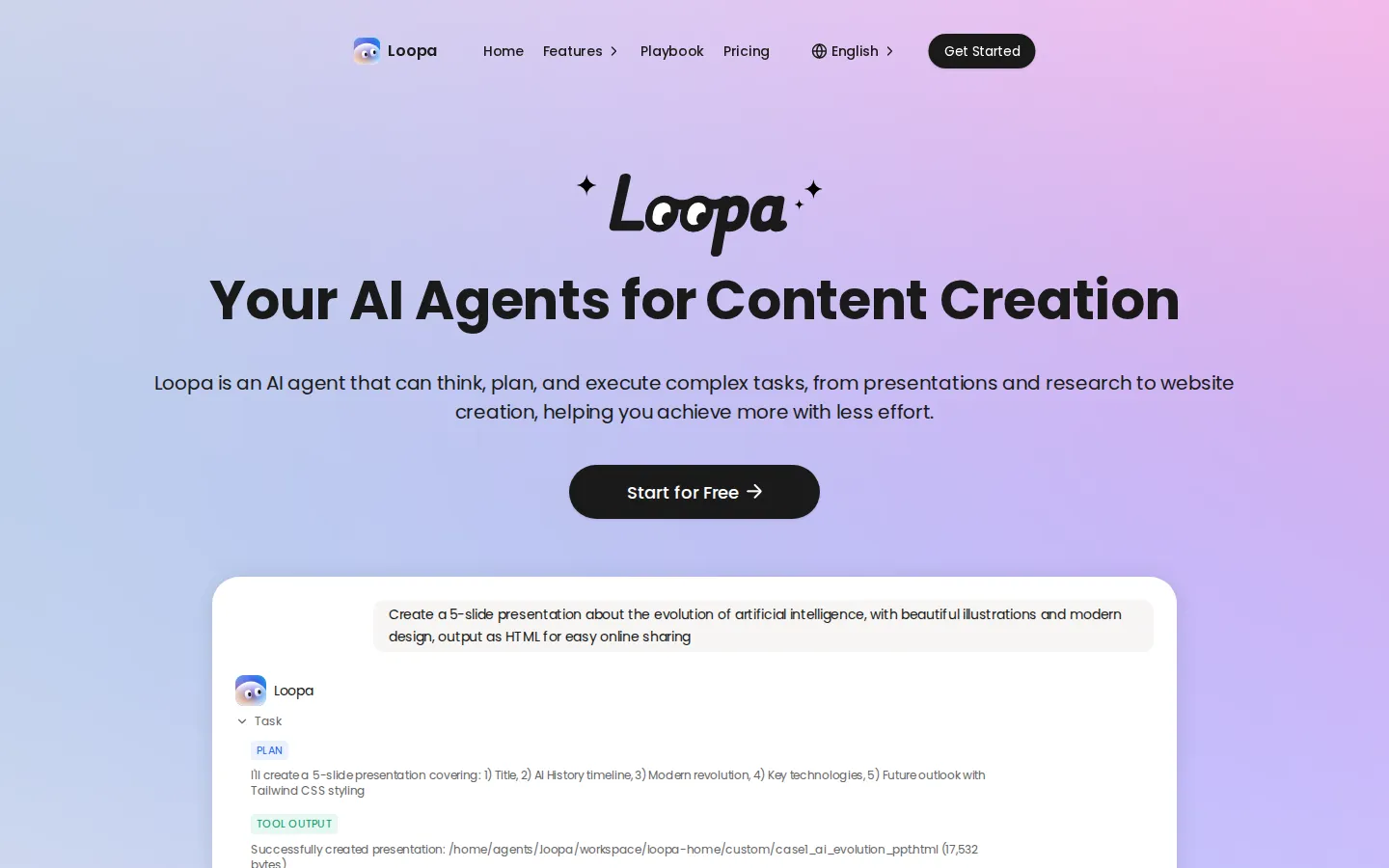
Loopa is an AI agent platform from the EaseUS team that is built around outcomes rather than conversations. Instead of answering a question and stopping, Loopa takes a goal in plain language, breaks it into a plan, chooses the tools it needs and executes the steps until a finished file exists in your workspace. A typical request, such as creating a five-slide presentation on the evolution of artificial intelligence, returns a styled HTML deck in minutes, and the same loop covers PDF research, spreadsheets, images, video and even a generated landing page.
The product is organised around agents, skills and workspaces. Agents carry the reasoning and the task list; skills extend what they can actually do. Loopa ships with skills for video generation, PDF summarisation, image generation, PowerPoint, Excel, Word and weather, and the Skill Center adds research, data analysis, document processing, presentation generation, branding, design and content creation. Users can create custom skills and combine several of them into a custom agent, so one agent can move from reading a report to summarising it and then to building the deck that presents it.
Model choice is unusually broad for a consumer tool. Loopa routes work across Qwen, StepFun, DeepSeek, Gemini, Hailuo AI, GPT, Claude, GPT Image 2 and Seedance 2.0. The Free tier is limited to the basic model set, while Pro and Ultra unlock all models. Workspaces persist between sessions, so files, context and long-running projects do not vanish when a conversation ends, and storage scales from 5GB on Free to 25GB on the paid tiers.
Everyday scenarios the site highlights include PDF summaries with action points, automated financial and market reports, research automation that scans sources and synthesises findings, email auto-replies that read, draft and send contextual responses, and quiz generation from learning material. Business pages add brand monitoring, SEO automation, AI ads, AI email generation, product videos and competitor analysis, while the study section adds essay writing, homework help and an AI detector.
Automation extends beyond the browser. Loopa can be linked to email, calendar, Telegram and Discord, where agents respond to messages and trigger tasks, and paid plans add 30 scheduled tasks so recurring workflows run without prompting. Several agents can work in parallel on research, writing, review and execution. Tasks run in a secure sandbox, uploaded files and generated content stay private, and the company states that customer content is never used for AI training.
Pricing is credit based. Free costs nothing and includes 600 credits per day plus 5GB of storage, Pro is listed at $17 per month against a $20 list price with 20,000 monthly credits, and Ultra is $28 against $40 with 40,000 credits, 25GB of storage and up to 10 custom agents.
Loopa Core Features
Task Planning and Execution
Describe a goal in plain language and Loopa splits it into a plan, runs each step with its tools and returns a finished deliverable such as an HTML slide deck, report or document.
Built-in Skill Library
Enable skills for video generation, PDF summarisation, image generation, PowerPoint, Excel, Word and weather so one agent handles mixed-format work without switching apps.
Parallel Agent Teams
Launch several agents at once to research, write, review and execute simultaneously, including repetitive and recurring workflows that would otherwise be handled by hand.
Document and PDF Analysis
Upload reports, spreadsheets or scans and ask for key takeaways, action points or a structured summary that can be reused in meetings and decks.
Image and Video Generation
Generate campaign visuals, product shots, posters and short promo videos from text prompts for marketing, presentations and social channels.
Cross-App Automation
Connect Loopa to email, calendar, Telegram and Discord so agents can read and reply to messages, schedule meetings and trigger tasks where you already work.
Persistent Sandboxed Workspaces
Keep files and project context across sessions in a secure sandbox with 5GB to 25GB of storage, with customer content never used for AI training.
Business Workflow Presets
Purpose-built agents for brand monitoring, SEO automation, AI ads, email generation, product videos, promo videos and competitor analysis.
Who is Loopa for?
Loopa fits people who need output rather than conversation. Creators and social media managers use it to move from an idea to finished assets, generating on-brand visuals, promo videos, posters, storyboards and short-form scripts for TikTok, Instagram Reels and YouTube Shorts without opening a design suite. Marketers and growth teams get agents for AI ads, SEO automation and brand monitoring, plus landing pages with layouts, pricing sections and calls to action written in one pass. Consultants, analysts and operators are the other natural audience. Uploading a long industry report and receiving key takeaways with action points is the use case the site leads with, and it extends to automated financial and market reports, research automation that scans sources, and competitor analysis that ends in a structured document instead of a transcript. Email auto-reply and calendar scheduling suit operations managers who spend their day triaging requests across inboxes and chat apps. Founders and small teams without a design or research department get the widest benefit, because a single subscription replaces a slide tool, an image generator, a PDF summariser and a website builder. Students and educators are covered by essay writing, homework help, quiz generation and AI detection, while teams that want repeatable processes can build shared agents and schedule recurring tasks on paid plans. It is a weaker fit for developers who need an API, since the site documents none, and for enterprises that require SSO, audit logs or procurement-ready security controls beyond a sandbox and a no-training data policy. Anyone doing very heavy video generation should also expect credit limits to matter.
Loopa Use Cases
Turn a rough topic into a styled multi-slide HTML presentation you can share online in minutes.
Summarise long industry reports and extract action points before a client or board meeting.
Generate on-brand product images and short promo videos for paid social campaigns.
Automate routine email replies so your inbox is triaged with a consistent tone.
Run competitor and market research that ends in a structured report instead of a chat answer.
Build a landing page with layouts, pricing sections and calls to action from a single prompt.
Create quizzes and practice tests from course material for students or internal training.
Schedule recurring agents that monitor brand mentions and report back to your team.
Loopa Pros and Cons
Pros
- A genuinely usable free tier with 600 credits per day lets you test real agent workflows before paying.
- One workspace covers slides, PDFs, spreadsheets, images, video, websites and email, cutting the number of subscriptions.
- Access to several leading model families, including GPT, Claude, Gemini, DeepSeek and Qwen, under one plan.
- Persistent workspaces with sandboxed storage keep long projects organised and state that content is never used for training.
- Plan limits for credits, storage, scheduled tasks and custom agents are stated explicitly on the pricing page.
Cons
- Credit consumption is not explained in detail, so heavy image and video work is hard to budget for in advance.
- The Free plan is capped at 5GB of storage and basic models, and lists no custom agents or scheduled tasks.
- No public API is documented, and the site footer links no X, LinkedIn, YouTube or Discord account, leaving developer and community support unclear.
FAQ About Loopa
Loopa Pricing
Freemium with three tiers. Free is $0 per month with 600 credits per day, 5GB of storage and basic AI models. Pro lists $17 per month against a $20 list price (15% off) with 20,000 credits per month, 25GB of storage, all models and 5 custom agents. Ultra lists $28 against $40 (30% off) with 40,000 credits, 25GB, all models and 10 custom agents. Paid plans also include 30 scheduled tasks and 5 GPT Image 2 generations as a one-time bonus.
Check official pricingFree
600 free credits per day, 5 GPT Image 2 generations as a one-time bonus, basic cloud computer, 5GB storage, basic AI models, custom skill creation and open source skills.
Pro
Discounted from $20 (15% off). 20,000 credits per month, 600 free credits per day, 5 GPT Image 2 generations one-time, Pro cloud computer, 25GB storage, all AI models, 30 scheduled tasks and 5 custom agents.
Ultra
Discounted from $40 (30% off). 40,000 credits per month, 600 free credits per day, 5 GPT Image 2 generations one-time, Ultra cloud computer, 25GB storage, all AI models, 30 scheduled tasks and 10 custom agents.
Loopa Alternatives

PostHero
PostHero connects your social accounts once, then lets Claude, ChatGPT, Claude Code, Cursor or any MCP-compatible agent research viral posts, write in your voice, build carousels and faceless reels, and schedule everything to LinkedIn, X, Instagram, Threads, Facebook, YouTube, TikTok and Bluesky. Every item lands as a draft in one calendar, so nothing publishes without your approval. Plans start at $9 per month.

Inkbox
Inkbox is identity infrastructure for AI agents. It issues each agent its own email inbox, phone number, iMessage line, public internet address and Agent2Agent channel, then keeps one shared memory of every person across all of them. Agents can sign themselves up, and teams can control which channels and contacts are allowed. Plans start free.

WHACKA
WHACKA is a no-code AI app builder that turns natural language descriptions into live applications. Describe what you need in a chat, and WHACKA generates the interface, database, logic, and a public link, usually within minutes. Hosting, authentication, storage, push notifications, and AI are included. Free plans start with 24 credits a month, and paid plans add credits, custom domains, and app store publishing.