
Inkbox
Inkbox is identity infrastructure for AI agents. It issues each agent its own email inbox, phone number, iMessage line, public internet address and Agent2Agent channel, then keeps one shared memory of every person across all of them. Agents can sign themselves up, and teams can control which channels and contacts are allowed. Plans start free.
What is Inkbox?
Inkbox is identity infrastructure for AI agents, built by Vectorly, Inc. and backed by Y Combinator. Its premise is that an agent with strong reasoning but no address cannot act on the world: it cannot receive a reply, follow up on a thread, or be reached by a colleague. Inkbox gives each agent a real communication surface instead of a borrowed seat inside a human's account.
An identity, in Inkbox's terms, bundles five things: an email inbox on inkboxmail.com or a custom domain, optionally a phone number for voice calls and SMS, iMessage support, a publicly reachable internet address issued as a tunnel subdomain, and an Agent2Agent channel that other agents can call directly. Every identity also carries contacts and access to a credential vault, so the agent can hold the logins it needs without exposing them to whoever is chatting with it.
The channels are meant to behave like one inbox. Inkbox keeps cross-channel memory: an email, a text and a call with the same person stay linked to one conversation, so when that person switches from email to iMessage the agent picks up with the earlier context rather than starting cold. Access control sits on top of every channel, letting an operator decide who is allowed to reach a given agent on email, phone, iMessage or the internet address, and by extension which traffic is refused.
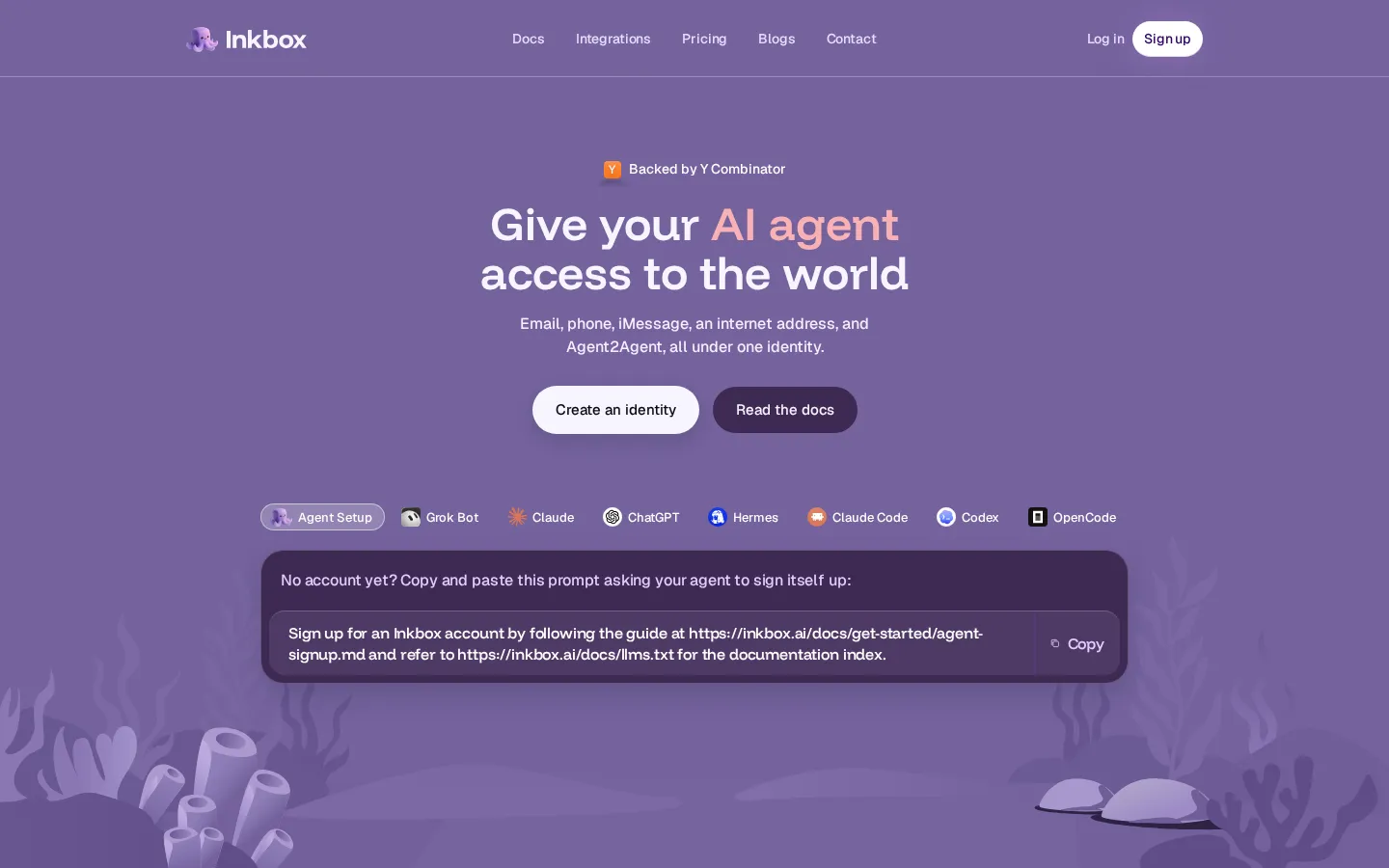
Provisioning is deliberately agent-first. A human can create an identity from the console, but an agent can also create its own: the setup prompt on the homepage asks the agent to read the signup guide and register itself. Programmatically, identities come from a CLI, SDK, MCP server or plugin, and the documented example inkbox identity create sales-agent --imessage-enabled returns a mailbox and a tunnel address in one step. Plugins exist for Hermes Agent, Claude, Claude Code, ChatGPT, Codex, OpenCode, Grok Bot and OpenClaw, so the same identity follows the agent across harnesses rather than being tied to one runtime.
Pricing is metered by identity. The free plan covers three identities with a mailbox, a shared iMessage router, a public URL and an Agent2Agent channel. Developer at $25 per month raises that to ten identities and adds a dedicated VoIP number, SMS allowances and custom email domains; Startup at $167 per month covers a hundred identities with a dedicated iMessage number and priority support. Enterprise adds international numbers and dedicated iMessage infrastructure, and message or minute overages are billed at posted rates.
The product is young, and some limits are structural. On the shared iMessage router the recipient has to text first, international telephony is quoted per country rather than listed, and the public pages do not describe attachments, group threads or rich formatting. What Inkbox claims plainly is coverage: email, phone, iMessage, internet address and agent-to-agent, under one identity rather than five disconnected integrations.
Inkbox Core Features
Agent email inbox
Every identity gets its own mailbox on inkboxmail.com or a verified custom domain, reachable through the API or a normal IMAP and SMTP mail client.
Phone and iMessage
Paid plans add dedicated VoIP numbers for HD voice, SMS and MMS, and Startup adds a dedicated iMessage number that can open conversations.
Public internet address
Each identity is published as a tunnel subdomain, giving apps and services a direct endpoint that reaches the agent without a separate proxy.
Agent2Agent channel
Agents contact each other, hand off work and return results over a dedicated A2A channel instead of routing every step through a person.
Cross-channel memory
Email, text and call history with the same person stay linked to one conversation, so the agent keeps context when someone changes channel.
Per-channel access control
Operators choose who can reach each agent on email, phone, iMessage and its internet address, and can refuse traffic on any channel.
Contacts and credential vault
Identities carry their own contact graph and scoped access to stored credentials, so an agent can authenticate without secrets in chat.
CLI, SDK and MCP provisioning
Identities are created from a command line, SDK, MCP server or agent plugin, and an agent can sign itself up without a human in the loop.
Who is Inkbox for?
Inkbox is aimed at people already running agents that need to reach the outside world, not at someone shopping for a chatbot. It fits best when an agent has to hold a conversation over days and across channels, because that is where a real identity and shared memory replace a pile of one-off integrations. - **Agent developers and platform engineers** who need a mailbox, a phone number and a reachable endpoint per agent without standing up mail servers, SIP trunks or their own tunneling layer. - **Startups running agent fleets**, where dozens of agents each need a separate address, a separate contact graph and a way for one agent to hand work to another over Agent2Agent. - **Automation and operations teams** wiring an agent into vendor email threads, support queues or appointment reminders, where replies must come from a recognizable address rather than a shared human inbox. - **Agencies and consultancies** shipping client-facing agents that should answer from the client's own domain, using the custom email domain support on paid plans. - **Growth and sales engineers** building inbound or outbound agents that need a real number for SMS follow-ups and voice, with per-message and per-minute costs that are easy to forecast. - **Teams with compliance or access-control requirements** that need channel-level allow lists, a credential vault and the ability to block inbound traffic for a single agent. It is a weaker fit for someone who only wants a hosted chat widget, or for a solo builder whose agent never needs to receive anything from the outside world.
Inkbox Use Cases
Give a support agent its own inbox so customer replies arrive at a real address, not a shared team mailbox.
Let a scheduling agent text a confirmation, take a reschedule over iMessage and keep both threads tied to one person.
Provision one identity per agent in a fleet and hand work between them over Agent2Agent without a human relay.
Send vendor and invoice follow-ups from a company domain so suppliers see a recognizable sender.
Route inbound calls to an agent that answers, qualifies and logs the transcript against the caller's contact record.
Hand an agent its own tunnel URL so a webhook or external service can reach it directly.
Restrict an experimental agent to a short allow list of test contacts before opening it to real customers.
Spin up a throwaway identity for a demo, then delete it once the evaluation ends.
Inkbox Pros and Cons
Pros
- One identity covers email, phone, iMessage, internet address and Agent2Agent, replacing four or five separate integrations.
- Agents provision themselves through a CLI, SDK, MCP server or plugin, so setup does not depend on a human copying credentials.
- Cross-channel memory keeps a person's email, texts and calls in one thread, which is the part most agent stacks get wrong.
- The free tier is usable at three identities, and overage rates of $0.03 per message or minute are published openly.
- Per-channel access control plus a credential vault gives operators a way to limit who reaches an agent and what it can authenticate to.
Cons
- On the shared iMessage router recipients must text first, so an agent cannot open a conversation until you pay for a dedicated iMessage number.
- The public pages say little about attachments, group threads or rich formatting, so those cases need testing before you rely on them.
- Phone, SMS and call allowances cover only U.S. and Canadian numbers, and international numbers are quoted per country rather than self-serve.
FAQ About Inkbox
Inkbox Pricing
A free plan covers three agent identities with mailbox, shared iMessage, public URL and Agent2Agent. Developer is $25 per month or $300 yearly with ten identities and a VoIP number, Startup $167 per month or $2,000 yearly with a hundred identities and a dedicated iMessage number, and Enterprise is custom.
Check official pricingFree
Three agent identities, each with an email inbox, 1 GiB stored mail, shared iMessage and calls, a public URL, an Agent2Agent channel, contacts, credential vault and IMAP/SMTP access.
Developer
Ten identities, 2 GiB mail each, custom signatures, one dedicated VoIP number with 300 SMS/MMS and 30 call minutes monthly, and ten custom email domains. $300 per year.
Startup
A hundred identities, 3 GiB mail each, one dedicated iMessage number, nine VoIP numbers with 2,700 SMS/MMS and 300 call minutes, 100 custom domains and priority support. $2,000 per year.
Enterprise
Volume pricing with custom identity, number and seat allowances, higher API rate limits, international telephony, dedicated iMessage infrastructure and white glove onboarding.
Inkbox Alternatives

PostHero
PostHero connects your social accounts once, then lets Claude, ChatGPT, Claude Code, Cursor or any MCP-compatible agent research viral posts, write in your voice, build carousels and faceless reels, and schedule everything to LinkedIn, X, Instagram, Threads, Facebook, YouTube, TikTok and Bluesky. Every item lands as a draft in one calendar, so nothing publishes without your approval. Plans start at $9 per month.

Loopa
Loopa turns a plain-language request into a finished deliverable instead of a chat reply. Its agents plan multi-step work, read your files, call skills such as slides, Excel, image and video generation, then hand back downloadable output. Free accounts get 600 credits a day, while paid plans add every model tier, more storage, scheduled tasks and custom agents.

WHACKA
WHACKA is a no-code AI app builder that turns natural language descriptions into live applications. Describe what you need in a chat, and WHACKA generates the interface, database, logic, and a public link, usually within minutes. Hosting, authentication, storage, push notifications, and AI are included. Free plans start with 24 credits a month, and paid plans add credits, custom domains, and app store publishing.