
Gradium
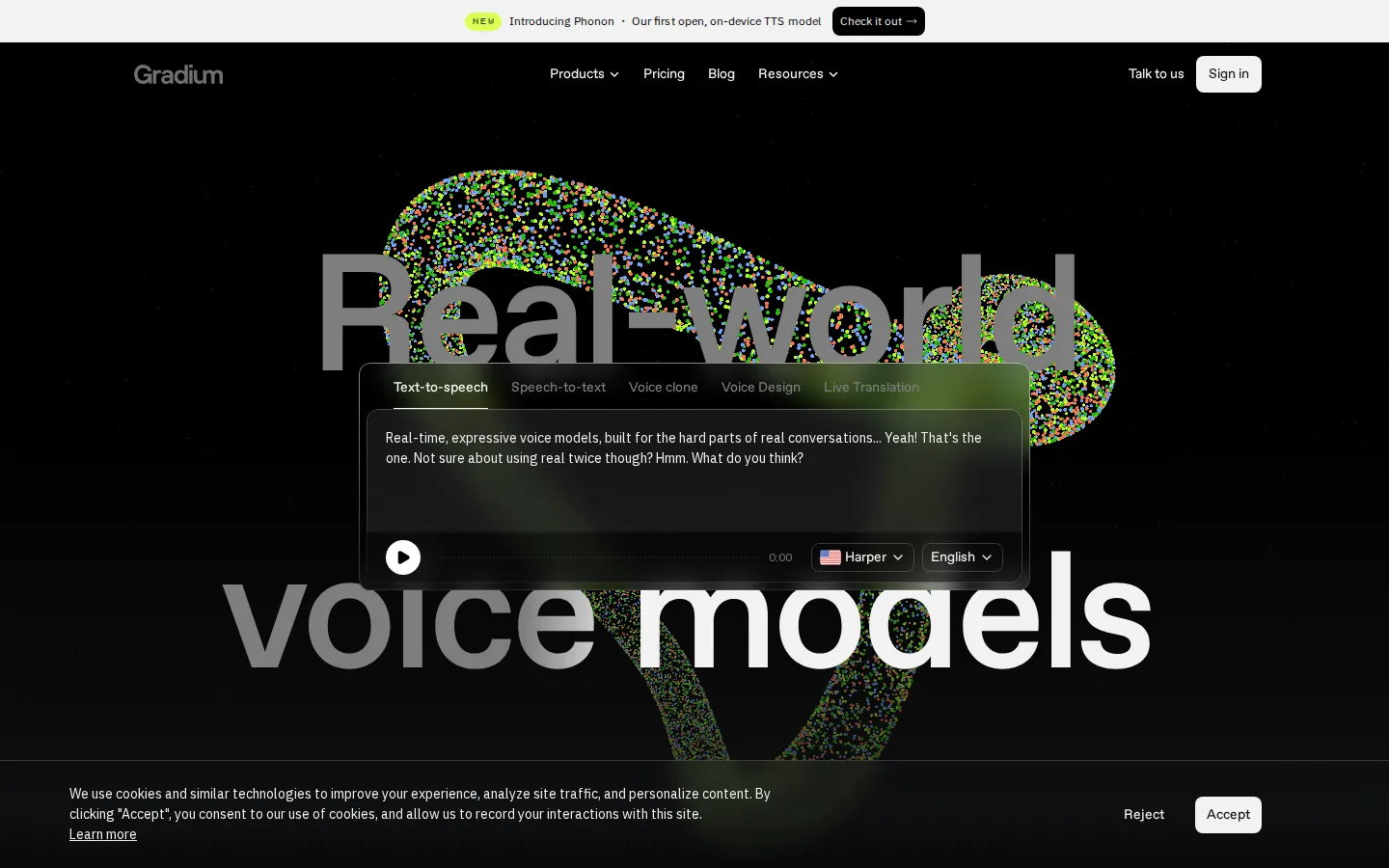
Gradium builds production-grade real-time voice models for conversational agents, from the researchers behind years of peer-reviewed speech work. The suite covers expressive streaming text-to-speech, speech-to-text with semantic turn detection, instant and pro voice cloning, text-prompt voice design and live voice-to-voice translation, plus Phonon, an open-weight on-device TTS model that runs completely offline on phones, laptops and embedded hardware.
What is Gradium?
Gradium is a voice AI platform built by speech researchers who spent years publishing peer-reviewed work before turning it into production APIs. Instead of offering a single text-to-speech endpoint, it ships a coordinated stack of real-time voice models: expressive streaming text-to-speech, speech-to-text with semantic voice activity detection for natural turn-taking, live voice-to-voice translation that preserves the speaker's prosody, voice cloning at two fidelity levels, and voice design that invents a brand-new speaker from a short text description. A fifth product, Phonon, is an open-weight text-to-speech model with 31M and 40M parameter variants that runs fully offline on CPUs, phones, Raspberry Pi boards, laptops and inside the browser, with a footprint as small as 64.5 MB.
The platform is engineered around the parts of voice AI that break in production rather than in demos: latency, reliability and cost at scale. Its bidirectional WebSocket API begins streaming audio back in roughly 200 milliseconds, and the company publishes a 47ms P50 figure on Coval's independent benchmark, where its default model also scores 5.3% word error rate against comparably priced competitors. Latency is designed to stay flat as concurrency climbs, which matters for call centers and voice agents handling thousands of simultaneous conversations.
Gradium speaks five languages for voice design and shipping voice presets include English, French, German, Spanish and Brazilian Portuguese, with real regional accents rather than a single neutral tone. Instant voice cloning needs only ten seconds of audio, while Pro Voice Clones accept thirty minutes to a few hours for the highest speaker similarity. Live translation performs zero-shot cloning at inference, so a caller's voice and delivery carry through into the target language.
Integration is deliberately conventional. Python and Rust SDKs install in one prompt, with first-class support for LiveKit, Pipecat and the open-source Gradbot agent builder, plus telephony audio formats built in. Teams can run on Gradium's cloud, dedicated instances, self-hosted or on-premise deployments for data sovereignty, or through Baseten and SageMaker endpoints. Security documentation covers SOC 2 Type II, ISO 27001, zero data retention and EU or US data residency, and the company backs that with a public trust center and status page. Gradium has extended its seed funding to $100 million with investors including NVIDIA and opened a Bay Area office alongside its European team.
Gradium Core Features
Expressive streaming TTS
Timestamp-accurate speech with custom pronunciations and concurrency that scales without latency drift.
Speech-to-text with semantic VAD
Code-switching support, controllable latency and turn detection tuned for live conversation.
Live voice translation
Real-time interpreting that preserves voice and prosody via zero-shot cloning computed at inference.
Two-tier voice cloning
Instant clones from about ten seconds of audio, or Pro clones trained on thirty minutes to hours of speech.
Voice Design
A brand-new speaker generated from a short text prompt, controlling age, gender and vocal texture across five languages.
Phonon on-device TTS
Open-weight 31M and 40M parameter models running fully offline on CPU, from 64.5 MB, including in the browser.
Streaming WebSocket API
Bidirectional audio streaming with first audio around 200ms and telephony formats built in.
Flexible deployment
Cloud API, dedicated instances, self-hosted or on-prem, plus Baseten and SageMaker endpoints for data sovereignty.
Who is Gradium for?
Gradium targets teams that put voice in front of real users and cannot afford demo-grade reliability. It is most useful to: Voice agent developers - engineers building inbound or outbound conversational agents for support, sales or scheduling, who need streaming TTS and STT with predictable latency rather than batch synthesis. AI product engineers at startups - founders shipping voice-first products who want a single vendor covering speech synthesis, transcription, translation and cloning, with a free tier to prototype and usage-based pricing as they grow. Contact center and CX platform builders - teams replacing scripted IVR with natural-sounding agents, where concurrency limits, telephony formats and stable latency under load decide whether the product works. Localization and media teams - studios and language service providers dubbing content or running live interpretation, using prosody-preserving translation and pro voice clones to keep a presenter's identity intact. Conversational AI and QA platforms - companies generating synthetic callers or test audio at scale, as Coval does, where voice variety and accent coverage determine how realistic an evaluation is. Enterprise platform and security teams - organizations with data residency, zero-retention or on-premise requirements, who need SOC 2 and ISO 27001 evidence before a voice vendor enters procurement. Embedded and edge developers - hardware and mobile teams using Phonon to ship offline speech on devices without a network round trip. It is less relevant for hobbyists wanting a consumer voice-over app, or for teams whose only need is batch narration in dozens of languages at the lowest possible per-character price.
Gradium Use Cases
Build a real-time voice agent that answers support calls with sub-100ms speech
Transcribe live meetings with semantic turn detection and code-switching support
Clone a brand spokesperson's voice from a ten-second recording
Generate a new brand voice from a text prompt in five languages
Translate a live call into another language while keeping the speaker's tone
Dub video content with pro voice clones for consistent presenter identity
Generate thousands of synthetic callers to evaluate a voice agent
Run offline speech synthesis on a Raspberry Pi or inside a mobile app
Gradium Pros and Cons
Pros
- Publishes independently benchmarked latency and accuracy figures, including a 47ms P50 and 5.3% WER on Coval's tracker
- One vendor covers TTS, STT, translation, cloning, voice design and on-device speech, reducing integration work
- Genuinely low entry cost: a free tier with 45k monthly credits, no card required, and plans from $12 per month
- Strong enterprise posture with SOC 2 Type II, ISO 27001, zero data retention and EU or US residency options
- Ships Python and Rust SDKs plus first-class LiveKit, Pipecat and Gradbot integrations
Cons
- Free plan excludes commercial use and caps custom voices at five, so any real product needs a paid tier
- Unused plan credits expire monthly rather than rolling over, which penalizes spiky seasonal usage
- Voice design is documented for five languages only, fewer than some competing synthesis platforms offer
FAQ About Gradium
Gradium Pricing
Free tier with 45k monthly credits, then five paid tiers from $12 to $1,480 per month plus custom enterprise pricing, all metered in credits.
Check official pricingFree
45k credits a month covering about an hour of TTS or four hours of STT, with Studio and API access but no commercial use.
XS
225k credits, commercial use, up to 1,000 custom voices and a choice of EU or US data residency.
S
900k credits, four times the XS allowance, cheaper top-ups and zero data retention.
M
9M credits, five Pro voice clones, higher concurrency and reduced overage rates.
L
45M credits, twenty Pro voice clones, the highest standard concurrency and the cheapest top-up rate.
Enterprise
Unlimited credits with dedicated inference, on-premise deployment, custom concurrency and volume, and enterprise SLAs.
Gradium Alternatives
KugelAudio
KugelAudio is a German voice AI platform for developers building voice agents. Its Kugel 3.5 text-to-speech model speaks 39 languages with native accents and reads numbers, IBANs and phone numbers digit-perfect, while Kugel Ear 1 transcribes callers and flags words it may have misheard. Pay per audio minute, billed by the second, hosted in the EU and fully GDPR compliant.
Filmpire
Filmpire combines AI video, image, and voice generation in one browser studio built on a shared credit balance. Start from a prompt or reference image, choose from models such as Hailuo, Seedance, Kling, Veo, or GPT Image, let the AI director plan a full story, then export watermark-free files with commercial rights on any paid plan.

Vidnoz AI
Vidnoz AI is a browser-based studio that turns text into talking-avatar videos. Pick an avatar and template, type a script, choose a voice from 2,000+, then export a lip-synced clip. It also bundles voice cloning, lip-synced translation in 135+ languages, Veo and Kling text-to-video models, an image generator, and a free plan with 30 daily credits.