
Firecrawl
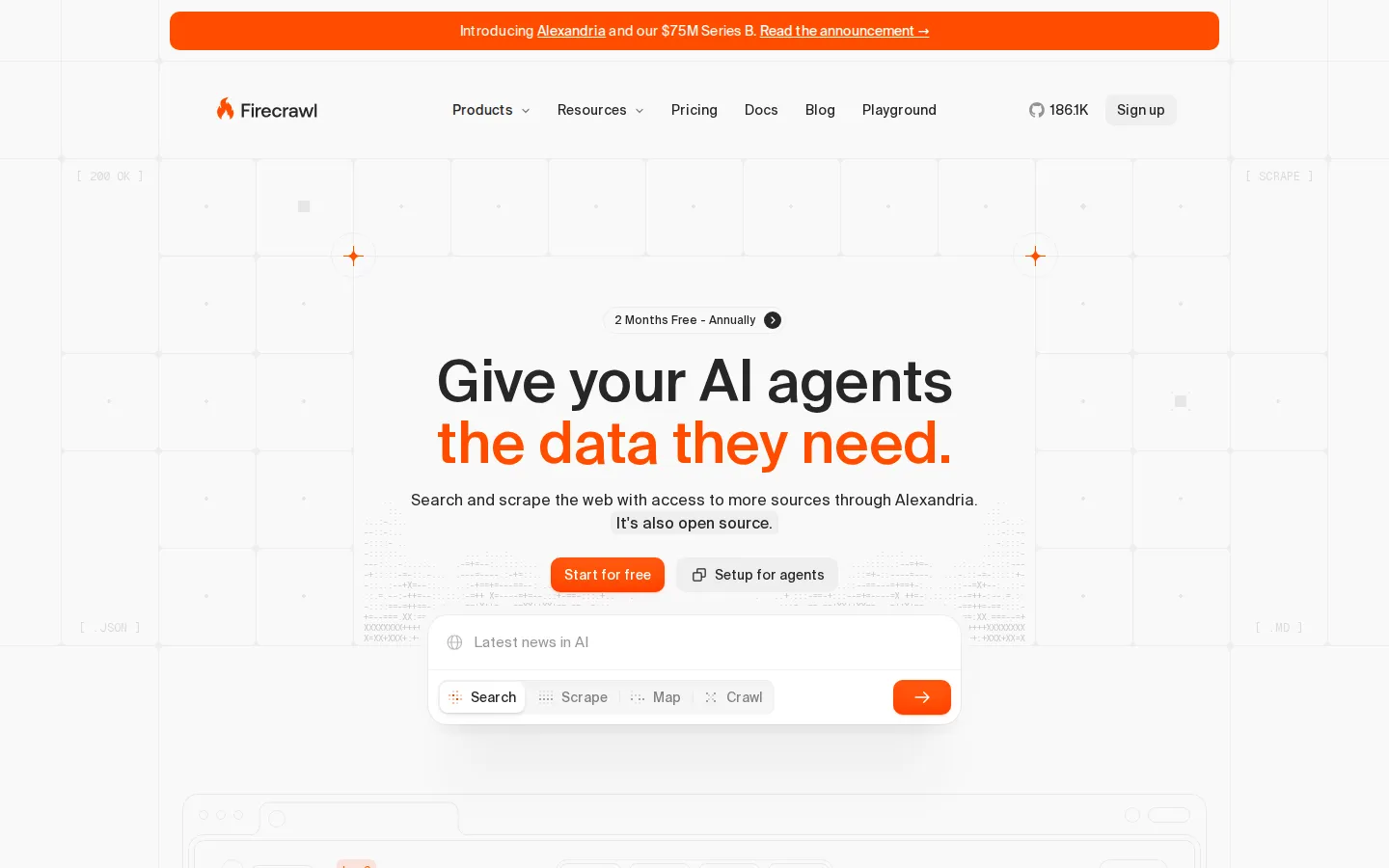
Firecrawl turns any website into clean, structured data through one API. Developers use it to search the web, scrape pages into markdown, JSON, screenshots, or schemas, crawl entire sites, and interact with pages behind logins or pagination. It handles JavaScript rendering, proxies, and parsing automatically, so AI agents, RAG pipelines, and research tools get reliable web context without maintaining their own scraping infrastructure.
What is Firecrawl?
Firecrawl is a web data API that helps AI systems search, scrape, and act on the live web. Built by SideGuide Technologies and best known for its open-source crawler, it converts any URL into clean, LLM-ready data: markdown, HTML, screenshots, page metadata, or structured JSON matching a schema you define. Instead of running your own browser fleet, proxy pool, and parsing pipeline, you send one API call and receive content already stripped of navigation, footers, and ads. The company reports roughly 93% fewer input tokens compared with raw page HTML.
The platform is organised around a small set of endpoints. Search returns web results with full-page markdown already attached, so a question becomes usable context in one call. Scrape fetches a single page and returns markdown, HTML, screenshots, metadata, or schema-driven JSON, handling JavaScript rendering, dynamic content, and complex layouts automatically. Map lists the URLs on a site, Crawl follows links from a starting URL with depth, page, and path limits, and Interact drives pages like a browser by clicking, typing, scrolling, waiting, and pressing keys, which reaches content behind logins, pagination, or multi-step flows. Document parsing extends the same pipeline to PDFs, DOCX, and other files, while Monitor watches a page and re-extracts data on a schedule.
Firecrawl also ships an official MCP server, so agents in Cursor, Claude Code, Windsurf, and other MCP clients can search, scrape, and interact with the web directly, plus a CLI and agent skills that complete setup in one command. Official SDKs exist for Python, Node.js, Go, Rust, Java, and Elixir, and the REST API is callable from any language. The hosted service adds Fire-engine, the company's proprietary infrastructure for proxies and rendering, a usage dashboard, and interact capabilities that the self-hosted open-source version does not include. A newer layer called Alexandria adds licensed, indexed sources for faster access to official providers and specialised indexes. The service is SOC 2 Type II compliant and reports more than 1.25 million developers and 150,000+ companies building on it.
Firecrawl Core Features
Search API
Returns web results with full-page markdown already attached in a single call
Scrape API
Converts one URL into markdown, HTML, screenshots, metadata, or schema JSON
Crawl and Map
Follows site links or lists a site's URLs with depth and path limits
Interact
Clicks, types, scrolls, and waits to reach content behind logins or pagination
Structured extraction
Pass a JSON schema and receive data matching your exact shape
Document parsing
Extracts content from PDFs, DOCX files, and other non-HTML documents
Agent integrations
Official MCP server, CLI, and SDKs for Python, Node, Go, Rust, Java, and Elixir
Monitoring
Watches pages on a schedule and re-extracts data when their content changes
Who is Firecrawl for?
Firecrawl is aimed squarely at people who build software that needs live web data rather than at casual browsing. AI and machine learning engineers are the core audience: they use the API to feed retrieval-augmented generation pipelines, fine-tuning datasets, and evaluation harnesses with clean text, and they value that markdown and schema JSON arrive ready for a model instead of raw HTML that still needs parsing. Backend and full-stack developers adopt it as a drop-in replacement for hand-rolled scraping stacks, because it removes the maintenance burden of headless browsers, rotating proxies, retry logic, and layout changes. Agent developers and automation engineers connect it through the official MCP server, CLI, or SDKs so assistants in Cursor, Claude Code, and Windsurf can search and scrape on demand. Data and analytics teams use Firecrawl for structured extraction and monitoring: pulling product listings, pricing tables, contact details, and competitor pages into warehouses on a recurring schedule. Growth, sales, and revenue operations teams apply it to lead enrichment and account research, turning public websites into enriched CRM records. Startup founders and product managers rely on it for deep research, market scans, and competitive intelligence without commissioning a bespoke scraper. Researchers, journalists, and analysts use search plus scrape to gather and cite sources at scale. Larger organisations pick the Scale and Enterprise tiers for high concurrency, dedicated support, SSO, and zero-data retention. Because the core is open source, infrastructure teams that must self-host also evaluate Firecrawl, though they should note the hosted platform's extra rendering and interact features. Beginners can start on the free tier to test a single idea before committing budget.
Firecrawl Use Cases
Feed deep research agents with comprehensive web content gathered across many sources.
Populate RAG pipelines with clean markdown sized for model context windows.
Enrich lead and company records with data pulled from public websites.
Track competitor pricing, product pages, and announcements on a recurring schedule.
Pre-populate user onboarding by importing a customer's own website content automatically.
Give AI chat assistants real-time web access for current, accurate answers.
Extract structured product listings, contact details, or tables using a JSON schema.
Drive browser workflows that need clicking, form filling, and multi-step navigation.
Firecrawl Pros and Cons
Pros
- One API covers search, scrape, crawl, map, interact, parse, and monitor instead of stitching several tools together.
- Open-source core with over 180K GitHub stars, so the crawler can be self-hosted and inspected.
- Official SDKs for Python, Node.js, Go, Rust, Java, and Elixir, plus an official MCP server and CLI.
- Generous entry point: 1,000 free credits every month with no credit card required.
- Publishes reliability and latency benchmarks and states SOC 2 Type II compliance.
Cons
- Credit pricing adds up at scale, and schema extraction plus advanced formats consume credits faster than base page scrapes.
- Costs are harder to predict than a flat per-page price because interact, JSON, and monitor usage bill differently.
- The self-hosted open-source version lacks the hosted platform's Fire-engine infrastructure, interact capabilities, and dashboard.
FAQ About Firecrawl
Firecrawl Pricing
Freemium credit-based pricing: a free tier with 1,000 credits every month and no card required, then Hobby at $16/month billed annually ($19 monthly), Standard at $83/month annually ($99 monthly), Growth at $333/month annually ($399 monthly), Scale at $599/month annually ($749 monthly), and custom Enterprise pricing. Paid plans include pay-as-you-go top-ups in $5 increments capped by a monthly limit you set.
Check official pricingFree
1,000 credits per month with no credit card, covering 500 searches or 1,000 pages scraped, 2 concurrent requests, and low rate limits.
Hobby
$19 per month billed monthly, or $16 billed annually ($190/year). 5,000 credits per month, 2,500 searches or 5,000 pages scraped, 5 concurrent requests, basic support, and 1,000 extra credits per $5 via pay-as-you-go.
Standard
Recommended plan. $99 monthly or $83 billed annually ($990/year). 100,000 credits per month, 50,000 searches or 100,000 pages scraped, 25 concurrent requests, standard support, and 2,000 extra credits per $5.
Growth
$399 monthly or $333 billed annually ($3,990/year). 500,000 credits per month, 250,000 searches or 500,000 pages scraped, 50 concurrent requests, priority support, and 2,500 extra credits per $5.
Scale
$749 monthly or $599 billed annually ($7,190/year). 1,000,000 credits per month, 500,000 searches or 1,000,000 pages scraped, 100 concurrent requests, priority support, one month of credit rollover, and 5,000 extra credits per $5.
Enterprise
Custom credits and concurrency with dedicated support and SLA, bulk discounts, zero-data retention, SSO and advanced security, SAML/OIDC single sign-on, SCIM provisioning, and static egress IPs.
Firecrawl Alternatives
FastRouter
FastRouter is a unified LLM gateway that gives developers one OpenAI-compatible API for 200+ models from providers such as OpenAI, Anthropic, Google, and xAI. It adds automatic model routing, fallbacks, caching, spend caps, role-based access, guardrails, and per-request observability, while passing provider token prices through with no markup on any plan, including the free tier.
Cindy
Cindy is an open-source desktop AI agent from XD Inc. that unifies Claude Code, Codex and Pi harnesses with 20+ tools, persistent memory and reusable skills. Use it free with your own API key or existing Coding Plan, or pay for the optional managed model service that works the moment you sign in. No setup project required.

MyToolster
MyToolster packs 41 free utilities into one browser-based site, sorted into Audio & Video, Text, Data, Web, Color, QR Code and Image. Beyond the usual encoders, formatters and generators it runs OpenAI Whisper transcription, AI text and image detection, background removal and subtitle export locally, with no uploads, account or installation, and every tool page does its work client-side.