
Devin
Devin is an AI software engineer built by Cognition that plans, codes, debugs, and ships software tasks autonomously. It combines Devin Desktop for local work, cloud agents powered by the SWE 1.7 model, Tab completions, and inline edits across major IDEs. Plans range from a free tier to Pro at $20 per month, Max at $200, and Teams with centralized billing.
What is Devin?
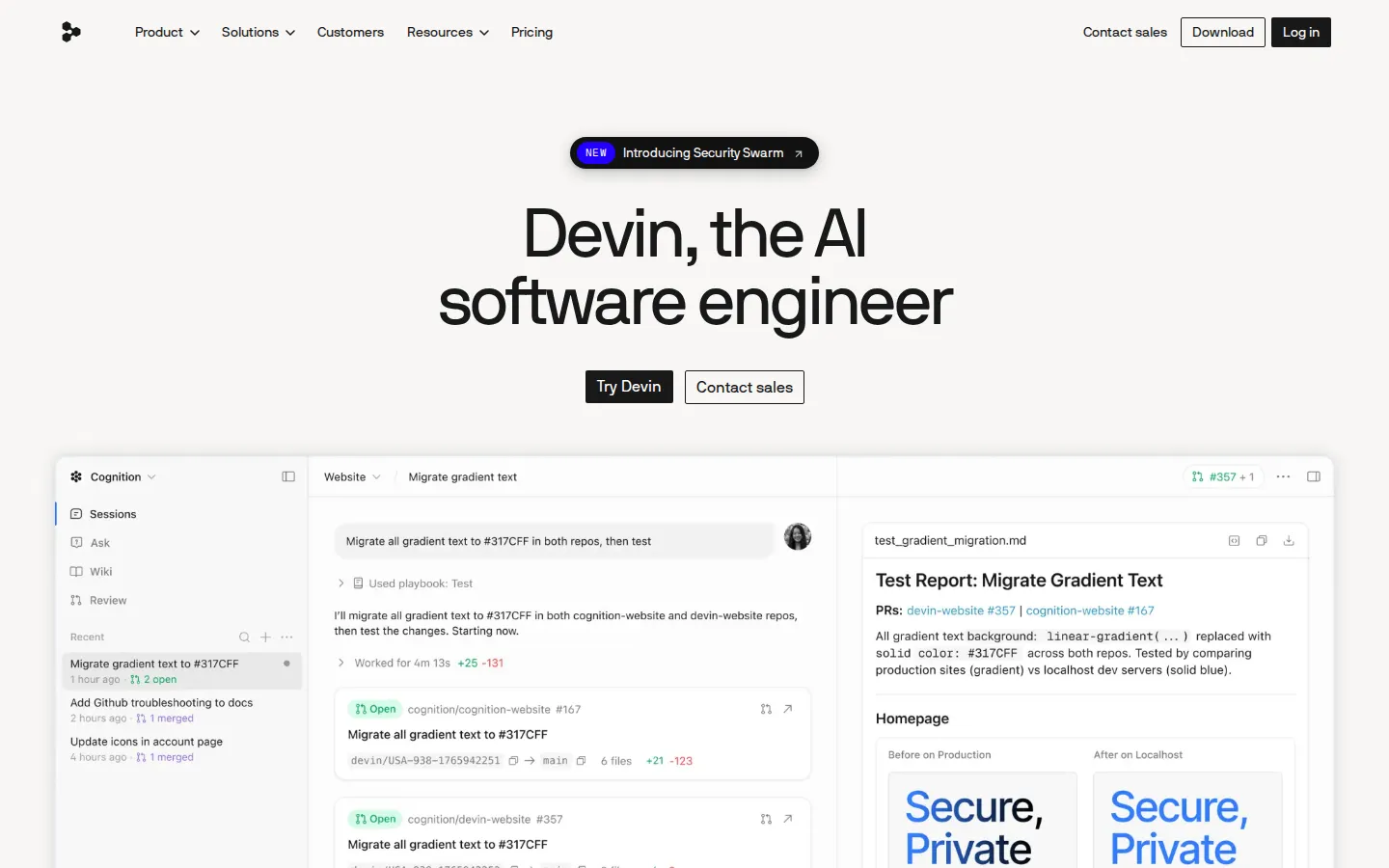
Devin is an AI software engineer developed by Cognition that goes beyond code suggestions to plan and execute engineering work. It understands a task, writes the code, runs it, debugs failures, and iterates until the work is done, acting like a teammate rather than an autocomplete tool. Devin is built around the SWE 1.7 model, Cognition's latest frontier model for software engineering, which is available free on paid plans alongside leading open-source models. Users interact with Devin through Devin Desktop, an application that brings the agent into local development workflows, and through Devin Cloud, where agents run in the cloud and can be assigned larger, longer-running tasks. The product also provides Tab completions and inline edits across IDEs, fast context windows, and premium model access to OpenAI, Claude, and Gemini frontier models on paid plans. Devin integrates with Slack and Teams for collaboration, Linear and Jira for issue tracking, and GitHub, GitLab, and Bitbucket for repositories, with support for custom git providers. Teams can share sessions, use centralized billing, and manage access through an admin dashboard with analytics. The pricing structure is designed for individuals and organizations alike: a Free plan at $0 per month includes a light quota for coding with agents, unlimited inline edits, and unlimited Tab completions. Pro at $20 per month increases quotas, unlocks frontier model access, and includes Devin Cloud, while Max at $200 per month provides significantly higher quotas. Teams start at $80 per month for the team plan plus $40 per month per full developer seat, and Enterprise adds SAML/OIDC SSO, dedicated deployment options, and centralized admin controls. Devin's integration depth is one of its strongest assets: the same agent that writes code can file pull requests, update issues in Jira, and report progress in Slack, so engineering teams get visibility without context switching. The Devin API and DeepWiki extend the platform programmatically, letting teams automate documentation and build custom agent workflows. Cognition continues to invest heavily in the model behind Devin, and the SWE benchmark improvements across releases indicate the agent's reasoning and code quality are improving steadily. For organizations standardizing on agentic development, Devin's combination of local IDE assistance, cloud agents, team tooling, and enterprise controls makes it one of the most complete offerings in the category.
Devin Core Features
SWE 1.7 model
Cognition's latest frontier software engineering model, free on paid plans.
Devin Desktop
Local application that brings the agent into daily development workflows.
Devin Cloud agents
Cloud-based agents for larger, longer-running engineering tasks.
Tab completions & inline edits
Fast, unlimited code assistance across major IDEs.
Frontier model access
Premium models from OpenAI, Claude, and Gemini on paid plans.
Integrations
Slack, Teams, Linear, Jira, GitHub, GitLab, Bitbucket, and custom git providers.
Team collaboration
Shared sessions, centralized billing, admin dashboard with analytics.
Devin API & DeepWiki
Programmatic access and automatic repository documentation.
Who is Devin for?
Devin serves software engineers and developers who want an AI teammate for routine implementation work, engineering managers who need visibility into agent work across teams, and startups that want to scale output without proportional headcount. Tech leads use Devin for spikes, refactors, and backlog cleanup, while product teams assign well-scoped features to cloud agents. QA engineers and testers use it to write and run tests, and organizations use Teams and Enterprise plans for centralized billing, SSO, and compliance controls. It also suits solo developers who want frontier-model coding assistance at a predictable monthly price. Engineering leads use Devin to clear backlog items and parallelize implementation work across their teams, while staff engineers delegate routine tasks and focus on architecture and code review. Startups with small engineering teams use Devin as force-multiplying capacity, and agencies building software for clients use it to deliver faster with leaner teams. QA engineers automate test writing and execution, and security-conscious organizations use Enterprise controls for SSO, VPC deployment, and admin oversight. Bootcamp students and self-taught developers use the free plan to learn agentic workflows, and technical founders prototype features hands-on before hiring full-time engineers. Freelance engineers use Devin to take on more projects, and technical founders delegate implementation work while focusing on product and strategy decisions.
Devin Use Cases
Assign a well-scoped feature implementation to a Devin cloud agent and review the resulting pull request.
Use Devin Desktop for day-to-day coding with tab completions and inline edits in your IDE.
Refactor legacy code and clean up technical debt with natural-language task descriptions.
Write and run tests automatically for new or modified functionality.
Let Devin investigate bugs by reproducing issues, reading logs, and proposing fixes.
Scale engineering output across teams with centralized billing, admin analytics, and SSO.
Devin Pros and Cons
Pros
- Executes full engineering tasks end to end instead of only suggesting code snippets.
- Free tier includes unlimited inline edits and tab completions with a light agent quota.
- Frontier model access and SWE 1.7 are included at Pro's $20 price point.
- Deep integrations with Slack, Jira, Linear, and major git providers fit real team workflows.
Cons
- Heavy agent usage may exceed included quotas and require extra usage purchases.
- Autonomous coding quality depends on task scope and repository complexity.
- The $200 Max tier is pricey for individual developers with occasional heavy needs.
FAQ About Devin
Devin Pricing
Free $0; Pro $20/month; Max $200/month; Teams $80/month + $40/seat/month; Enterprise custom (official pricing at devin.ai/pricing).
Check official pricingFree
Light agent quota, unlimited inline edits and tab completions, limited models
Pro
Increased quotas, frontier models, SWE 1.7, Devin Cloud access
Max
Significantly higher quotas for power users
Teams
Team plan plus $40/month per full developer seat, centralized billing
Enterprise
SSO, dedicated deployment, admin controls, priority support
Devin Alternatives

FastRouter
FastRouter is a unified LLM gateway that gives developers one OpenAI-compatible API for 200+ models from providers such as OpenAI, Anthropic, Google, and xAI. It adds automatic model routing, fallbacks, caching, spend caps, role-based access, guardrails, and per-request observability, while passing provider token prices through with no markup on any plan, including the free tier.

Cindy
Cindy is an open-source desktop AI agent from XD Inc. that unifies Claude Code, Codex and Pi harnesses with 20+ tools, persistent memory and reusable skills. Use it free with your own API key or existing Coding Plan, or pay for the optional managed model service that works the moment you sign in. No setup project required.

MyToolster
MyToolster packs 41 free utilities into one browser-based site, sorted into Audio & Video, Text, Data, Web, Color, QR Code and Image. Beyond the usual encoders, formatters and generators it runs OpenAI Whisper transcription, AI text and image detection, background removal and subtitle export locally, with no uploads, account or installation, and every tool page does its work client-side.