
Crazyrouter
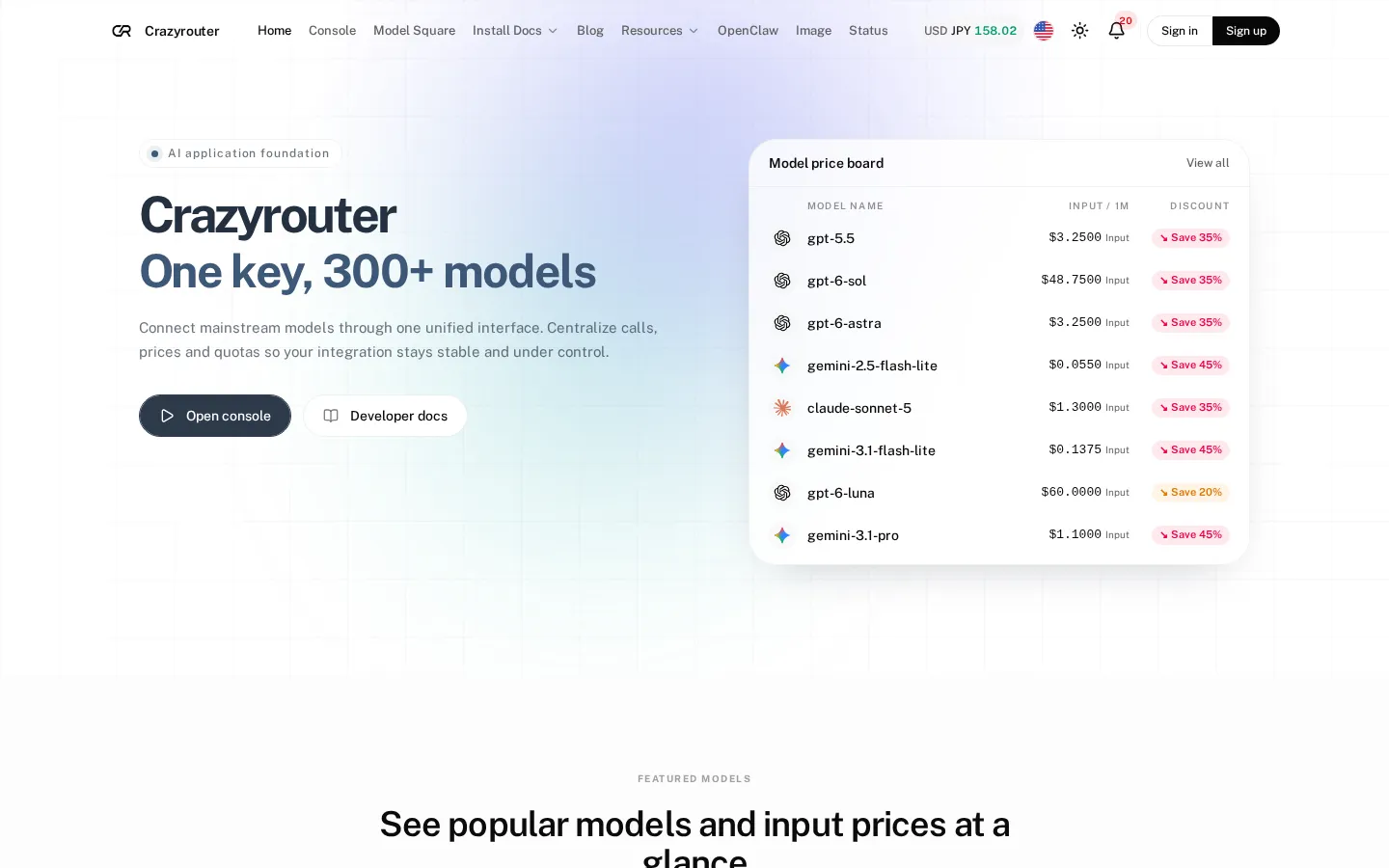
Crazyrouter is a Chinese AI API relay that puts 300+ models from OpenAI, Anthropic, Google, xAI and Chinese vendors behind one OpenAI-compatible key. Developers top up in CNY with Alipay or WeChat, pay per token or per request at below-list rates, and connect Claude Code, Codex CLI, Cursor or any existing OpenAI SDK by changing the base URL.
What is Crazyrouter?
Crazyrouter is a Chinese AI API relay and model aggregator operated by ORANGE LAKE LIMITED. It sells access to more than 300 models from vendors such as OpenAI, Anthropic, Google, xAI, DeepSeek, Alibaba, Zhipu, Moonshot, MiniMax and ByteDance through a single account, a single API key and one OpenAI-compatible endpoint. Instead of holding separate contracts and cards with each lab, a developer registers at crazyrouter.com, tops up a prepaid balance and calls models by name.
The integration model is deliberately ordinary. OpenAI SDKs point at https://api.crazyrouter.com/v1, with a mainland-oriented https://cn.crazyrouter.com/v1 for East Asian networks, and only the base URL, key and model identifier change. Anthropic-native clients use the root domain https://api.crazyrouter.com and reach /v1/messages, the Responses API is exposed for Codex CLI, and Gemini's generateContent route is available too. Published setup guides cover Claude Code, Codex, Cursor, Cline and Cherry Studio.
The catalogue is broader than chat. At review the public Model Square showed 168 enabled models across more than 30 vendors, with 160 chat endpoints, 19 Anthropic, 12 Gemini, 15 image and 2 video routes, while the site's marketing figure is 300+ models. Image and video lines include GPT Image, Qwen Image, Midjourney, Kling, Veo and Seedance; audio covers text-to-speech and transcription; embeddings and rerank are listed as well. Some image and video jobs bill per request or per second rather than per token.
Billing is prepaid and usage-based. Every rate is published in USD per million tokens, usually beside the vendor's list price and a discount figure; Claude Opus 4.8, for example, is listed at $3.25 in and $16.25 out against a $5/$25 list. A few models, such as DeepSeek V4.1 Flash, split peak and off-peak rates. Balances are topped up in CNY through Alipay, WeChat Pay or bank card, with no subscription and no stated minimum spend, and the header shows a live USD to CNY reference rate.
Operationally, Crazyrouter markets multi-node scheduling, redundant links and failover, plus a console with token management, usage logs, a playground and a status page. Native Claude Code and Codex deploy paths make it a practical drop-in for coding agents that expect Anthropic or OpenAI protocols. Support runs through email and a Telegram channel, and a refund policy is published, though its terms are worth reading before a large top-up. The trade-off is the usual one for a relay: the models are not hosted by Crazyrouter, so latency and availability follow the upstream channels it routes to, and no self-hosted deployment or enterprise SLA is listed.
Crazyrouter Core Features
One Key for Many Vendors
A single account and API key reach Claude, GPT, Gemini, Grok, DeepSeek, Qwen, GLM, Kimi, MiniMax and Doubao models without separate vendor contracts.
OpenAI-Compatible Endpoint
Existing OpenAI SDKs and frameworks work by changing base_url to https://api.crazyrouter.com/v1, the API key and the model name.
Native Anthropic and Gemini Routes
Claude Code talks to /v1/messages on the root domain, Codex CLI uses the Responses API, and Gemini clients use generateContent.
Model Square and Price Board
A searchable catalogue lists context length, endpoint type, latency, throughput and per-million-token input and output prices with discount percentages.
Token and Usage Console
Create and revoke keys, review request logs, check remaining balance and monitor spend from one dashboard.
Image, Video and Audio APIs
Generate images through GPT Image, Qwen Image and Midjourney routes, video through Kling, Veo and Seedance, and speech through TTS and transcription endpoints.
Claude Code and Codex Setup
One-command scripts and manual environment-variable guides configure Anthropic-native and OpenAI Responses tooling in minutes.
Failover and Multi-Node Routing
The platform advertises smart scheduling across nodes and redundant links so a single upstream failure does not stop every request.
Who is Crazyrouter for?
Crazyrouter is aimed at developers and small teams who need several model vendors but would rather not manage multiple accounts, cards and SDK configurations. It suits people who are comfortable with an API key and a base URL, and who value yuan payment more than enterprise procurement paperwork. Application developers building chat, agent or retrieval-augmented features use it to switch between Claude, GPT, Gemini, DeepSeek and Qwen by editing a model string rather than integrating each vendor separately. The same key covers text, image and speech calls, which keeps a prototype in one codebase. Developers in mainland China use it because Alipay, WeChat Pay and bank-card top-ups avoid the need for an overseas credit card, and the cn.crazyrouter.com endpoint is positioned for local network conditions. For teams that cannot obtain a foreign card, that alone can decide the choice. Coding-agent users run Claude Code, Codex CLI, Cursor or Cline against one Crazyrouter key. Anthropic-native streaming, tool calls and prompt caching pass through the Messages route, and the published scripts write the environment variables for them. Product, design and marketing teams use the image and video models for mockups, ad variants and short clips without opening separate accounts with Midjourney, Kling or Google. Per-request billing keeps a small campaign easy to cost. Agencies and indie developers prototyping several AI products keep one prepaid balance and one billing line across client projects, then compare per-model prices before choosing what to ship. Platform engineers evaluating a second provider for redundancy can replay the same prompts through Crazyrouter, check latency and output quality, and add it to a fallback chain only if it holds up. The service is less suited to buyers who need a single-vendor contract, formal data-residency guarantees or negotiated support terms.
Crazyrouter Use Cases
Consolidate Claude, GPT, Gemini and Chinese models behind one key and one prepaid balance.
Run Claude Code or Codex CLI on models that would otherwise need an overseas card and a separate Anthropic or OpenAI account.
Compare a model's Crazyrouter rate with the vendor's list price before choosing it for a production feature.
Build a chatbot that falls back from a flagship model to a cheaper one when a request or budget threshold is hit.
Generate marketing images or short video clips through Midjourney, Kling, Veo or Seedance without separate subscriptions.
Prototype a multilingual assistant using Qwen, GLM, Kimi or DeepSeek alongside Western models on the same endpoint.
Serve an application from mainland China through the cn.crazyrouter.com endpoint and pay in yuan.
Test a second API provider for redundancy before adding it to a production fallback chain.
Crazyrouter Pros and Cons
Pros
- Migration is genuinely small: an OpenAI SDK needs a new base URL, key and model string, and Anthropic-native tools use documented environment variables.
- Many token rates sit 20-45% below vendor list prices, with no subscription, and top-ups can start small.
- Alipay, WeChat Pay and bank-card top-ups in CNY remove the foreign-card barrier for developers in China.
- Claude Code, Codex, Cursor, Cline and Cherry Studio guides ship alongside the API, so coding-agent setup is well covered.
Cons
- Model rates are quoted in USD while top-ups are paid in CNY, so the effective yuan cost depends on the exchange rate applied at checkout; the header panel is a reference rate, not a locked quote.
- The marketing claims 300+ models, but the public Model Square listed 168 enabled models at review, so availability varies by account and must be checked with /v1/models.
- As a relay, Crazyrouter adds a dependency between the application and every upstream vendor; latency on the public board ranged from about 1 to 38 seconds, and no uptime SLA is published.
FAQ About Crazyrouter
Crazyrouter Pricing
Prepaid, usage-based access with no subscription: token rates are published in USD per 1M tokens, from $0.02 input for text-embedding-3-small and about $0.029 for the cheapest chat model, with many flagship rates 20-45% below vendor list; image and video jobs bill per request or per second. Balances are topped up in CNY via Alipay, WeChat Pay or bank card, and the site quoted a live reference rate of ¥6.69 per $1 at review, so the yuan charged follows the rate at checkout.
Check official pricingPrepaid pay-as-you-go
Lowest token rate on the public board at review is text-embedding-3-small input at $0.02 per 1M; chat starts at $0.029 per 1M input for Qwen3.5 Flash, with usage deducted from a prepaid balance and no monthly fee.
Flagship token rates
Claude Opus 4.8 is listed at $3.25 input and $16.25 output per 1M tokens, 35% below the $5/$25 vendor list; Claude Sonnet 4.6 is $1.95/$9.75 against $3/$15.
Peak and off-peak billing
DeepSeek V4.1 Flash bills $0.149254 per 1M tokens off-peak and $0.298507 at peak, selected by request time rather than by a plan.
CNY top-up
Balance is bought in CNY through Alipay, WeChat Pay or bank card with no subscription and no stated minimum spend; the header showed ¥6.69 per $1 on 19 October 2026.
Crazyrouter Alternatives

FastRouter
FastRouter is a unified LLM gateway that gives developers one OpenAI-compatible API for 200+ models from providers such as OpenAI, Anthropic, Google, and xAI. It adds automatic model routing, fallbacks, caching, spend caps, role-based access, guardrails, and per-request observability, while passing provider token prices through with no markup on any plan, including the free tier.

Cindy
Cindy is an open-source desktop AI agent from XD Inc. that unifies Claude Code, Codex and Pi harnesses with 20+ tools, persistent memory and reusable skills. Use it free with your own API key or existing Coding Plan, or pay for the optional managed model service that works the moment you sign in. No setup project required.

MyToolster
MyToolster packs 41 free utilities into one browser-based site, sorted into Audio & Video, Text, Data, Web, Color, QR Code and Image. Beyond the usual encoders, formatters and generators it runs OpenAI Whisper transcription, AI text and image detection, background removal and subtitle export locally, with no uploads, account or installation, and every tool page does its work client-side.