
Command Code
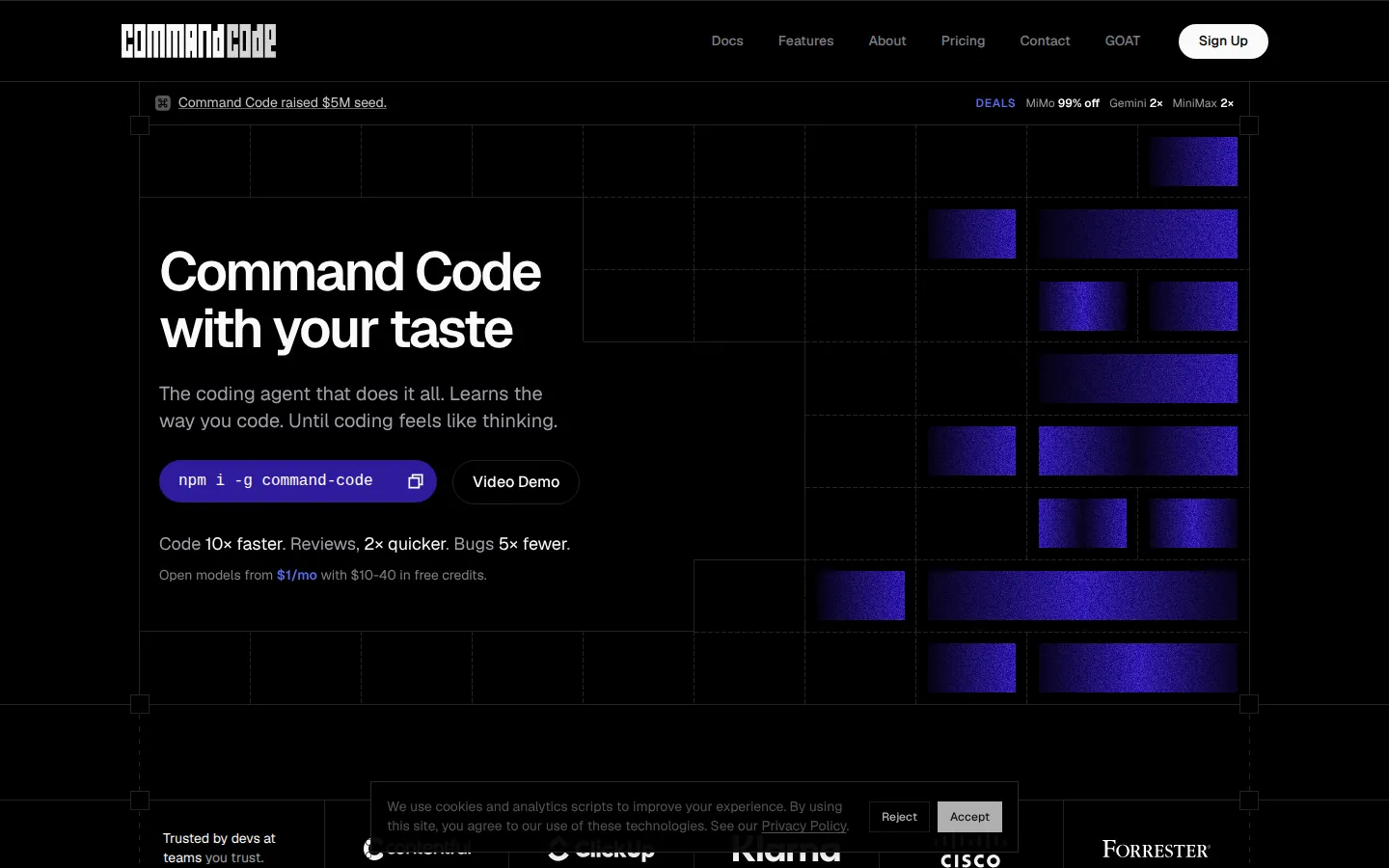
Command Code is a frontier AI coding agent that lives in the terminal and continuously learns your coding taste through its taste-1 model. It ships, fixes, tests, and refactors code, turning every edit into reusable project skills and personal memory. It supports interactive and headless modes, a background sandbox, custom agents, MCP servers, and plugins, with 50+ models. Pricing includes a free tier plus Go, GOAT, Max, and API plans.
What is Command Code?
Command Code is a frontier AI coding agent that runs in the terminal and is built around a model called taste-1, which continuously learns the user's coding taste. Every accept, reject, and edit the user makes is treated as a signal, and those signals are distilled into project-level skills and personal memory, so the next session opens with the conventions the developer already prefers, with no rules to write and no prompts to maintain. The agent ships, fixes, tests, and refactors code, and it supports a range of modes: an interactive CLI, a headless mode with flags for scripted or autonomous operation, and a background sandbox for long-running work. It includes built-in pro tools such as file operations, shell access, grep, and extended thinking, plus custom agents and persistent memory that carry across sessions. It is hackable out of the box with reusable skills, commands, MCP servers, and plugins, and collaboration features let users share sessions and push or pull taste across a team. The product supports more than 50 models from vendors including Anthropic, OpenAI, Google, xAI, DeepSeek, Qwen, Kimi, GLM, MiniMax, and Tencent, and its pricing page promotes deals such as MiMo V2.5 Pro at 99 percent off, Gemini 3.7 Flash at 2x, and MiniMax M3 at 2x. Pricing includes a free tier for solo developers, the Go plan at $1 per month with $10 in included credits and roughly 15,000 requests, the GOAT plan at $10 per month with $70 in credits and about 75,000 requests, the Max plan at $100 per month with $150 in credits and about 219,000 requests, and the Provider API plan at $15 per month with zero markup on model access. The company raised a $5 million seed round and is led by people with strong developer credibility, with testimonials from founders like Zeno Rocha of Resend and Tom Preston-Werner of GitHub. Command Code is based at 2261 Market St, San Francisco, and it promises that user code is never used for training, with everything staying on the user's machine.
Command Code Core Features
taste-1 continuous learning
Every accept, reject, and edit becomes a signal that distills into project skills and personal memory.
Multiple modes
Interactive CLI, headless flag-driven mode, and a background sandbox for automation.
Built-in pro tools
File ops, shell, grep, and extended thinking bundled in the agent.
Custom agents and memory
Persistent /agents and /memory carried across every session.
Hackable by design
Reusable /skills, /commands, MCP servers, and plugins.
Team taste sharing
Share sessions and push or pull skills with npx taste push and pull.
50+ models
Anthropic, OpenAI, Google, xAI, DeepSeek, Qwen, Kimi, GLM, MiniMax, and more.
Data privacy
Code, skills, and memory stay on the machine and are never used for training.
Who is Command Code for?
Command Code is built for software developers and engineering teams who want an AI coding agent that adapts to their conventions instead of producing generic output. Individual developers and freelancers use the free tier and the $1 Go plan to accelerate personal projects, relying on taste-1 to learn their preferences for frameworks, package managers, and test runners. Professional engineers at companies like the ones listed as customers, including Microsoft, Databricks, Atlassian, Klarna, and Zapier, use the CLI in interactive mode or headless mode for CI-style automation. Technical leads and staff engineers value the background sandbox, extended thinking, and persistent memory for large refactoring sessions, and they push project skills to teammates with npx taste push and pull. Startups use the GOAT plan as a low-cost way to give every engineer frontier-model access, with $70 in included credits across models like GPT-5.6 Sol and GLM-5.2. API builders and teams that want to use their own OpenAI or Anthropic clients with zero markup choose the Provider plan at $15 per month. Developers who prefer open models benefit from the claim that Command Code's harness closes the tool-calling gap, letting open models perform like premium ones. Teams that review code frequently use its review features, which the company claims halve review time, and organizations that care about data privacy appreciate that code, skills, and memory stay on the machine and are never used for training. The product suits everyone from solo coders on a budget to companies standardizing AI coding workflows across many engineers.
Command Code Use Cases
Build a CLI tool from scratch while the agent learns that you prefer TypeScript, tsup, and vitest.
Run headless coding agents in CI to automate tests, reviews, and refactors across repos.
Refactor a large codebase in a background sandbox while you continue other work.
Give a team consistent coding conventions by pushing project skills with npx taste push.
Use open models like DeepSeek Flash through a harness built for reliable tool calling.
Attach MCP servers to connect the agent with your internal APIs and databases.
Review pull requests with AI that already knows your codebase's conventions.
Prototype full applications on the $10 GOAT plan with $70 in included model credits.
Command Code Pros and Cons
Pros
- The taste-learning approach genuinely reduces repeated corrections once the agent learns your patterns.
- Very low entry cost: a free tier and a $1/month Go plan with included credits.
- Broad model support with deals like 99 percent off MiMo and 2x Gemini and MiniMax credits.
- Strong data privacy: code and memory stay local and are never used for training.
- Highly hackable with skills, commands, MCP servers, and team taste sharing.
Cons
- It is a terminal-first tool, so developers who prefer GUI editors may find the learning curve steeper.
- Processing fees apply on top of plan prices, so the final bill varies with usage.
- The taste-1 learning model needs time and editing history before it fully adapts to your style.
FAQ About Command Code
Command Code Pricing
Freemium; free tier for solo devs, Go $1/mo, GOAT $10/mo, Max $100/mo, Provider API plan $15/mo, plus processing fees.
Check official pricingFree
Free tier for solo developers
Go
$10 in included credits, open models, ~15K requests
GOAT
$70 in included credits, ~75K requests, best low-cost plan
Max
$150 in included credits, ~219K requests, priority support
Provider
API plan for OpenAI or Anthropic clients with zero markup
Command Code Alternatives
Kitool.AI
Kitool.AI is an AI coding workspace that puts Claude Code and Codex behind one account and one API key. It offers transparent usage-based billing, a model plaza with per-million-token prices, and routing that can cost less than paying each vendor directly. Configure it once in VS Code, JetBrains, or the terminal on macOS, Windows, or Linux.

claude-mem
claude-mem keeps structured project memory outside the chat. An open-source engine captures decisions, discoveries, and fixes locally, while CMEM Pro adds hosted observation, cloud sync, and a private MCP link. Recall synced notes from Claude Code, Cursor, Codex, Gemini CLI, Windsurf, or ChatGPT, or keep everything local-first on your own machine.
GetLayers
GetLayers is Textura's library of design foundations for AI coding workflows. Browse templates, motion sections, 3D scenes, backgrounds, and gradients, then copy structured prompts into your preferred assistant. Paid plans include commercial licensing, while Full Stack adds source files and private Discord support. Full Stack Lifetime also connects the library directly to compatible assistants through MCP.