
Cognee
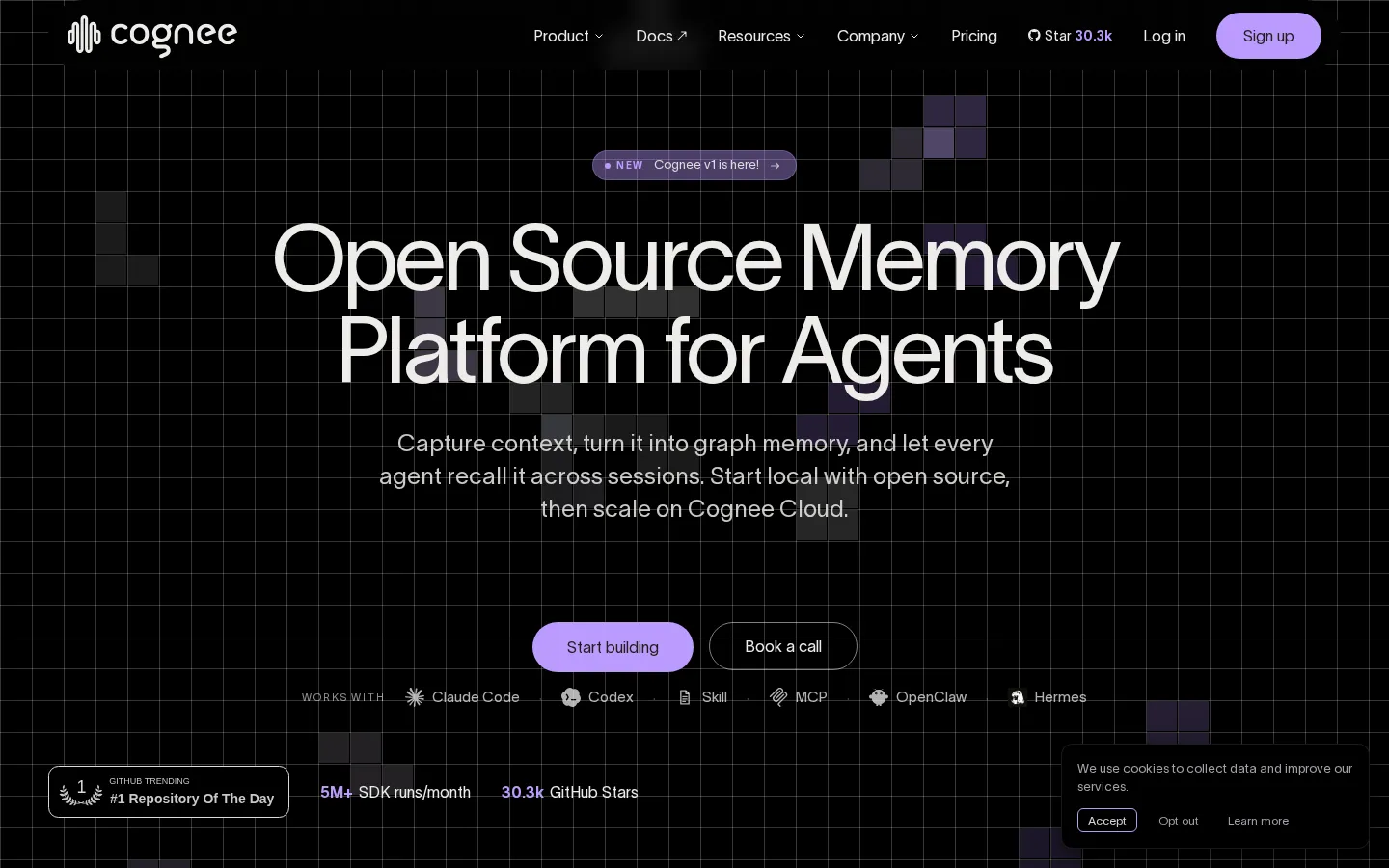
Cognee is an open-source memory platform for AI agents with 30,000 GitHub stars. It captures context, converts it into graph memory, and lets agents recall it across sessions, starting locally and scaling on Cognee Cloud. It works with Claude Code, Codex, MCP, and OpenClaw, with a free tier at $0 per month plus usage-based pricing. Cognee suits developers and teams building persistent memory into agentic applications.
What is Cognee?
Cognee is an open-source memory platform designed to give AI agents persistent, structured memory across sessions. The core workflow captures context from conversations, documents, and interactions, turns that context into graph memory that encodes entities and their relationships, and lets every agent recall relevant information later. This addresses a fundamental limitation of stateless agents: without memory, each session starts from zero. Cognee provides an SDK that developers integrate into their applications, plus a cloud platform for teams that want managed infrastructure. The project has strong open-source traction with over 30,000 GitHub stars, and the cloud offering is the commercial layer on top of the free open-source core. The platform integrates with popular agent ecosystems including Claude Code, Codex, MCP, OpenClaw, and the OpenAI Agents SDK, so developers can add memory to their existing stacks rather than rebuilding. Pricing follows a freemium model: the free tier starts at zero dollars per month, usage beyond the free allowance is billed at 2.50 dollars per million tokens, and additional workspaces cost five dollars each per month with unlimited workspaces available. Teams can start local with the open-source version and scale to Cognee Cloud when they need managed infrastructure, collaboration, and higher reliability. The company positions Cognee as the memory layer for the agent era, competing with approaches that store raw chat logs or embeddings only, by structuring memory as a graph that supports rich recall and reasoning. For developers building agentic applications, customer support copilots, research assistants, or personal AI systems, Cognee provides the persistence layer that makes agents feel continuous and context-aware across long-running interactions. The platform is designed around three layers: capture, storage, and recall. Capture ingests conversations and documents from the connected tools, storage converts the ingested context into a knowledge graph, and recall exposes that graph to agents through query APIs. Developers can choose how much of the pipeline runs locally versus in the cloud, which makes Cognee flexible for privacy-sensitive deployments where data should not leave the organization. The graph structure also supports incremental updates, so memory grows and corrects itself as new context arrives rather than requiring full re-indexing.
Cognee Core Features
Graph memory engine
Converts captured context into graph memory that encodes entities and relationships for rich recall.
Open-source core
Free to start locally with over 30,000 GitHub stars and full documentation.
Cognee Cloud
Managed infrastructure for teams that want to scale without operating memory services themselves.
Agent integrations
Works with Claude Code, Codex, MCP, OpenClaw, and the OpenAI Agents SDK.
Cross-session recall
Agents retrieve relevant context from previous sessions automatically.
Workspace model
Unlimited workspaces at $5 each per month for team separation.
Usage-based pricing
$2.50 per million tokens beyond the free allowance keeps costs proportional.
SDK-first design
Developers integrate memory directly into their applications and agent stacks.
Who is Cognee for?
Developers building agentic applications use Cognee to add persistent memory so agents remember users and context across sessions. AI engineers working with Claude Code, Codex, or MCP integrations use the SDK to give coding agents memory of project decisions and history. Startup teams building AI copilots and support assistants use the cloud tier to avoid managing memory infrastructure themselves. Researchers prototyping personal AI systems use the open-source version to experiment with graph-based memory. Product teams at enterprises exploring agent platforms use Cognee Cloud for managed scale, collaboration, and reliability guarantees. Teams building retrieval-augmented generation pipelines can use the graph memory as a structured alternative to plain vector stores. Indie developers and hobbyists integrate Cognee with OpenClaw and other personal agent frameworks for always-on assistants. Finally, technical founders evaluating the agent memory category use the large open-source community and documentation as evidence of the platform's maturity. Teams building multi-agent systems use Cognee as the shared memory layer so agents do not duplicate or contradict each other. Platform engineers evaluating memory infrastructure compare Cognee against vector stores and fine-tuning for their recall use cases. Customer success teams piloting AI copilots use the cloud tier to test memory features without infrastructure investment. Security-conscious organizations use the self-hosted open-source version to keep data in-house while still benefiting from structured memory. Open-source contributors and community members extend the platform through the active GitHub repository, shaping features that later appear in the cloud offering.
Cognee Use Cases
Give a coding agent persistent memory of project architecture decisions across sessions.
Build a customer support copilot that remembers each user's history and preferences.
Create a research assistant that recalls findings from documents processed weeks earlier.
Add memory to an OpenClaw personal agent so it behaves consistently over time.
Power an agentic workflow with MCP integration so multiple tools share the same memory.
Run retrieval-augmented generation with structured graph memory instead of flat embeddings.
Prototype a personal AI system locally with the open-source version before moving to cloud.
Scale a team's agent platform with separate workspaces per product line or client.
Cognee Pros and Cons
Pros
- Graph-based memory is more structured than raw chat logs or embeddings, supporting richer recall.
- A large open-source community with 30,000 stars provides credibility and ecosystem momentum.
- Integrations with Claude Code, Codex, and MCP make adoption straightforward for existing stacks.
- Freemium pricing with a $0 tier lets teams evaluate before spending.
Cons
- Usage-based token pricing means costs scale with the volume of context processed.
- Graph memory adds engineering complexity compared with simpler vector stores.
- The platform is developer-oriented, so non-technical teams need engineering support to adopt it.
FAQ About Cognee
Cognee Pricing
Freemium: Free $0/month, usage $2.50/1M tokens, additional workspaces $5 each/month (unlimited); open-source core free to self-host.
Check official pricingFree
Cloud free tier with limited usage; start building agents with memory.
Usage
Pay-as-you-go for context processing beyond the free allowance.
Workspaces
Unlimited additional workspaces for team and project separation.
Open Source
Full open-source core on GitHub with 30k+ stars, run locally.
Cognee Alternatives

FastRouter
FastRouter is a unified LLM gateway that gives developers one OpenAI-compatible API for 200+ models from providers such as OpenAI, Anthropic, Google, and xAI. It adds automatic model routing, fallbacks, caching, spend caps, role-based access, guardrails, and per-request observability, while passing provider token prices through with no markup on any plan, including the free tier.

Cindy
Cindy is an open-source desktop AI agent from XD Inc. that unifies Claude Code, Codex and Pi harnesses with 20+ tools, persistent memory and reusable skills. Use it free with your own API key or existing Coding Plan, or pay for the optional managed model service that works the moment you sign in. No setup project required.

MyToolster
MyToolster packs 41 free utilities into one browser-based site, sorted into Audio & Video, Text, Data, Web, Color, QR Code and Image. Beyond the usual encoders, formatters and generators it runs OpenAI Whisper transcription, AI text and image detection, background removal and subtitle export locally, with no uploads, account or installation, and every tool page does its work client-side.