
Capacities
Capacities is a note-taking and knowledge management app that organizes ideas as connected objects instead of files and folders. People, books, projects, and ideas become structured objects with properties and backlinks. Daily notes, custom object types, and full-text search help you capture and connect knowledge across devices, while Pro adds an AI assistant, smart queries, and calendar integration. The core product is free forever on Mac, Windows, Linux, iOS, Android, and web.
What is Capacities?
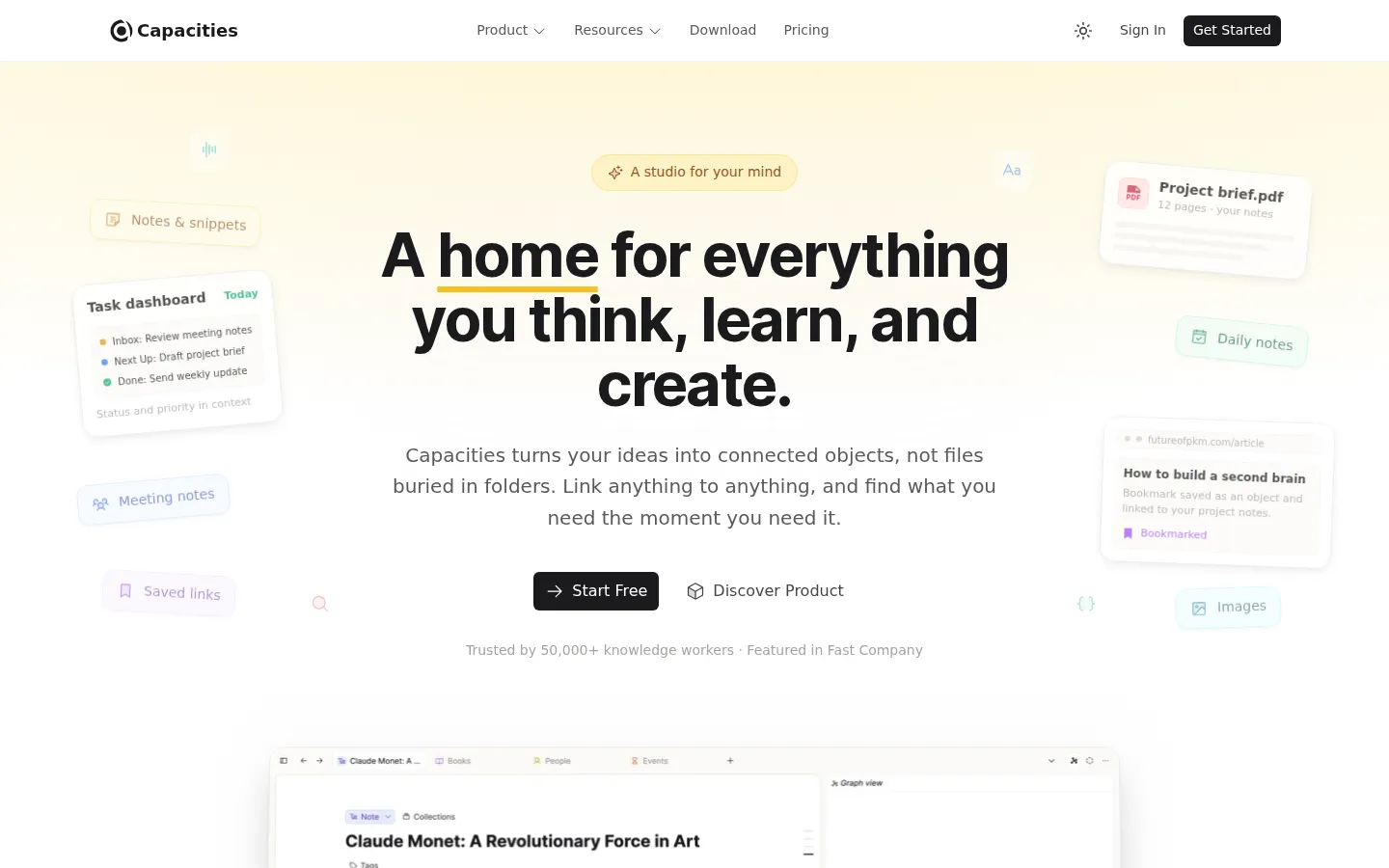
Capacities is an object-based note-taking and knowledge management app that calls itself "a studio for your mind" and "a home for everything you think, learn, and create." Instead of organizing notes in files and folders, everything you care about becomes an object: a person, a book you are reading, a project you are working on, an idea you want to explore. Objects have structure and properties, and they connect to each other, creating a living network of thoughts. Your daily note acts as an inbox, so you can capture freely without deciding where things belong. Backlinks show every connection at a glance, and Related Content scans your notes to surface places where you wrote about something without ever linking it, alongside unlinked mentions. Custom object types, page layouts, templating, block linking, tagging, and full-text search are all included. The free Basic plan offers unlimited spaces, objects, and blocks, unlimited custom object types, synchronization across devices, import and export, saving content from WhatsApp, Telegram, Twitter, or email, view-only sharing, full-text search, and offline support, with media uploads up to 5 GB total and 100 MB per month afterwards. The Pro plan adds an AI assistant that can chat with any note, auto-fill object properties such as author, genre, publication year, and summary, run smart commands like summarizing, translating, critiquing, or continuing thoughts, and suggest contextual tags, collections, and properties. Pro also adds smart queries for dynamic, filterable views that can be embedded anywhere, calendar integration that turns events into objects with meeting context and timeline views, built-in task management with Inbox, Today, Scheduled, Open, and Completed views plus Kanban boards, task actions for tools like Todoist and Things, formulas in tables, smart search, unlimited media uploads, a curated icon set, API access, and extensions such as Raycast and Webhighlights. Reading integrations sync highlights from Readwise, Reader, and Kindle, turning quotes and ideas into objects. The company is an independent team in Germany funded by users rather than VCs, with GDPR-compliant EU hosting, encrypted servers, and guaranteed export to Markdown, Word, HTML, LaTeX, and CSV. It is trusted by 50,000+ knowledge workers and has an active Discord community of 10,000+ members.
Capacities Core Features
Object-based notes
people, books, projects, and ideas become structured, connected objects with properties.
Bi-directional links, contextual backlinks, and Related Content that surfaces connections you never made consciously.
Daily notes act as a capture inbox across desktop, mobile, and web with offline support.
AI assistant chats with any note, auto-fills properties, and suggests tags, collections, and properties (Pro).
Smart queries build dynamic, filterable views that stay current and can be embedded anywhere (Pro).
Calendar integration turns events into objects with meeting context and timeline views (Pro).
Built-in task management with Inbox, Today, Kanban, and task actions tied to notes (Pro).
Reading integrations import Readwise, Reader, and Kindle highlights as connected objects (Pro).
Who is Capacities for?
Capacities is built for individuals who think for a living, and the site says so explicitly: "For you. Not your team." The target audience spans writers, researchers, developers, students, managers, and founders, plus anyone building a personal knowledge base. Writers use it to plan stories, develop characters, and keep a bank of research and inspiration; one writer describes it as a "massive Wikipedia database" of their world and story. Researchers get a home for research and writing where saved links and bookmarks become objects tied to project notes. Students turn lectures, readings, and course material into a connected knowledge base that grows with them. Developers and PKM enthusiasts migrating from Roam, Obsidian, Notion, or Craft find a structure that works without constant maintenance, and the site highlights users with ADHD who were overwhelmed by folder hierarchies. The core workflow suits anyone who captures daily notes, meeting notes, highlights, and ideas: you start each day in the daily note, turn recurring things into custom objects, and let backlinks and Related Content surface connections automatically. The app is deliberately individual-first, so it is not aimed at teams: there are no team plans, collaboration features, or organizational accounts. Scenarios covered on the site include research and writing, task management with tasks tied to project notes, and Getting Things Done (GTD) workflows. It also suits readers who want to process Kindle and Readwise highlights into usable knowledge, and knowledge workers who want their calendar, tasks, and notes in one context-aware view.
Capacities Use Cases
Writers plan stories, flesh out characters, and keep research and inspiration in one place.
Researchers build a connected library of papers, notes, bookmarks, and daily insights.
Students turn lectures, readings, and projects into an evolving personal knowledge base.
Knowledge workers link meeting notes, action items, and projects to the people involved.
Getting Things Done practitioners keep tasks and actions attached to their project notes.
Readers process Kindle and Readwise highlights into quotes, concepts, and usable objects.
Founders and managers see tasks and calendar events alongside relevant notes in one view.
Developers capture code research, bookmarks, and ideas as linked objects for daily reference.
Capacities Pros and Cons
Pros
- Object-based model with automatic Related Content surfaces connections across notes without manual linking.
- Free plan is unlimited and promised to stay free, with full export to Markdown, Word, HTML, and CSV anytime.
- Context-aware AI assistant works on your own notes rather than as a generic chatbot.
- Offline support, GDPR-compliant EU hosting, and encrypted servers protect your knowledge.
- Independent team funded by users, with an active 10,000+ member community and feedback board.
Cons
- AI assistant, smart queries, calendar, and task features are locked behind the paid Pro plan.
- Designed for individuals only, with no team plans, collaboration features, or organizational accounts.
- Minimal customization by design, with a small extension ecosystem (Raycast, Webhighlights) compared to plugin-heavy rivals.
FAQ About Capacities
Capacities Pricing
Freemium: Basic is free forever, Pro is $9.99/month (or $120/year) with AI assistant, smart queries, and API access.
Check official pricingBasic
Unlimited spaces, objects, and blocks; sync across devices; full-text search; offline support; 5 GB media uploads.
Pro
Everything in Basic plus AI assistant, smart queries, calendar integrations, task management, formulas, API access, and unlimited media uploads.
Capacities Alternatives
OpenRead
OpenRead is an AI-powered research platform offering paper search, deep research, notes taking, and an AI agent called Oat. Users can search academic papers and the web, generate paper summaries, compare multiple papers, ask questions about content, and build structured notes. Free and Basic plans cover casual researchers, while Premium unlocks unlimited usage, top-tier models, and advanced Oat capabilities including image upload, search, and drawing.

Coconote
Coconote is an AI-powered note-taking app for students and professionals who want to stop taking notes by hand. It records or accepts uploaded lectures, meetings, videos, PDFs, and links, then instantly produces structured notes, transcripts, quizzes, flashcards, study games, and AI-narrated podcasts. Available across iPhone, iPad, Mac, Android, and web with support for 100+ languages, Coconote positions itself as an honor-code-friendly study companion that helps users learn faster without doing the work for them.

Chiefly
Chiefly is an AI-powered Chief of Mind that helps you organize your work and personal life using the PARAISO framework.