
BreezeBlue
BreezeBlue is a voice AI platform from Resonia, Inc. Its Breeze TTS 2 model ranks first among open-weight text-to-speech models on the Artificial Analysis Provider Voice Arena. The Studio generates directed speech from scripts, a voice library covers narration, characters and promo reads, and voices can be cloned or designed from prompts. A developer API shares the same account, credits and saved voices, with first audio in under 25 milliseconds.
What is BreezeBlue?
BreezeBlue is an AI voice and speech generation platform operated by RESONIA, INC. It is built around Breeze TTS 2, the company's text-to-speech model, which the site reports as first among open-weight models and ahead of several proprietary models on Artificial Analysis' Provider Voice Arena, with an Elo score of 1215 recorded on 8 September 2026. The product is sold as three connected surfaces: BreezeCreator, a browser Studio for producing speech and long-form audio; the Breeze API for developers, with Python, TypeScript and cURL examples plus an API reference and a CLI reference; and a voice library of ready-made voices grouped by purpose, including conversational, narration, characters, social, education, ads and entertainment.
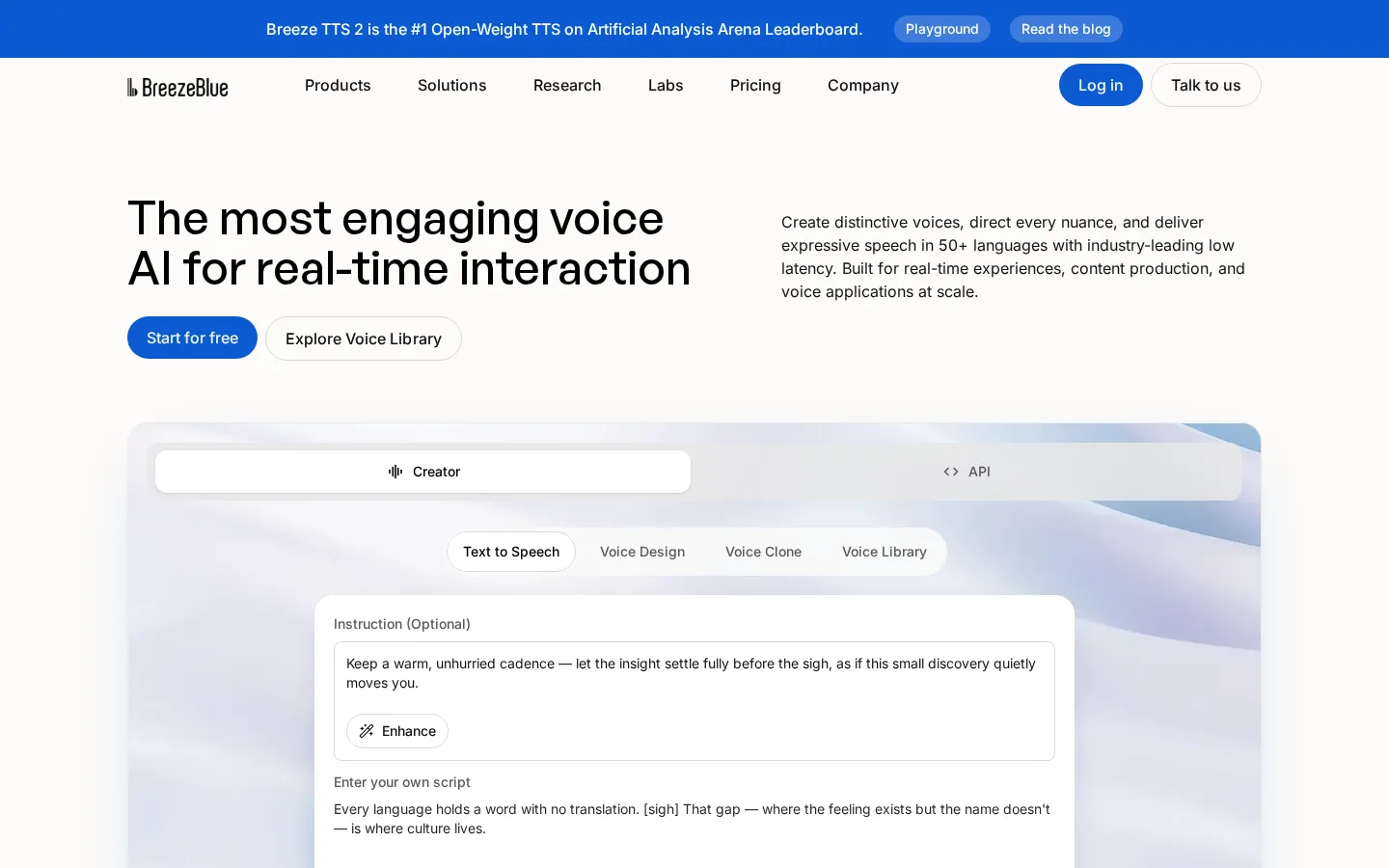
The Studio supports four main modes. Text to Speech converts a script into audio and accepts an optional instruction that describes how a line should be delivered, such as a warm and unhurried narration. Voice Design creates a new voice from a text prompt describing gender, age, tone and language without recording any audio. Voice Clone builds a voice from a reference recording. The Voice Library supplies pre-built voices with distinct personalities, and the Studio also handles longer projects such as podcasts and audiobooks, with project allowances that vary by plan.
The company publishes separate benchmark pages for voice design, voice direction and latency, and states that the model returns its first audio byte in under 25 milliseconds, which matters for real-time and conversational applications. Accent control and multilingual output are supported across more than 50 languages, and the documentation includes a dedicated page on multilingual behaviour. Voice direction, the ability to describe a performance and have the model follow it, is presented as one of the model's strengths alongside voice diversity.
The Breeze API uses the same account, subscription, credit balance and saved voices as the Studio, so work started in the browser can continue through the API. API keys, usage and request logs are managed in a developer console. The platform is credit-based: plans include a monthly credit allowance, top-ups are sold at a stated number of credits per dollar, and characters are the underlying unit, with per-million-character rates that fall on higher tiers. The free tier includes daily credits, five voice slots, Studio access, commercial use and a standard queue.
BreezeBlue also runs Labs projects and publishes research posts, including one on BreezeRT for ultra-low-latency serving. The site is available in eight languages, every plan carries commercial use rights, and the pricing page notes that any user can claim free credits every day.
BreezeBlue Core Features
Breeze TTS 2 voice model
the text-to-speech engine behind the platform, reported as first among open-weight models on the Artificial Analysis Provider Voice Arena with an Elo score of 1215 as of 8 September 2026
Voice direction
an optional instruction field lets you describe how a line should be delivered, such as a reflective or urgent tone, and the model follows it while keeping the speaker identity stable
Voice design
create a new voice from a text prompt that describes character, age, tone and language, without recording reference audio
Voice cloning
build a voice from a reference audio sample and reuse it across projects and languages
Voice library
ready-made voices organised by purpose, including conversational, narration, characters, social, education, ads and entertainment
Multilingual output
speech in more than 50 languages with accent control, produced by the same model and workflow
Low-latency streaming
the platform reports a first audio byte in under 25 milliseconds, which is aimed at real-time interaction rather than offline rendering
Developer API and console
documented Python, TypeScript and cURL usage, an API reference, a CLI reference, and a console for API keys, usage and request logs
Who is BreezeBlue for?
BreezeBlue is aimed at teams and individuals who need finished speech rather than a text chat model. The clearest fit is product builders adding voice to an application: the Breeze API exposes voice cloning, voice design and performance direction as separate operations, ships Python, TypeScript and cURL examples, and shares one account, credit balance and voice library with the Studio, so a prototype can move toward production without changing vendors. Streaming first audio in under 25 milliseconds and support for more than 50 languages make the API suitable for real-time agents, voice assistants and conversational interfaces that cannot tolerate long pauses before playback starts. Content teams form the second group. Podcast producers, audiobook publishers and video editors use the Studio to generate long-form narration, hold one voice identity across episodes, and steer individual lines by describing the delivery they want. The voice library is organised by purpose, with conversational, narration, character, social, education, ads and entertainment voices, which helps creators match a voice to a scene instead of auditioning candidates one at a time. Game and interactive studios are a third audience. Voice design creates a character voice from a text prompt that describes character, age, tone and language, and voice direction keeps a performance consistent across a long script, both of which suit dialogue-heavy projects where recording every variant is impractical. Smaller users are covered by the free tier: 400 credits a day, five voice slots, Studio access and commercial use rights, which is enough for occasional voiceover work, social clips or evaluation. Marketers producing ad reads, e-learning teams localising courses, and accessibility teams adding spoken versions of documents also fit, because multilingual output and accent control come from the same model rather than a separate product. The lower per-character rates on higher tiers, where the cost per million characters falls from $40 to $28, suit teams with steady, high-volume generation rather than one-off projects.
BreezeBlue Use Cases
Generate voiceovers for product videos, ads and social clips without booking a recording session
Produce long-form narration for podcasts and audiobooks in one consistent voice
Build real-time voice agents and assistants that need streamed audio with low latency
Create distinct character voices for games, animation and interactive stories from text prompts
Clone a spokesperson's voice and reuse it for updates and localised versions
Localise one script into more than 50 languages while keeping a single voice identity
Prototype voice features through the API before committing an application to production
Add spoken versions of documents, courses or articles for accessibility and e-learning
BreezeBlue Pros and Cons
Pros
- Free tier with daily credits, five voice slots and commercial use rights, so evaluation does not require a card
- One account, credit balance and saved-voice set covers both the Studio and the API, so work is not duplicated across products
- Published benchmark and latency pages, with comparisons against named competing models rather than only marketing claims
- Documented multilingual support with accent control, which matters for localisation work
- Published per-million-character rates that fall from $40 on the free tier to $28 on Pro, making volume costs predictable
Cons
- Plans are expressed mainly in credits, so comparing real cost per finished audio minute requires converting the monthly allowance yourself
- Yearly billing is described as two months free with no separate annual feature set, so the saving depends on how much of the monthly credit allowance you actually use
- Concurrency limits differ by plan and there is no published free tier for team features, so higher volume and custom limits require contacting the company
FAQ About BreezeBlue
BreezeBlue Pricing
Freemium with a daily-credit free tier. Free costs $0 and includes 400 free credits daily, five voice slots, Studio access for long-form content, top-ups at 2,500 credits per dollar, a standard queue and commercial use. Monthly plans are Starter at $9 (first month $4.50 for new subscribers, 25k credits, roughly 375 minutes), Creator at $19 (first month $9.50, 59.4k credits, roughly 900 minutes) and Pro at $99 (first month $49.50, 353.6k credits, roughly 5,300 minutes). Yearly billing gives two months free. Per-million-character rates fall from $40 on Free to $36 on Starter, $32 on Creator and $28 on Pro. Teams needing higher volume or custom limits are directed to contact the company.
Check official pricingFree
400 free credits daily, 5 voice slots, Studio access for long-form content, top-ups at 2,500 credits per dollar, standard queue, commercial use. Listed rate $40 per 1M characters.
Starter
25k credits per month (about 375 minutes), 20 voice slots, up to 200 Studio projects, top-ups at 2,700 credits per dollar, low concurrency limit, priority queue, commercial use. $36 per 1M characters. First month $4.50 for new subscribers.
Creator
59.4k credits per month (about 900 minutes), 50 voice slots, up to 500 Studio projects, top-ups at 3,100 credits per dollar, medium concurrency limit, priority queue, commercial use. $32 per 1M characters. First month $9.50 for new subscribers.
Pro
353.6k credits per month (about 5,300 minutes), 300 voice slots, up to 5,000 Studio projects, top-ups at 3,500 credits per dollar, high concurrency limit, high-priority queue, commercial use. $28 per 1M characters. First month $49.50 for new subscribers.
Custom / Team
For teams that need higher volume or custom limits; the pricing page directs these users to talk to the team to build a custom plan.
BreezeBlue Alternatives

Voice.ai
Voice.ai is an AI voice platform that combines a real-time voice changer, natural text to speech, instant voice cloning, and human-sounding voice agents in one toolkit. It offers a large library of voices and accents, browser and desktop apps, plus developer APIs and SDKs. Free credits let anyone start generating audio or automating calls before upgrading.

LOVO AI
AI voice generator and text-to-speech tool for creating voiceovers, cloning voices, and editing audio with video.

TTSOpen
TTSOpen is a free AI text-to-speech generator that converts written text into natural-sounding speech directly in your browser. It offers 13 AI voices and a free character allowance with no login required, plus downloadable MP3 output. Pay-as-you-go character packs start at $6 for 200,000 characters, with commercial use rights, up to 20,000 characters per conversion and no subscription.