
Billow
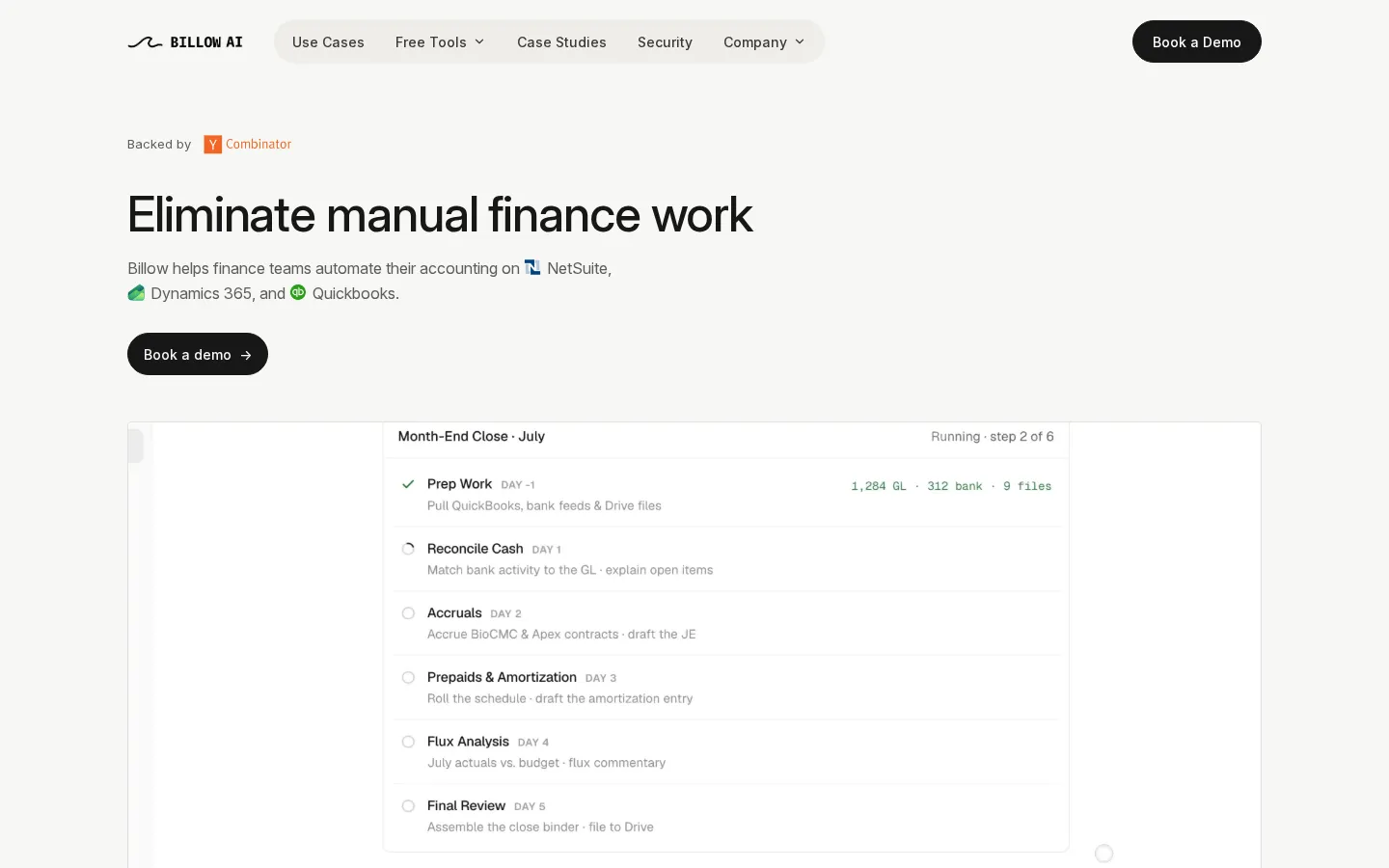
Billow automates the manual work behind month-end close. It connects to NetSuite, QuickBooks, Dynamics 365 and adjacent tools, pulls the balances it needs, matches transactions, and assembles workpapers in Excel. Anything that does not reconcile is flagged as an exception and routed to a person. Your finance team reviews and approves; Billow handles the assembly.
What is Billow?
Billow is an AI finance platform that automates the manual assembly work behind the month-end close. The company, Billow Labs, Inc., is backed by Y Combinator and was founded by an accountant and a platform engineer, which shows in where the product puts its attention: not on dashboards, but on the reconciliations, accruals and workpapers that consume the first weeks of every month. Billow describes its job simply as eliminating manual finance work, with the finance team reviewing and approving what the system prepares.
The product works inside the systems a finance team already runs rather than pulling everything into a separate workspace. Billow connects to NetSuite, QuickBooks, Dynamics 365, Xero, Excel, Coupa, Bill.com, Ramp and Slack, reads balances and transactions where they live, and writes results back. A close workflow is built from those pieces: a month-end trigger pulls the trial balance, an agent matches transactions, and the output goes to a reviewer. The company says it learns an existing process from prior closes, so teams do not have to redesign their close to adopt it.
Coverage centers on the recurring close: bank and credit card reconciliations, balance sheet accounts, accruals, prepaids and fixed assets, payroll and expense entries, multi-entity consolidation, and reporting with close workpapers. Billow also packages narrower workflows, including turning signed contracts into an updated contract log and accrual schedules, tracing budget-to-actual variances and drafting commentary, and converting open purchase orders into accrual schedules with prepared journal entries. Each produces a draft that a person signs off on.
The design assumption is that automation should surface exceptions rather than hide them. In a reconciliation run, Billow matches the bulk of transactions and places the remainder in a queue with context such as an ACH without an exact ledger match, a check outstanding since the prior month, or a wire that matches two bills instead of one. Workpapers are prepared in Excel and sent for approval, with approval trails kept so a reviewer can see what changed and who accepted it.
Security is pitched at the reviews finance and compliance teams actually run. Billow states that it holds SOC 2 Type II and SOC 1 reports, aligns with SOX segregation-of-duties expectations, encrypts data in transit with TLS 1.3 and at rest with AES-256, and does not train models on customer ledger data. A HIPAA-configurable deployment under a BAA is offered when protected health information is in scope. Buyers should verify current reports and scope directly during a security review.
Billow is sold through a demo rather than a self-serve signup, and no price list is published. Teams typically start by mapping one workflow, often bank reconciliations, then extend to accruals, consolidation and reporting once the review loop is trusted. It fits organizations already running a mainstream ERP, particularly multi-entity and life-sciences finance teams, more than very small businesses closing a single set of books.
Billow Core Features
System-native operation
Billow reads from and writes to NetSuite, QuickBooks, Dynamics 365, Xero, Excel, Coupa, Bill.com, Ramp and Slack, so work stays in the tools the team already opens instead of moving through exported files.
Bank and card reconciliations
Matches transactions against the ledger, codes card activity, and isolates items without an exact match so a reviewer sees only what needs attention.
Close workpaper assembly
Builds the month-end folder, Excel workpapers and supporting documents, then routes the package for approval.
Accruals, prepaids and fixed assets
Prepares schedules and journal entries from open purchase orders and contract terms for reviewer sign-off.
Multi-entity consolidation
Rolls subsidiary results into a consolidated view with the mappings and eliminations a recurring close requires.
Exception routing
Sends unmatched or ambiguous items, such as a wire that matches two bills, to a queue with the context a reviewer needs rather than forcing a match.
Process learning
Learns a team's existing close steps from prior periods and builds the workflow around them instead of imposing a new template.
Approval trail and controls
Records who prepared, changed and approved each workpaper, supporting the segregation-of-duties evidence auditors ask for.
Who is Billow for?
Billow is aimed at finance teams that close the books every month in a mainstream accounting system and still spend the first week or two assembling reconciliations, accruals and workpapers by hand. It fits organizations with enough transaction volume that manual matching has become a bottleneck, and with a close process defined well enough to be taught to an agent. In practice that means companies with a dedicated accounting function, several bank and card accounts, and a controller who already reviews workpapers before the books are locked. Roles it typically serves: - Controllers who own the close calendar and would rather review drafts than build workpapers from scratch. - Accounting managers who supervise reconciliation and accrual work across a team and need a clear exception queue. - CFOs and VPs of finance at mid-market companies who want the close compressed without adding headcount. - Staff and senior accountants who spend close week matching transactions, coding card activity and chasing support. - Multi-entity finance teams that consolidate subsidiary results and repeat the same steps for each entity. - Finance teams in life sciences and other regulated industries, where audit trails, segregation of duties and review evidence matter as much as speed. Size matters less than process discipline. A ten-person accounting team with clean ledgers and a documented close will get more from the platform than a larger team whose books are rebuilt every month. It is a weaker fit for solo bookkeepers with a handful of accounts, for teams whose reconciliations are already largely automated, and for companies running heavily customized or niche systems outside the supported integration list. Those teams would likely spend more time on setup and exception handling than they save.
Billow Use Cases
Reconcile bank and credit card accounts across several entities during month-end close.
Prepare accrual schedules and journal entries from open purchase orders.
Turn signed vendor contracts into an updated contract log and accrual workbook.
Trace budget-to-actual variances to their source and draft commentary for controller review.
Consolidate subsidiary results into one close package with supporting workpapers.
Assemble the month-end folder and Excel workpapers for approval before a board meeting.
Clear a backlog of unreconciled transactions ahead of an audit or financing round.
Standardize a close process across a newly acquired entity or after an ERP migration.
Billow Pros and Cons
Pros
- Operates inside existing systems such as NetSuite, QuickBooks, Dynamics 365 and Excel rather than requiring a migration or manual file exports.
- Exception-first design keeps a person in the approval loop and leaves a trail showing what was prepared, changed and accepted.
- Covers the close end to end, from reconciliation through accruals, consolidation and reporting workpapers.
- Founding team combines accounting and platform engineering backgrounds, with advisors drawn from biotech and finance leadership.
Cons
- No public pricing and no self-serve trial, so evaluation requires a sales conversation and a demo.
- Integration coverage is concentrated on mainstream ERPs, and teams on niche or heavily customized systems should confirm fit first.
- Outputs still depend on clean source data and a defined close process; inconsistent books mean setup work before any time is saved.
FAQ About Billow
Billow Pricing
Billow does not publish prices. Its /pricing URL returns a not-found page, and the site routes commercial conversations through a demo request, so cost is quoted after the team maps a workflow to your systems. Scope, entity count and the number of close workflows handled are the likely drivers of a quote. A free AI Transaction Categorizer is available separately as a standalone tool. Confirm current terms, implementation fees and any minimum commitment directly with sales.
Check official pricingCustom
Scope-based pricing agreed after a demo and workflow mapping. No public tiers, no published starting price, and no self-serve checkout; implementation support and entity coverage are part of the commercial conversation.
Billow Alternatives

FinConv
A free online tool that extracts transactions from bank and credit card statement PDFs into Excel, CSV, or JSON.

SpendKeep
SpendKeep is a 100% private, zero-sync budget tracker. Drop CSVs to spot SaaS bleed and cure financial amnesia without vulnerable bank logins or SMS scraping.