
AINA
AINA is an all-in-one recruiting platform for companies that hire without a large talent team. A short voice brief becomes a published vacancy and a ranked shortlist, async AI interviews screen applicants against your criteria, and a built-in Kanban ATS holds recordings, transcripts, scores, messages and offers in one place. Flat $49 monthly pricing, free to start.
What is AINA?
AINA is an AI recruiting platform that covers the hiring cycle from the first conversation about a role to a signed offer, sold as one product rather than a stack of tools. It is operated by TECH DUCK L.L.C-FZ and launched with a $1M raise reported by Tech.eu. Companies use it to describe a role, receive a shortlist of scored candidates, run screening interviews and manage the pipeline; candidates use the same platform to build a profile, get CV feedback and apply to open roles.
The starting point is the brief. Instead of writing a job description from a template, a hiring manager records a short voice brief explaining what the new person must solve, what the team expects and what would disqualify someone. AINA asks follow-up questions, narrows the level, competencies and deal-breakers, and produces three artefacts from that conversation: a candidate profile, a public vacancy page and a set of screening questions with assessment criteria. Roles can also be written by hand or imported. The company claims a role can go from description to live sourcing in about five minutes, and that setup takes under thirty minutes with nothing to connect or configure.
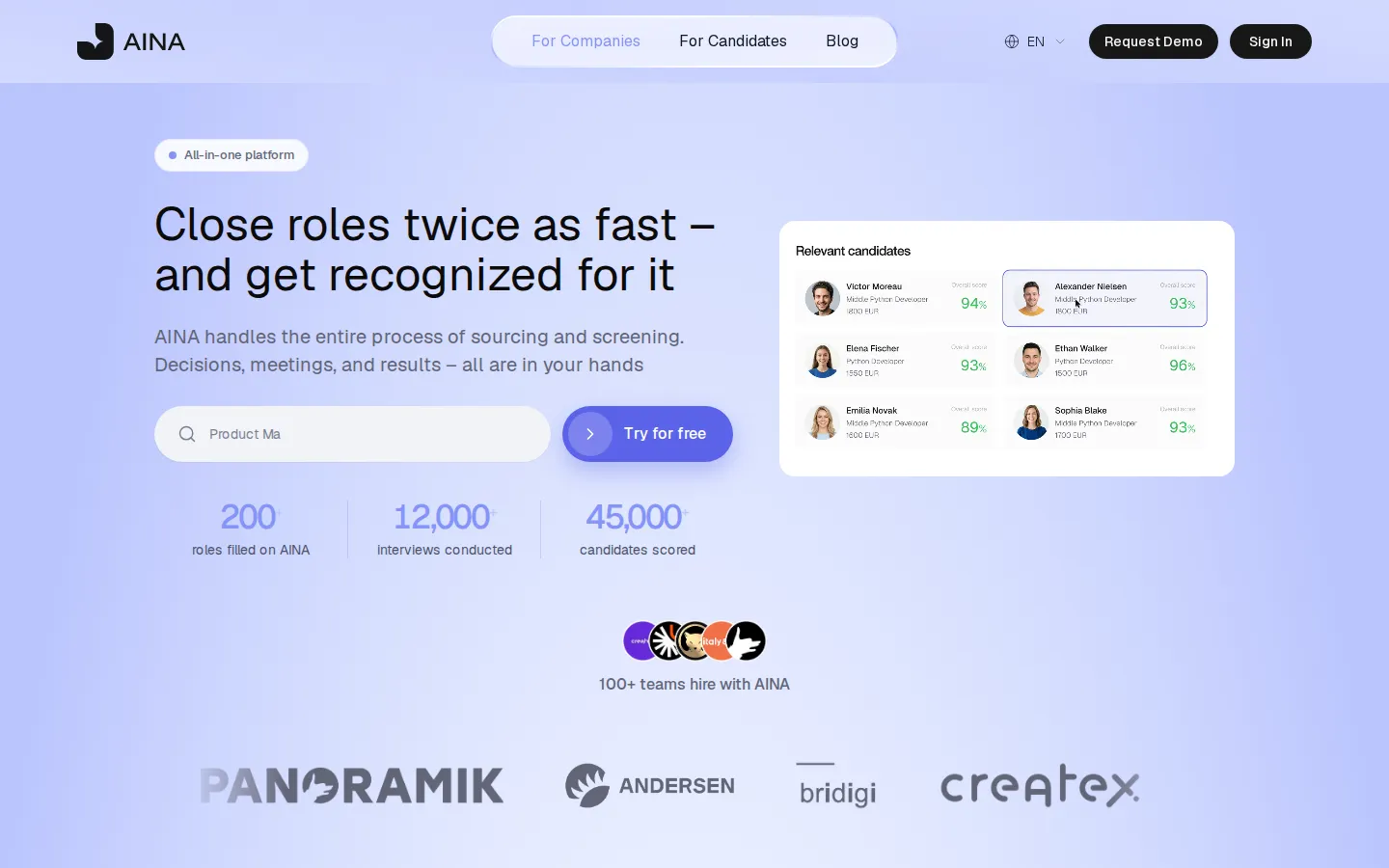
Sourcing then runs against that profile. AINA searches its own candidate database, which the company says holds more than 45,000 scored candidates, and the open web, and merges those matches with inbound applications in a single ranked list. Rankings come from what AINA calls a Talent Mirror Score: a fit assessment split into Job Fit, Company Fit and an estimated probability of success in the role. Scores come with visible reasoning rather than a bare number.
Screening happens through two interview formats. The async interview lets candidates answer structured questions whenever suits them, which removes calendar coordination across time zones; AINA evaluates answers against the criteria set in the brief and surfaces motivation, key signals and risks. Live interviews run inside AINA over built-in video, so the platform doubles as a Zoom replacement, and the recording, transcript and AI summary attach to the candidate card automatically. The company reports 12,000+ interviews conducted through the platform.
Everything after that is applicant tracking: a Kanban pipeline with custom stages, a shared candidate database, one-click offer preparation, team comments and a full interaction history. Analytics cover conversion by stage, time spent per stage, candidate source and rejection reasons. AINA reports 200+ roles filled and more than 100 teams using it, with customers spanning game studios, IT services firms and hospitality operators.
Pricing is a single $49 monthly subscription with no per-seat maths and a free start, positioned against roughly $307 a month for the seven tools it replaces. AINA states it is GDPR compliant, offers a DPA, and lets customers export their data on exit. A separate free candidate product adds CV review, mock interviews and a shareable career card.
AINA Core Features
Voice brief to candidate profile
Describe the role out loud in about five minutes; AINA asks follow-up questions and turns the answers into a candidate profile, vacancy copy, screening questions and assessment criteria.
Database and web sourcing
AINA searches its own candidate database and the open web against your criteria, ranks matches as they arrive and assembles the shortlist without a manual search string.
Talent Mirror Score
Each candidate is scored on Job Fit, Company Fit and predicted success probability, with the reasoning behind the score shown so a recruiter can see why someone ranks where they do.
Async AI interviews
Candidates answer structured questions on their own schedule in any time zone; AINA assesses the answers against your criteria and surfaces the CV, motivation, key signals and risks.
Built-in video interviews
Live calls run inside AINA as a Zoom alternative, with recordings, transcripts and AI summaries written to the candidate card automatically.
Kanban ATS
A shared candidate database with custom pipeline stages, one-click offers, team comments and the full interaction history on every profile.
Hiring analytics
Conversion by stage, time per stage, candidate sources and rejection reasons, so bottlenecks and lost strong candidates are visible without chasing the team for updates.
Candidate career tools
Job seekers get a free profile, a scored CV review, AI mock interviews and a shareable career card they can post to LinkedIn.
Who is AINA for?
AINA is built for the teams that do the hiring but do not have a recruiting department behind them. Founders and hiring managers at startups and SMBs are the core audience: companies of ten to a few hundred people that open a handful of roles a year, have no dedicated sourcer, and cannot justify the cost of an agency retainer or a LinkedIn Recruiter seat. For them AINA replaces the spreadsheet-and-inbox workflow with one place where a role is described in plain language and candidates arrive already scored. In-house recruiters and talent acquisition leads use it as a full applicant tracking system rather than a point tool. Small recruiting teams working several open roles at once get a Kanban pipeline, a shared candidate database, built-in video calls, transcripts and summaries, and analytics on stage speed, source quality and rejection reasons. Agencies and outstaffing firms that screen high volumes of similar profiles, such as developers, support staff or hospitality roles, use the async interview to clear the first round without booking calls. The product also fits companies hiring in narrow, hard-to-fill niches where the search itself is the bottleneck: a head chef in Cyprus who speaks Italian, a C# developer for a game studio, a specialist role in a market where the local talent pool is thin. Because AINA searches its own database and the open web against a written brief, it works where a keyword filter on a job board does not. It is less suited to very large enterprises with an entrenched enterprise ATS, formal procurement and compliance reviews that expect a pre-existing vendor relationship. Organisations that need per-role approval chains, deep HRIS integrations or a fully recruiter-managed service model will find the flat, self-serve approach too narrow. Candidates are a second audience: job seekers get a free profile, CV review, mock interviews and a shareable career card, and only expose their profile to a company when they apply.
AINA Use Cases
Fill a first engineering hire without a recruiter or agency retainer.
Screen hundreds of similar applications for support or hospitality roles before booking any calls.
Source niche specialists such as game developers or Italian-speaking chefs in a thin local market.
Replace job board, sourcing, scheduling and transcription subscriptions with one monthly plan.
Run first-round interviews across time zones without coordinating anyone's calendar.
Give hiring managers full candidate context so they decide without a separate debrief call.
Find where hiring slows down using stage conversion, stage speed and rejection reasons.
Prepare for interviews and fix a weak CV as a job seeker using the free candidate tools.
AINA Pros and Cons
Pros
- One subscription covers brief, sourcing, AI screening, video interviews, ATS, offers and analytics, at a flat $49 a month with no per-seat charge.
- The voice brief is a genuinely different entry point: it forces hiring managers to define selection criteria before sourcing starts, which is where most bad hires begin.
- Async AI interviews remove first-round scheduling entirely, and every recording, transcript and score stays attached to the candidate card.
- Fast setup with nothing to integrate: the company says a role can be live in under thirty minutes and sourcing within five.
- GDPR terms, a DPA and full data export are in place, and the free candidate side feeds a real job board rather than a demo.
Cons
- No public API or documented third-party integrations, so teams already running an ATS or HRIS cannot plug AINA into an existing stack.
- Pricing is published as a single $49 figure; there is no visible volume or enterprise tier, so larger teams cannot estimate cost without talking to sales.
- A young vendor on a $1M raise with limited independent reviews, so roadmap certainty and support depth trail established ATS providers.
FAQ About AINA
AINA Pricing
AINA is sold as one flat subscription at $49 per month, with no per-seat charge, and you can start free without a card. That single fee covers the whole hiring cycle: brief and sourcing, the candidate database, async AI interviews and scoring, the Kanban ATS, built-in video calls with transcripts and summaries, offers and analytics. AINA compares it with the roughly $307 a month it says teams spend across seven separate tools, so the claim is a saving of about $258 monthly. There is no published volume or enterprise tier; the site's /pricing path returns a 404, and the $49 figure is stated on the FAQ page.
Check official pricingFree start
Create an account, post a role and get a first shortlist of scored candidates free, with no card required.
All-in-one
One flat subscription covering brief and sourcing, AI interviews, the Kanban ATS, video calls, transcripts, analytics and offers, with no per-seat pricing.
AINA Alternatives

Alex
Alex is an AI recruiter from Apriora that automates end-to-end hiring: it screens resumes, scores every applicant, interviews them by video, phone, SMS or WhatsApp in 26+ languages, verifies identity and fraud risk, then books qualified candidates onto recruiter calendars through more than 33 ATS integrations, so teams hire faster without adding headcount.

Jobsuit AI
Jobsuit AI is a resume builder and analyzer for job seekers. You upload a resume or start from a template, paste in a job description, and the tool scores ATS fit, flags missing keywords, and rewrites bullets with interactive feedback before you apply. It also generates matching cover letters, tracks applications, and offers ATS-friendly layouts on a free plan.

Hire-a-Mind
Hire-a-Mind links job definition, CV screening, AI interviews, evaluation and the final hiring decision into one connected workflow, so nothing starts over and nothing gets lost. Its named agents Beacon, Sift, Scout and Laura carry context forward at every stage, meaning each shortlist, score and recommendation traces back to real candidate evidence. AI supports the process while your team makes the final call.