Agenlify
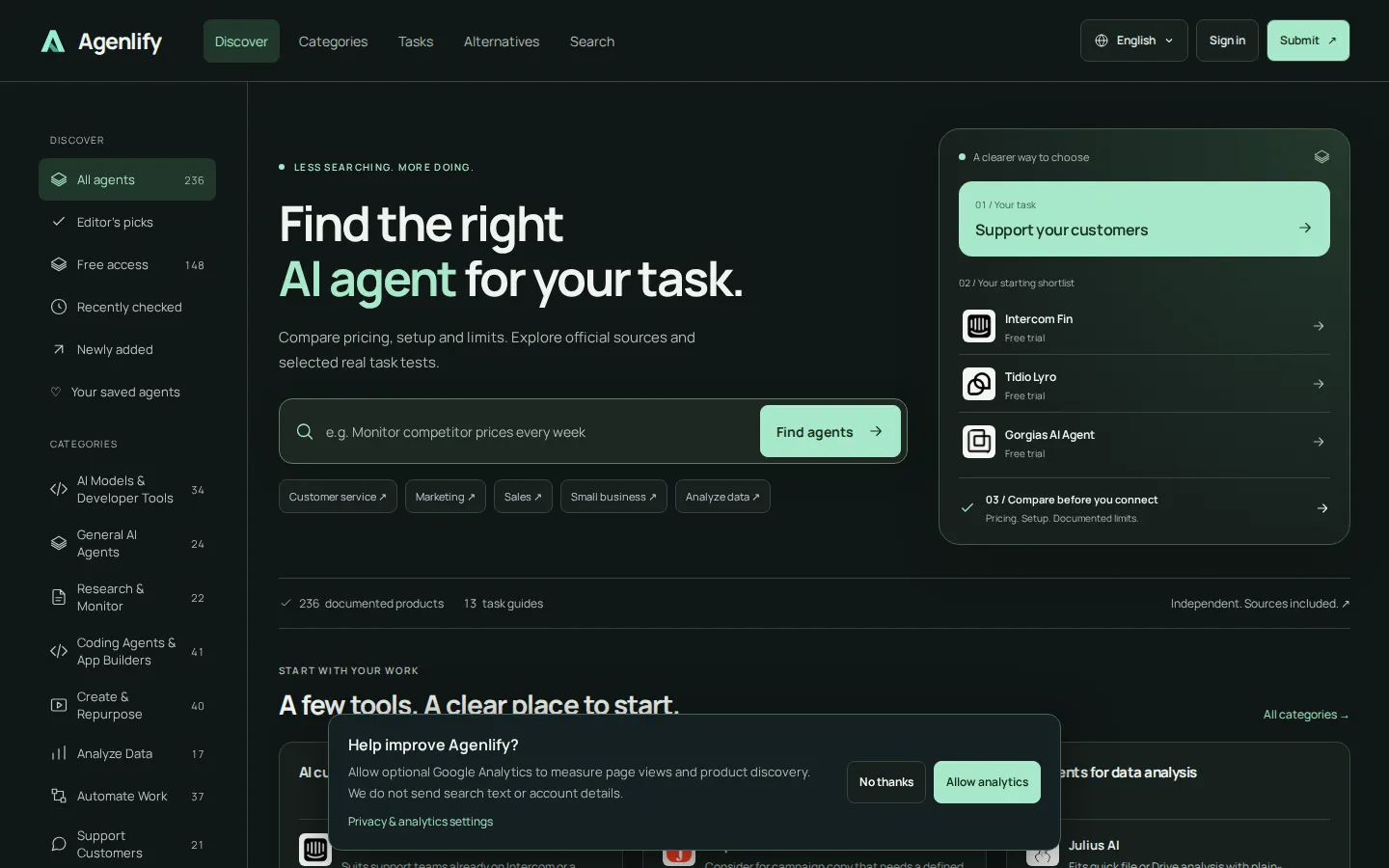
Agenlify is a free directory of 236 documented AI agents and AI-assisted tools, organized by the task you need done rather than by vendor. Each listing records what you provide, what you get, setup requirements, limits, pricing with a check date, and official sources. Search by task or name, compare up to three products, and use curated collections or recorded task cases to shortlist.
What is Agenlify?
Agenlify is an independent discovery directory for AI agents. Instead of starting from a vendor name, you start from the work: answering customer questions, drafting inbox replies, fixing a bug, analysing a spreadsheet, building a first website. Agenlify then shows documented products that claim that task, with the preparation each one needs, the output it produces and the human review it still requires. The site sums this up as "from intent to action", and the editorial line is deliberately modest: reading a product page is not testing a product.
The catalogue is small and hand-checked rather than exhaustive. The homepage counts 236 documented products split across eight categories: AI Models and Developer Tools, General AI Agents, Research and Monitor, Coding Agents and App Builders, Create and Repurpose, Analyze Data, Automate Work, and Support Customers. Each entry carries a product type label such as AI agent, AI-assisted workflow, AI tool, developer framework or AI model, so a workflow built on top of a model is not presented as an autonomous agent.
Every profile follows the same structure. An overview states the best fit, what you provide and what you get. A setup and workflow section lists the ordered steps and the installation requirements. A limits and review section records the charges, quotas and caveats that vendors bury, followed by a "your part" list of the work that stays with you. Profiles end with cost planning, official sources with review dates, and a short FAQ. Pricing labels run from free access and free trial to paid, and a product whose price could not be confirmed is labelled pricing not verified rather than guessed.
Search is task-first. It matches documented product names, a controlled task vocabulary, English and Chinese aliases and capability phrases, and it is explicitly not an open-ended chatbot: an unsupported phrasing returns an empty state with related task guides instead of a fabricated answer. Filters narrow results by setup, pricing, evidence and product type. A comparison view puts up to three products side by side on fit, getting started, pricing with context, inputs, outputs, handover points and limits. Beyond the directory there are category pages, workflow task guides, alternatives and head-to-head comparisons, six curated collections, a blog field guide, and recorded case studies that publish the exact input, prompt, output and check results.
Two smaller details matter for evaluation. First, the site states that no paid placements or affiliate links are currently included, that sponsored placement does not affect organic results, and that a task guide is published only when at least three candidates support it. Second, a public MCP server exposes the same catalogue to AI assistants in English or Chinese, with three read-only tools, no account and no API key. The interface is bilingual in English and Simplified Chinese.
Agenlify Core Features
Task-first search
Describe the work in plain English or Chinese and Agenlify matches documented product names, task vocabulary and capability phrases, with filters for setup, pricing, evidence and product type.
Structured product profiles
Every listing records what you provide, what you get, ordered setup steps, installation requirements, limits, charges and the work that stays with you.
Source links with review dates
Each profile cites the official pages behind its claims and records when they were checked, so pricing and capability statements can be re-verified before you pay.
Side-by-side comparison
Put up to three products in one table covering fit, getting started, pricing with context, inputs, outputs, handover points and limits to know.
Explicit evidence labels
Products are tagged free access, free trial, paid or pricing not verified, and marked ready to use or requires setup, with a product type such as AI agent or AI-assisted workflow.
Curated collections and task guides
Six collections of four products and a set of workflow guides give an editorial starting point when you do not want to search from scratch.
Recorded task cases
Case studies publish the original input, exact prompt, unchanged model output and verification checks, such as a bug fix that passed 24 independently written tests.
Free public MCP server
An endpoint at agenlify.ai/mcp exposes search_agents, get_agent and list_tasks to MCP-capable assistants, with no account or API key and read-only access.
Who is Agenlify for?
Agenlify suits people who know the job they need done but not which product does it. Operations and support leads are the clearest audience: a small team that wants an AI agent on its helpdesk can compare three candidates on pricing unit, setup effort and handover behaviour before booking a pilot, instead of reading six pricing pages. Founders and non-technical buyers get the same benefit, because each profile states what to prepare and what still needs a human. Developers evaluating coding agents use the category pages, alternatives pages and head-to-head comparisons to see how an editor, a terminal agent and an app builder differ on repository access, model billing and review work. Agencies and consultants can hand a client a shortlist with source links and review dates rather than an opinion. Research-minded buyers are served by the recorded cases, which publish the original input, the exact prompt, the generated output and the checks that were run, making it clear what a single run does and does not prove. Teams already using an AI assistant can connect the free MCP server so the assistant searches the same catalogue and returns sources. It is a weaker fit for anyone who wants hands-on benchmark scores, since Agenlify reviews official documentation rather than running every product. It is also thin for enterprise procurement: there are no user ratings, no security questionnaires and no negotiated pricing, and the catalogue deliberately excludes most frameworks, APIs and component libraries, so a developer shopping for an SDK will often find nothing.
Agenlify Use Cases
Find an AI agent for a specific job such as dental reception, inbox drafting or spreadsheet analysis, without knowing the vendor names first.
Compare three customer-support agents on pricing unit, setup effort and handover behaviour before committing to a pilot.
Check what a product needs from you, including helpdesk seats and support content, before connecting it to live customer conversations.
Shortlist alternatives when switching a coding environment, and read how editors, terminal agents and app builders differ.
Verify whether a vendor charges per outcome, per seat or per credit before approving a subscription.
Connect the free MCP server so an AI assistant can search the catalogue and return official sources with its recommendations.
Read a recorded test run to see the exact prompt, model output and checks before trusting a similar task to the same product.
Submit your own agent for editorial review, or request a task guide when the workflow you need is not covered yet.
Agenlify Pros and Cons
Pros
- Every profile links its official sources and a review date, so a price or capability claim can be checked rather than taken on trust.
- The task-first search and structured profiles answer the practical questions buyers actually ask: what to prepare, what comes out, and what still needs a person.
- Comparison tables put pricing unit, setup effort and limits side by side for three products, which is faster than reading three vendor pricing pages.
- Access is free with no paid placements or affiliate links currently included, and the read-only MCP endpoint needs no account or API key.
Cons
- Agenlify documents vendor pages rather than testing products, so there are no benchmark scores and only a handful of recorded runs as hands-on evidence.
- The catalogue is small and deliberately narrow at 236 products, excludes most frameworks, APIs and component libraries, and leaves many entries labelled pricing not verified.
- There are no user ratings or community reviews, and comparison is capped at three products, so cross-shopping a longer shortlist is still manual work.
FAQ About Agenlify
Agenlify Pricing
Free. No paid plan, subscription or credit system is offered: /pricing returns a 404 and the directory, task guides, comparisons and MCP endpoint are open without payment. A Google account is optional for saving agents and submitting products.
Check official pricingFree
Full access to the 236-product directory, task-first search, filters, three-way comparison, task guides, curated collections, recorded cases and the bilingual interface, with no account required to browse.
Google account
Optional sign-in with Google to save agents across devices and to submit a product for editorial review; only basic profile and email are requested.
MCP server
Public Streamable HTTP endpoint at agenlify.ai/mcp with search_agents, get_agent and list_tasks; read-only, stateless, no account or API key, 16 KiB request limit and 300-character query limit.
Agenlify Alternatives

Vidily
Vidily is a browser studio that animates still images: upload a product shot, a portrait, or two frames, pick one of six camera moves, and generate a short clip. Kling 3.0 Omni, Veo 3.1 Fast, Seedance, and MiniMax models are offered. Pricing is one-time credit packs from $9 with no subscription, and clips download as MP4 for CapCut or Premiere.
WayPointo
A curated directory of AI and creative products. Submit your tool, compare alternatives, and make faster decisions.

Viddir
Discover AI-generated livestreams shaped by real-time audience interaction. Every frame happens live.