
ActiveBook
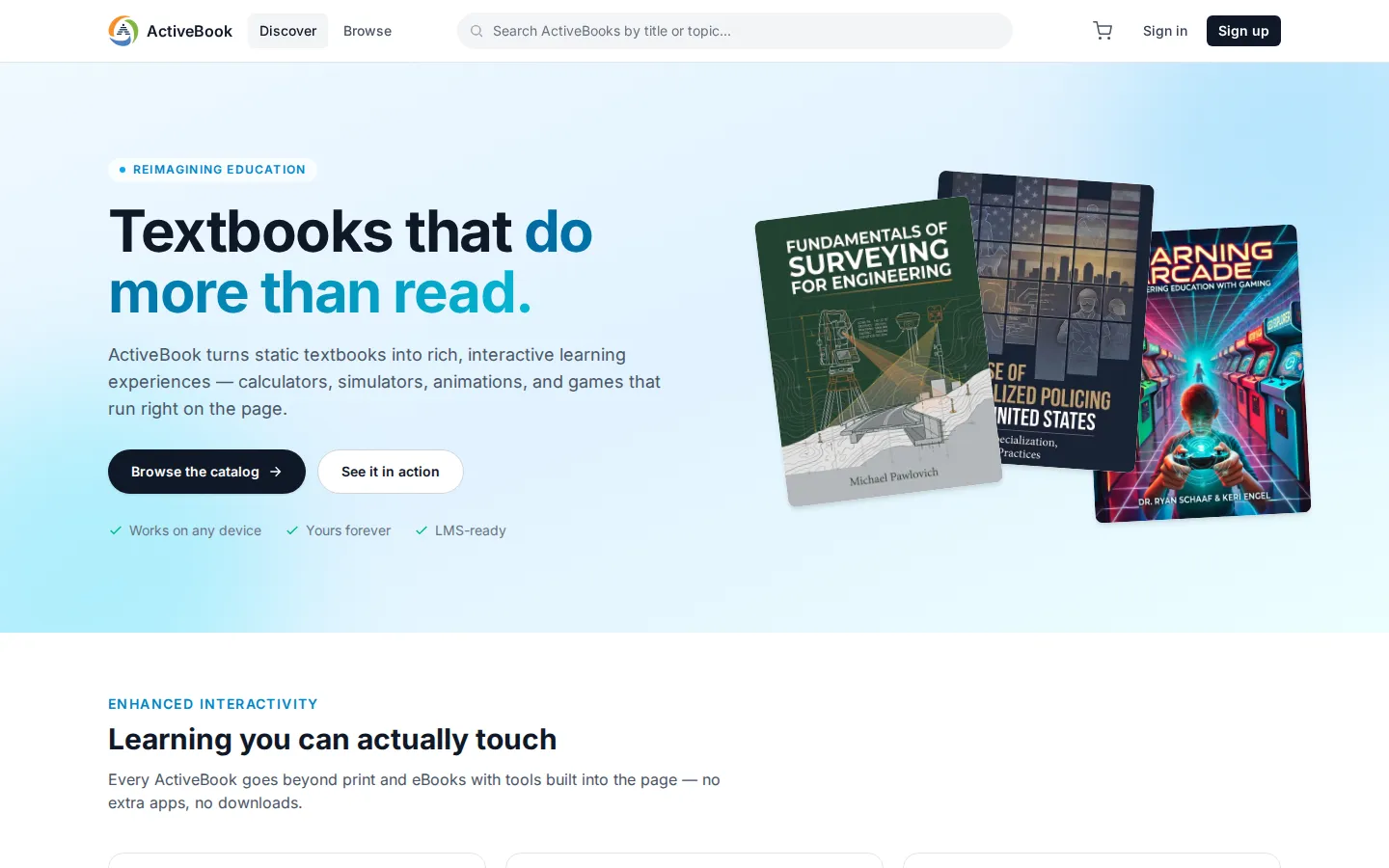
ActiveBook is a digital textbook platform that replaces static pages with working quizzes, simulations, calculators, animations and 3D environments built directly into each chapter. Titles span engineering, science, business, education and the humanities, are read in free apps for desktop and mobile, update in real time, and launch from Moodle, Canvas, Blackboard or D2L through LTI 1.3.
What is ActiveBook?
ActiveBook is a publishing platform and store for interactive digital textbooks, sold under the line "Textbooks that do more than read." Instead of shipping a fixed PDF or EPUB, each title is assembled from interactive blocks that live on the page: click tips that open plain-language explanations of a term, animations that show a concept moving, simulators and calculators that recalculate as you type, 3D model viewers and virtual environments, quizzes graded the moment an answer is clicked, and spaced flashcards. The public demo page on the homepage walks through a chapter on waves and frequency, where a frequency slider drives an animated wave, a quick-check question awards points instantly, and a wavelength calculator converts hertz to centimetres without leaving the chapter.
Titles are read in free ActiveBook apps for iPhone, iPad, Mac, Android and Windows; the website handles discovery, purchase and account management, and opening a book in a browser redirects to the app. A purchase is a personal licence that lasts as long as the title remains on the platform, and revisions push to existing readers at no extra cost, so an author can correct an error or add a chapter without a new edition. Reading position, highlights, notes and completed activities sync across devices, with a three-device simultaneous-reading limit, and a progress indicator tracks completion.
For institutions, ActiveBook supplies an LTI 1.3 tool that launches students directly from Moodle, Canvas, Blackboard, D2L Brightspace or any LTI-compliant platform, with every launch cryptographically verified and a personal access code pre-assigned, so nobody types a code. Open enrollment and grading APIs, SCORM-standard content and an assessment-validation API let results flow back to a course. Authors get an instructor account, a live editor that accepts Word imports, and a review workflow before changes go live. The catalog is organised by subject, from accounting and anthropology to veterinary medicine, with individual titles typically priced between $36 and $92 and no subscription tier. AI appears as one block type, an AI tutor, alongside audio narration, video lessons and discussion threads.
ActiveBook Core Features
Click tips that open instant plain-language explanations for any technical term on the page
Animations and simulations that respond live to sliders and inputs inside the chapter
Built-in calculators, function graphers, unit converters and equation solvers
Auto-graded quizzes and spaced flashcards with points awarded the moment an answer is clicked
3D model viewers, virtual environments and subject sandboxes such as circuit and chemistry labs
LTI 1.3 launch from Moodle, Canvas, Blackboard and D2L with access codes assigned automatically
Open enrollment and grading APIs plus SCORM-standard content and assessment validation
Free reader apps for iPhone, iPad, Mac, Android and Windows with synced progress and notes
Who is ActiveBook for?
ActiveBook is built for people who teach and study from textbooks rather than for casual readers. Its primary audience is college and university instructors who want a required title that does more than a PDF: the platform lets a course launch straight from the learning management system, assigns each student a personal access code automatically, and can sync completions back to the gradebook. Faculty in engineering, mathematics, statistics, computer science, health sciences, education and business are the heaviest users, because those subjects benefit most from calculators, circuit simulators, equation solvers, 3D models and auto-graded practice. Department chairs and instructional designers evaluating courseware also fit here, since the LTI 1.3 tool, SCORM-standard content and enrollment and grading APIs mean no rebuild of an existing course. Students are the second audience. They buy or redeem a title once, read it in the free apps for iPhone, iPad, Mac, Android and Windows, and keep access for as long as the book stays on the platform, including free updates when the author revises it. Students who struggle with abstract material get animations, clickable definitions, worked calculators and instant feedback instead of waiting for office hours. Because progress, highlights, notes and reading position sync across devices, the same book works for a commute, a lecture hall and a late-night study session. Authors and subject-matter experts form the third group. An instructor account opens an author panel and live editor where a Word document can be imported or chapters assembled from interactive blocks, then updated at any time through a short review workflow, so there are no new editions or reprints. Independent publishers and training providers use the same route to ship certification or continuing-education material. ActiveBook is not aimed at K-12 districts seeking a full district-wide LMS, at readers who only want cheap fiction, or at teams looking for a generic course builder: it is a catalog-led textbook platform, and every title is sold individually rather than through a subscription.
ActiveBook Use Cases
Replace a static PDF textbook with a chapter that includes working simulators and instant practice
Launch a required title directly from Canvas or Moodle without distributing access codes by hand
Sync quiz completions and assessment results back to an LMS gradebook through the API
Give engineering students circuit, physics and unit-conversion tools without separate software
Teach statistics with function graphers, probability simulators and auto-graded checks
Publish and revise your own course book from a Word import and push updates to every reader
Study on a phone, tablet and laptop with reading position and highlights carried across devices
Evaluate a title before adoption by opening the live sample chapter on the homepage
ActiveBook Pros and Cons
Pros
- Genuinely interactive pages rather than embedded video or a linked quiz tool
- Strong institutional plumbing: LTI 1.3, enrollment and grade APIs, SCORM and auto-assigned codes
- Lifetime licence with free updates whenever the author revises the book
- Free reader apps on five platforms with synced highlights, notes and progress
- Transparent per-title pricing in the $36 to $92 range with a 14-day refund window
Cons
- Reading requires installing an app; the browser only shows an open-in-app page
- No public pricing page or subscription plan, so cost has to be checked title by title
- Catalog is still modest, with several subjects holding only one or two titles
FAQ About ActiveBook
ActiveBook Pricing
ActiveBook sells interactive textbooks individually at roughly $36 to $92 per title with lifetime access and free updates, and institutions assign titles through LMS access codes rather than a subscription.
Check official pricingSingle title
Entry-level price for shorter catalog titles such as Chord and Scale Structures, bought once with lifetime access.
Standard title
The most common catalog price, covering most engineering, science, education and business titles.
Premium title
Upper end of the catalog for large multi-edition engineering texts such as Solving Mechanical Engineering Problems.
Institutional / LMS
Per-student access codes issued through an LTI 1.3 launch from Moodle, Canvas, Blackboard or D2L; contact ActiveBook for terms.
ActiveBook Alternatives

Praktika
Praktika is an AI language tutor app where lifelike avatar tutors hold real conversations, correct your grammar and pronunciation as you speak, and build a study plan around your goals. It covers 13 languages across speaking, listening, reading and grammar, and includes 1,000+ lessons, role-play scenarios, adjustable tutor tone, business plans and a genuinely useful free tier.

Keet
Keet is an iOS learning app that turns any topic you type in into a complete video course, pairing short AI-produced explainer videos with quizzes and Duolingo-style games inside a structured roadmap. Roadmaps split each subject into modules and four-minute lessons, and you can set depth, complexity and narration style when generating a course. New users get two free courses before buying credits.

Makon AI
Makon AI is a test-prep platform for the Digital SAT, ACT, and AP exams that pairs a 5,000+ question practice library with Mako, an always-available AI tutor that gives hints and step-by-step explanations. Prediction tests, spaced-repetition vocabulary, and analytics that flag weak topics keep each study session pointed at the skills most likely to move a score before test day.