
8090
8090 builds the 8090 Software Factory, an AI-native SDLC platform that turns business intent into governed, verifiable software delivery. It captures requirements in plain English, produces Blueprints engineers sign off on, issues Work Orders to agents through MCP, then triages feedback. Enterprises use it to modernize legacy code, automate critical workflows and open existing ERPs to AI agents.
What is 8090?
8090 is an AI-native software development platform built around the 8090 Software Factory, which its makers describe as an AI-native SDLC platform that refines intent, governs execution, verifies outputs and preserves a complete audit trail. Rather than bolting a code assistant onto an existing process, 8090 wraps the whole delivery lifecycle - requirements, design, build and feedback - in an environment where every change can be traced back to the business intent that produced it.
The methodology runs through four stages. Requirements capture business intent in plain English so everyone agrees on what is being built before any code is written. Blueprints turn that intent into a technical design that engineers review and sign off on. Work Orders break the build into tasks and dispatch them to engineers and their AI agents through MCP inside Cursor, VS Code or Claude Code. Feedback is then collected and triaged to close the loop and keep improving the system.
Results show up in named customer stories. At CMS, the Centers for Medicare & Medicaid Services, 8090 extracted more than 100,000 rules from 18 million-plus lines of COBOL, making decades of Medicare claims code readable with each rule traced to the line it came from. At BISSELL, over 10,000 part names are automatically validated, with agents taking on the manual work and routing exceptions to a person.
8090 also tackles agent access. It adds an MCP layer to the ERP a company already runs so AI agents can use it without a migration; for IFS, 8090 built the result as a headless ERP. EY, AdaptHealth, BISSELL, CMS, IFS and Dompe appear among the logos it shows, and quotes from BISSELL, Tie and EY back the claims up.
Engagements are deliberately staged. Customers are invited to start with one problem and see how 8090 works before taking on more, or to bring the whole program and scope the bigger picture together. Throughout, the customer keeps their own tools while 8090 hosts, maintains and keeps the platform current as both the business and the underlying models change, which matters when a system is expected to live for years rather than a sprint.
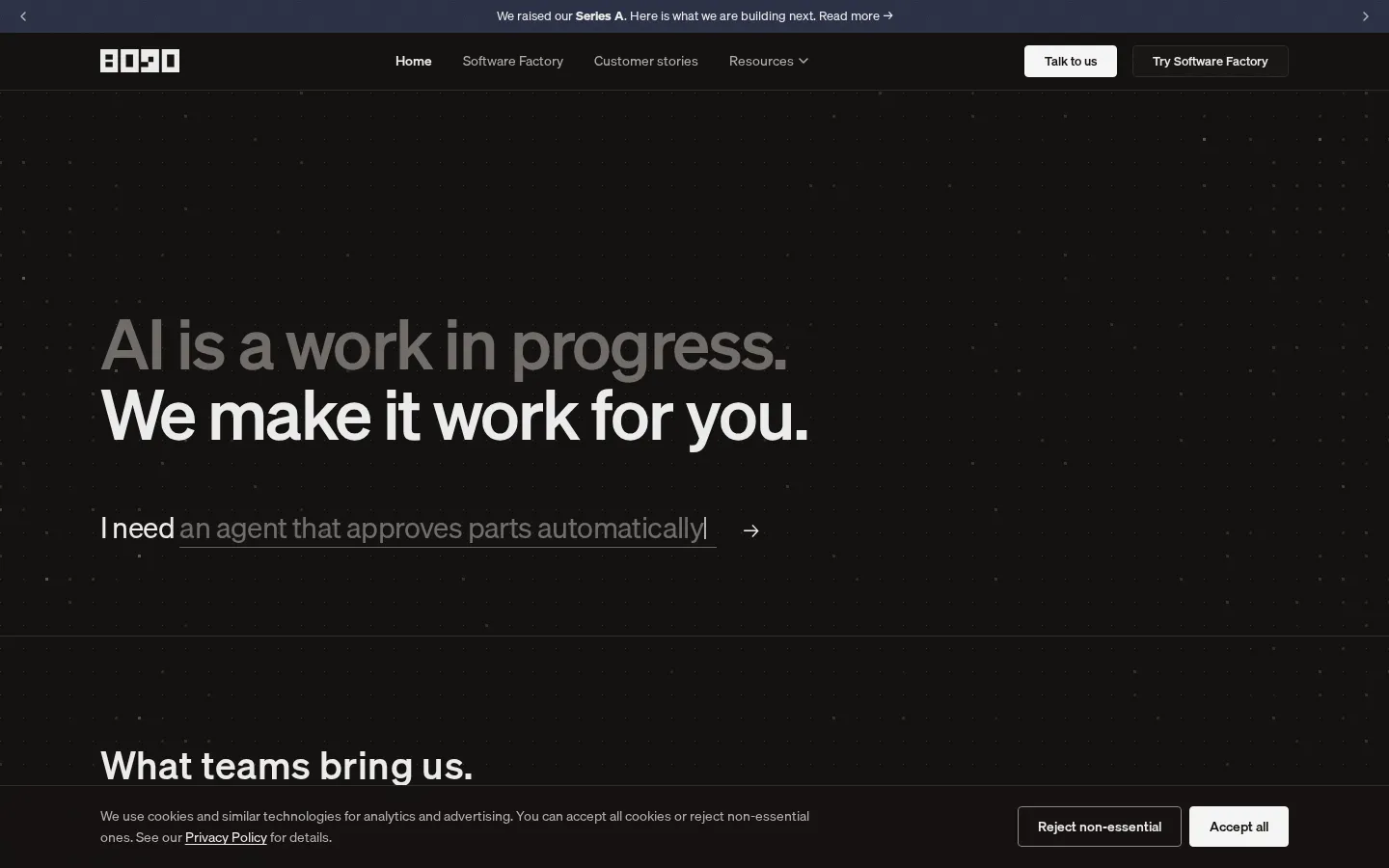
The company behind it is 8090 Solutions Inc., which raised a $135M Series A led by Salesforce Ventures alongside WndrCo, Craft Ventures, The Production Board and LAUNCH. Its tagline captures the posture - AI is a work in progress, and 8090 makes it work for you - and its resources include a documentation site at docs.8090.ai, a news blog, a newsletter and a demo playlist on YouTube. For directory purposes, 8090 is best understood as a governed delivery platform plus a services motion, not a self-serve coding tool.
8090 Core Features
Requirements stage
Captures business intent in plain English so stakeholders agree on what is being built before any code exists.
Blueprints
Converts agreed intent into a technical design that engineers review and formally sign off on.
Work Orders
Breaks the build into tasks and sends them to engineers and their AI agents through MCP.
Agent support
Works inside Cursor, VS Code and Claude Code so agents build in the tools teams already use.
Feedback loop
Collects and triages feedback to close the cycle and keep improving the system over time.
Audit trail
Every change is traced back to the originating intent and tested, giving auditors a visible record.
Legacy modernization
Extracted 100,000+ rules from 18M+ lines of COBOL for CMS, each rule traced to its source line.
ERP agent access
Adds an MCP layer to existing ERPs so AI agents can use them without a migration.
Who is 8090 for?
8090 is built for large enterprises and the engineering leaders inside them: CTOs, CIOs, heads of engineering, platform and modernization teams, and the consulting partners who deliver alongside them. Its clearest fit is an organization carrying a critical, decades-old system or a high-stakes manual workflow that it cannot afford to get wrong, and that has already tried AI coding assistants without changing the delivery process around them. Typical buyers sit in regulated or complex industries where traceability matters - government, healthcare, insurance, manufacturing and enterprise software. The customer stories on the site point to this: CMS, the Centers for Medicare & Medicaid Services, worked with 8090 on Medicare claims code, BISSELL automated validation of more than 10,000 part names, IFS gained a headless ERP, and EY brings 8090 into client engagements as a consulting partner. Teams that will get less from it: small startups and solo developers looking for a cheap autocomplete-style coding helper, and anyone who wants a self-serve free tier without a sales conversation. 8090 is sold through a talk-to-us and get-started motion and priced per engagement, with the site explicitly inviting prospects to start with one problem before scaling up. The practical profile is a team that knows its business well but lacks the time - or the confidence to hand AI a critical system. That is exactly the gap 8090 positions against, offering its own engineers to build with the customer's team on the Software Factory, then handing back something the customer's team runs while 8090 carries hosting, maintenance and model churn. Decision makers should also expect a services-backed engagement: the platform is delivered with 8090's own engineers building alongside the customer's team, not as a standalone subscription anyone can switch on.
8090 Use Cases
Modernize decades-old COBOL and legacy systems into readable, traceable business rules.
Automate repetitive validation work such as checking thousands of part names and routing exceptions.
Give AI agents governed access to an existing ERP through an MCP layer instead of a migration.
Capture business requirements in plain English and turn them into signed-off technical designs.
Dispatch build work to engineering agents inside Cursor, VS Code or Claude Code with full traceability.
Run AI-assisted delivery in regulated environments where every change needs an auditable record.
Scale a governed engineering process from one pilot workflow to a company-wide program.
Deliver commercial-grade software products faster with a consulting partner on the platform.
8090 Pros and Cons
Pros
- Covers the full delivery lifecycle - requirements, design, work orders and feedback - rather than just code generation.
- Strong proof points at recognizable organizations: CMS, BISSELL, IFS, EY and AdaptHealth.
- Audit trail and intent traceability suit regulated industries where governance is mandatory.
- An MCP layer lets AI agents use existing ERPs without an expensive migration.
- Well funded and actively shipping, with a $135M Series A and a public docs site.
Cons
- No public pricing or free tier; everything starts with a sales conversation.
- Heavy, enterprise-oriented engagement that is overkill for small teams or solo developers.
- Several details, such as timelines and environment options, sit behind the FAQ and sales contact.
FAQ About 8090
8090 Pricing
8090 does not publish prices publicly; pricing is quoted per engagement, so you need to talk to sales.
Check official pricingEnterprise
Pricing is tailored to the engagement - talk to sales
8090 Alternatives

FastRouter
FastRouter is a unified LLM gateway that gives developers one OpenAI-compatible API for 200+ models from providers such as OpenAI, Anthropic, Google, and xAI. It adds automatic model routing, fallbacks, caching, spend caps, role-based access, guardrails, and per-request observability, while passing provider token prices through with no markup on any plan, including the free tier.

Cindy
Cindy is an open-source desktop AI agent from XD Inc. that unifies Claude Code, Codex and Pi harnesses with 20+ tools, persistent memory and reusable skills. Use it free with your own API key or existing Coding Plan, or pay for the optional managed model service that works the moment you sign in. No setup project required.

MyToolster
MyToolster packs 41 free utilities into one browser-based site, sorted into Audio & Video, Text, Data, Web, Color, QR Code and Image. Beyond the usual encoders, formatters and generators it runs OpenAI Whisper transcription, AI text and image detection, background removal and subtitle export locally, with no uploads, account or installation, and every tool page does its work client-side.