Qwen3.8-Flash-Next vs Qwen3.8-27B: Which Model Should You Run?

WithAI.Top Editorial Team
Qwen3.8-Flash-Next and Qwen3.8-27B arrived within the same release cycle, share a native 262,144-token context window, and target coding, agentic work, and multimodal tasks. Their deployment profiles, however, are radically different.
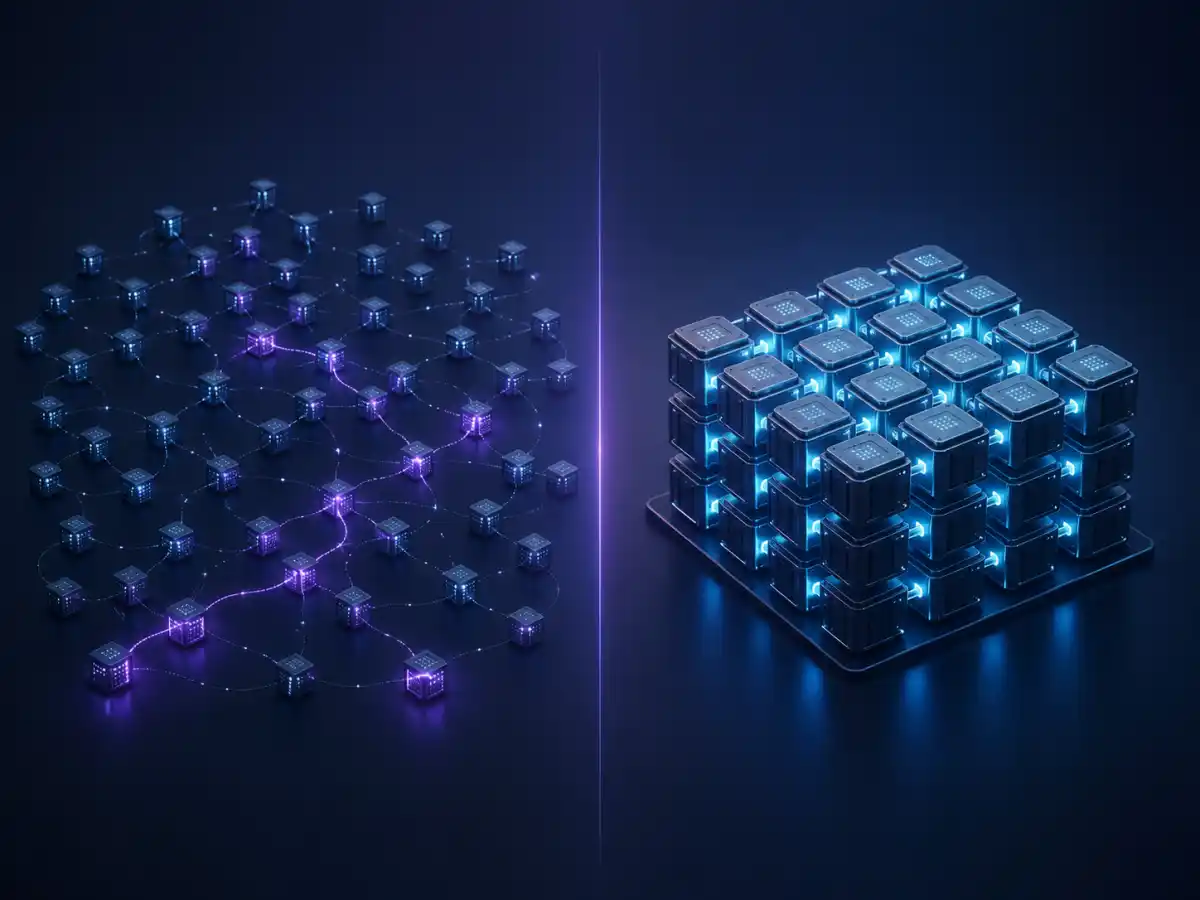
Qwen3.8-Flash-Next is a 125-billion-parameter mixture-of-experts model that activates about 6 billion parameters per token. Qwen3.8-27B is a dense model that activates all 27 billion parameters. Choosing between them is less about finding a universal winner and more about matching the architecture to your hardware, workload, and licensing requirements.
If you are still comparing the broader market, the large language model directory provides more models to evaluate alongside these two Qwen releases.
Quick answer
| Qwen3.8-Flash-Next | Qwen3.8-27B | |
|---|---|---|
| Architecture | Sparse mixture of experts | Dense transformer |
| Language-model parameters | 125B plus 51B n-gram embedding and 4B MTP | 27B |
| Active parameters per token | About 6B | All 27B |
| Attention design | Gated DeltaNet plus Qwen Sparse Attention | Gated DeltaNet plus full Gated Attention |
| Context window | 262,144 native; extensible to about 1M | 262,144 native; extensible to about 1M |
| Modality | Text, image, and video understanding | Text, image, and video understanding |
| License | Qwen Community License 1.0 | Apache 2.0 |
| Practical hardware profile | Multi-GPU server infrastructure | Single high-memory consumer GPU with a suitable 4-bit quantization |
| Best fit | High-throughput serving and architecture evaluation | Local inference, experimentation, and accessible fine-tuning |
The short version: choose Qwen3.8-27B when you want a model that can realistically fit into a personal workstation. Consider Qwen3.8-Flash-Next when you operate multi-GPU infrastructure and want its sparse-compute economics or an early look at the architecture planned for Qwen4.
What Qwen3.8-Flash-Next actually is
Qwen describes Qwen3.8-Flash-Next as an experimental preview of the architecture intended to underpin Qwen4. Its official model card lists 125B language-model parameters with 6B activated per token, plus a 51B n-gram embedding table and a 4B multi-token-prediction module.
The model combines four notable ideas:
- Qwen Sparse Attention: it replaces the conventional full-attention layers used in earlier hybrid Qwen models with sparse attention that selects micro-blocks rather than individual tokens.
- Gated DeltaNet: linear-attention layers handle most of the sequence processing.
- Gated Residual: read and write gates regulate information flowing through widened residual streams.
- N-gram embedding: a large embedding table adds capacity in a form that Qwen says is comparatively easy to offload and cheap to compute.
The language-model stack contains 48 layers arranged as 12 repeated groups. Each group runs three Gated DeltaNet and MoE blocks followed by one Qwen Sparse Attention and MoE block. The MoE layer contains 512 experts, with 10 routed experts and one shared expert active at a time.
This is why “6B active” should not be read as “a 6B model.” Sparse activation reduces computation per token, but serving still requires access to the complete parameter set. Current Hugging Face repository metadata is roughly 360GB for the BF16 repository and 186GB for the FP8 repository. Exact runtime memory also depends on the inference engine, tensor parallelism, KV cache, context length, and batch size.
The LLM Stats profile for Qwen3.8-Flash-Next is a useful companion to the official card, providing a consolidated view of the release date, context window, license, benchmarks, and model comparisons.
What Qwen3.8-27B actually is
Qwen3.8-27B is the more accessible release. It is a dense, native vision-language model with 27B parameters, 64 layers, and a hybrid attention pattern. According to the official Qwen3.8-27B model card, every repeated group contains three Gated DeltaNet layers followed by one full Gated Attention layer.
Because it is dense, every parameter participates in each token pass. That means more active computation than Flash-Next's approximately 6B active parameters, but the total model is far smaller and easier to fit into a workstation.
The official BF16 repository occupies roughly 56GB. A 4-bit quantization can reduce the weight footprint to roughly 14GB before runtime overhead, but a practical setup needs additional memory for the KV cache, vision components, context, and inference engine. A 24GB GPU is therefore a sensible target for many local configurations, although the exact requirement depends heavily on quantization and context length.
For developers evaluating local coding workflows, it is also worth comparing dedicated AI code assistants and the wider collection of AI developer tools. A self-hosted model gives you control, but a purpose-built tool may require less setup.
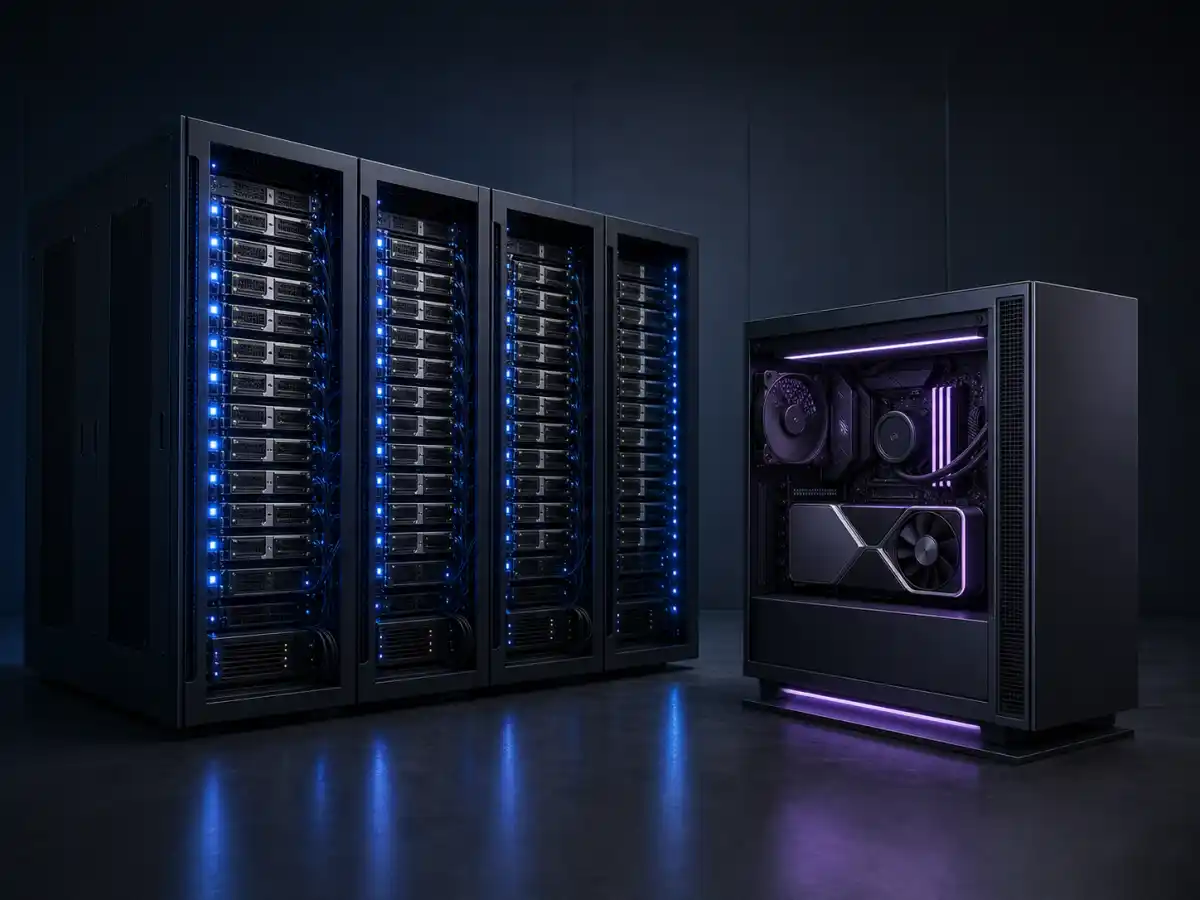
Flash-Next belongs in multi-GPU server territory, while a quantized 27B deployment can fit a high-memory desktop GPU.
Sparse MoE versus dense: why the distinction matters
The two architectures optimize different constraints.
A sparse MoE model stores many experts but routes each token through only a subset. This can provide high total capacity without paying the full compute cost on every token. The trade-off is operational complexity: the complete model remains large, expert routing creates communication overhead, and efficient deployment often depends on specialized multi-GPU serving software.
A dense model is simpler. Every token follows the same fully active network, so the total parameter count more directly reflects both memory and compute. Dense models are often easier to quantize, fine-tune, and run with consumer-oriented tools.
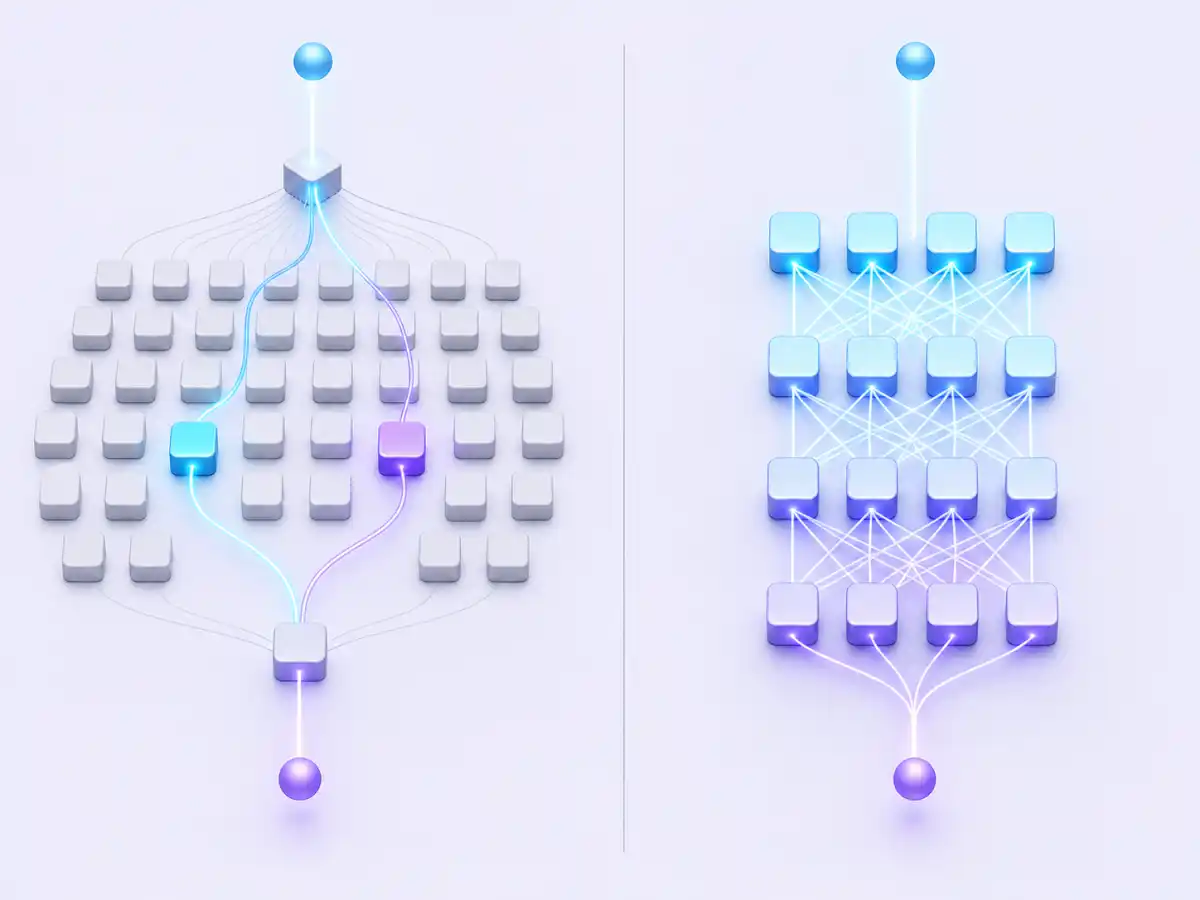
Sparse routing activates a small selection from a large expert pool; a dense network activates its full set of layers for every token.
For inference, the important distinction is:
- Flash-Next lowers active compute, not total storage. It is attractive when throughput and cost per generated token matter across many requests.
- 27B lowers the total model footprint. It is attractive when the model must fit into one workstation or a smaller server.
For fine-tuning, dense models also tend to have a smoother tooling path. LoRA and QLoRA can work with MoE models, but the complete expert set still has to be stored, and framework support is less uniform than it is for a conventional dense checkpoint.
Benchmark comparison
Unlike the earliest release-day summaries, Qwen now publishes detailed benchmark tables for both models. These are provider-reported results, so they should be treated as useful reference points rather than a substitute for testing your own prompts and serving stack.
| Benchmark | Qwen3.8-Flash-Next | Qwen3.8-27B |
|---|---|---|
| SWE-bench Pro | 62.5 | 61.7 |
| DeepSWE 1.1 | 58.7 | 42.2 |
| CoWorkBench | 73.9 | 70.7 |
| GPQA Diamond | 91.7 | 89.2 |
| AndroidWorld | 84.5 | 81.9 |
| RealWorldQA | 88.5 | 85.9 |
Flash-Next leads in each of these official comparisons, but the gap is not equally meaningful for every deployment. A few benchmark points may not justify multi-GPU infrastructure when a 27B quantized model already meets the latency and quality needs of a local coding assistant.
If benchmark methodology and evaluation workflows are central to your decision, browse additional AI research tools and reproduce the tests that most closely resemble your own workload.
Hardware and deployment considerations
Choose Qwen3.8-27B for a single workstation
Qwen3.8-27B is the realistic choice if you have one 24GB GPU and are comfortable using a 4-bit quantization. Shorter context windows and smaller batch sizes keep KV-cache memory manageable. Apple Silicon systems with sufficient unified memory are another possible local route, depending on current MLX and quantization support.
At BF16, the roughly 56GB checkpoint requires a larger accelerator or multiple devices. FP8 and 8-bit variants sit between the BF16 and 4-bit footprints.
Choose Qwen3.8-Flash-Next for multi-GPU serving
Flash-Next is designed for an infrastructure environment where its large stored capacity can be distributed across devices while sparse activation reduces compute per token. Qwen recommends current versions of serving engines such as SGLang, vLLM, and TokenSpeed.
Long context deserves special attention for both models. Although each supports 262,144 tokens natively and can be extended to about one million with YaRN scaling, the KV cache and latency cost can become the practical limit long before the configured maximum.
Licensing difference
Qwen3.8-27B uses the Apache 2.0 license. That is the simpler option for teams that want a widely understood permissive open-source license.
Qwen3.8-Flash-Next uses the Qwen Community License 1.0. It permits many use, modification, distribution, deployment, and fine-tuning scenarios, but it includes additional conditions for very large commercial services and certain Model-as-a-Service or AI work-assistant uses. Review the current license text before building a commercial offering around the checkpoint.
If you need X, choose Y
- One GPU for a private coding or agent setup: choose Qwen3.8-27B.
- The easiest fine-tuning path: choose Qwen3.8-27B.
- A permissive Apache 2.0 license: choose Qwen3.8-27B.
- High request volume on multi-GPU infrastructure: evaluate Qwen3.8-Flash-Next.
- The strongest official benchmark result between these two models: Qwen3.8-Flash-Next generally leads.
- An early view of the architecture planned for Qwen4: choose Qwen3.8-Flash-Next.
The best final decision still comes from a small evaluation set built from your own tasks. Run the same prompts, tools, context lengths, and output constraints against both models, then compare quality, latency, memory use, and cost.
FAQ
Is Qwen3.8-Flash-Next the same as Qwen4?
No. Qwen describes it as an experimental preview of the architecture intended to underpin Qwen4, not as a Qwen4 model.
Can Qwen3.8-Flash-Next run on one consumer GPU?
Not realistically with the official checkpoints. Its sparse routing lowers the number of parameters activated per token, but the complete checkpoint remains far larger than consumer GPU memory.
Which model is better for fine-tuning?
Qwen3.8-27B is usually the more practical choice. Its lower total parameter count and dense architecture fit existing LoRA and QLoRA workflows more comfortably.
Do both models support images and video?
Yes. Both official model cards describe a causal language model with a vision encoder and provide image and video input examples.
Which model is faster?
There is no universal answer. Flash-Next activates fewer parameters per token and is designed for efficient large-scale serving, but communication across a multi-GPU deployment matters. A quantized 27B model may feel faster and simpler on a single local workstation because it avoids that infrastructure overhead.
Sources
Stay at the cutting edge.
Join thousands of AI practitioners receiving our weekly digest on tools and trends.
Share this story
Continue Exploring
More insights from our research team.