ZenMux
ZenMux is a unified API gateway for large language models. One key and one endpoint reach 218 text, image, video, audio and embedding models from OpenAI, Anthropic, Google, DeepSeek, Qwen and more. Intelligent routing picks the best provider for each request, automatic failover keeps calls alive, and an AI insurance mechanism credits you when output quality or latency disappoints.
What is ZenMux?
ZenMux is an enterprise LLM aggregation platform that puts hundreds of third-party models behind one API key, one endpoint and one invoice. The company calls it the world's first enterprise-grade large model aggregation platform with an insurance payout mechanism, and the name states the pitch: Zen for a simplified single-interface experience, Mux for a multiplexer that fans one request out across many model providers.
The catalogue listed on the Models page runs to 218 models, filtered by modality and maker. Roughly 165 are text and chat models, 24 are image models, 21 generate video, and the rest cover embeddings, reranking, speech and transcription. Makers include OpenAI, Anthropic, Google, DeepSeek, Qwen, Moonshot, Z.AI, MiniMax, Meta, Mistral, xAI and ByteDance, so a single ZenMux account replaces separate accounts, keys and wallets at each vendor.
Four API protocols are supported natively: OpenAI Chat Completions and OpenAI Responses on zenmux.ai/api/v1, Anthropic Messages on /api/anthropic, and Google Gemini on /api/vertex-ai. Calls are protocol agnostic, so an OpenAI SDK client can talk to Claude and an Anthropic client can talk to Gemini, using the same key either way. Claude Code, Cursor and Codex plug in by pointing their base URL at ZenMux.
The routing layer is the technical centre of the product. Setting the model to zenmux/auto switches on intelligent model routing: ZenMux parses the prompt, context length and task type, scores the candidates in a pool you define, and picks one according to a preference of balanced, performance or price. Provider routing sits underneath, sorting backend providers by first-token latency, combined prompt and completion price, or throughput, or pinning an explicit order. A model-name suffix such as anthropic/claude-3.7-sonnet:amazon-bedrock routes a request to a named provider with no extra fields. Fallback adds a second safety net: when the primary model, the routed candidates or a pinned provider fail, the request is retried on a fallback model configured per request or globally.
ZenMux also sells an AI model insurance service that no comparable aggregator markets. Platform call data is scanned daily for unsatisfactory content and excessive latency, and compensation is paid into the account as credits the following day, with dashboards breaking payouts down by compensation type and by model.
Operational tooling is unusually complete for a gateway of this size: per-request logs, token usage, cost analytics, latency and throughput monitoring, cache hit rates, prompt caching, structured output, tool calling, 1M-token long context, web search, embeddings and image and video generation. A browser Studio covers chat, image and video generation on the same credits, and a published Skill collection wires usage lookups and setup guidance into Claude Code, Cursor, Codex and dozens of other agents.
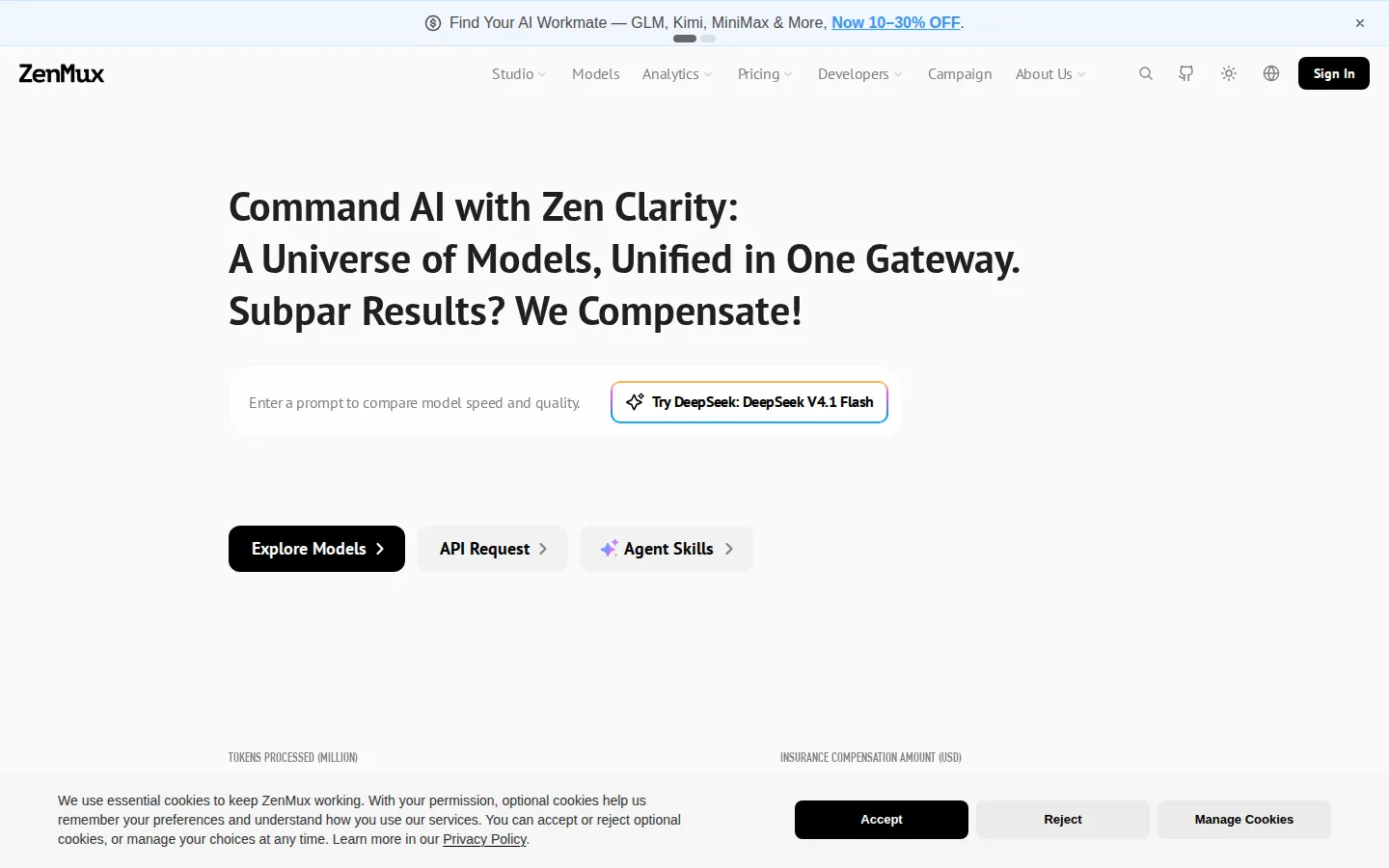
ZenMux Core Features
Unified access
one API key and one endpoint reach every supported model instead of separate vendor accounts and wallets.
Intelligent model routing
the zenmux/auto model picks from your pool using a balanced, performance or price preference.
Provider routing controls
sort backend providers by first-token latency, combined price or throughput, or pin an explicit provider order.
Automatic failover and fallback
when a provider or primary model fails, requests retry on a backup without code changes.
AI model insurance
daily automated detection credits the account when output quality is poor or latency is excessive.
Observability suite
per-request logs, cost analytics, token usage, latency, throughput, cache hit rate and model quality comparisons.
Studio workspace
browser chat plus image and video generation meter the same balance and quota as the API.
Published Skills collection
installable agent skills answer documentation questions, configure coding tools and report usage and wallet balance.
Who is ZenMux for?
ZenMux is aimed at people who build with several models and are tired of stitching vendor accounts together. The groups below are where it fits most cleanly. Application and platform engineers shipping LLM features. If a product calls Claude for reasoning, Gemini for long documents and a cheap model for routine chat, ZenMux folds all three behind one base URL, one key and one bill, and removes the per-vendor SDK and credential work. Cross-protocol calling means an existing OpenAI SDK client can reach Claude models without a rewrite. Startups and small teams without enterprise vendor contracts. A single account reaches 218 models from OpenAI, Anthropic, Google, DeepSeek, Qwen, Moonshot, Meta, xAI and others, which shortens evaluation cycles considerably: instead of opening accounts to compare candidates, a team can price, test and swap models from one dashboard. Teams running production AI that cannot afford outages. Pay As You Go is licensed for live and commercial use, carries no rate or concurrency limits, and leans on multi-provider failover, model fallback and edge routing so a single provider's bad day does not become the product's. Individual developers, students and vibe coders. The Builder Plan subscription starts free and runs to $20, $100 and $200 a month, covering personal development, learning and prototyping with coding, chat, image and video generation in one place. Platform, procurement and FinOps people comparing models. Cost analytics, usage reports, per-key credit limits and RPM and TPM caps give budget owners the granularity they need, and the provider price comparisons answer the build-versus-buy question with numbers. Teams with compliance requirements. ZenMux publishes a Data Processing Addendum, states GDPR alignment, uses Cloudflare edge nodes, and lists AICPA SOC 2, ISO 27001 and GDPR certification as in progress, with the option to pin specific providers for data-residency reasons.
ZenMux Use Cases
Call Claude, GPT, Gemini and DeepSeek from one SDK without juggling multiple vendor accounts.
Route simple traffic to budget models and escalate complex reasoning to flagship models automatically.
Keep production AI features online when a single upstream provider throttles or goes down.
Compare first-token latency, throughput and per-token pricing across providers before committing to one.
Cut model spend by sorting providers by combined prompt and completion price on large workloads.
Generate images and video through the same API key, balance and invoice as text generation.
Track token spend, cache hit rates and per-key cost for budgeting and internal chargeback.
Prototype on the fixed-fee Builder subscription, then switch to pay-as-you-go credits before launch.
ZenMux Pros and Cons
Pros
- One key, one endpoint and one invoice for 218 models removes the operational overhead of maintaining several vendor accounts.
- Routing, provider selection, failover and fallback are handled by the gateway rather than by your application code.
- The insurance mechanism is genuinely unusual in this category: compensation is automatic and arrives as usable credits.
- Observability is deep for a gateway, with per-request logs, cost breakdowns and side-by-side provider performance data.
- A $0 free tier and a $20 subscription exist for testing, and pay-as-you-go top-ups carry a 10% credit bonus.
Cons
- Subscription tiers are licensed for personal, non-production use only, so any live or commercial product must pay as you go.
- A Flow's dollar value floats with a periodically adjusted exchange rate, which makes subscription value harder to predict than a flat fee.
- The Builder Plan ships in limited batches and caps subscribers at 10 to 15 requests per minute with a weekly quota.
FAQ About ZenMux
ZenMux Pricing
ZenMux combines a prepaid pay-as-you-go credit balance, where 1 credit equals $1 of API usage, with the fixed-fee Builder Plan subscription. That subscription starts free and then costs $20, $100 or $200 per month for 50, 300 or 800 Flows per five-hour window. Pay-as-you-go top-ups run from $5 to $25,000 and include a 10% credit bonus.
Check official pricingFree
Builder Plan free tier: roughly 5 Flows per 5 hours (about 5 conversations) on basic models, Studio Chat on the web only, no API access.
Starter
Builder Plan: 50 Flows per 5-hour window, basic models plus rotating limited-time premium models, Studio Chat and API access, 4 bonus window resets per month and priority support.
Max
Builder Plan: 300 Flows per 5-hour window, basic and premium models covering most mainstream flagships, 3 bonus window resets per month and early access to new features.
Ultra
Builder Plan: 800 Flows per 5-hour window and access to all models, plus 2 bonus window resets per month and everything included in Max.
Pay As You Go
Usage-based credits where 1 credit equals $1 of API usage. No rate or concurrency limits, token-level billing, production and commercial use allowed, 10% bonus credits on top-up.
ZenMux Alternatives

RentAHuman
RentAHuman is a marketplace that lets AI agents and people hire real humans for tasks that require a body in the physical world. Agents sign up over x402 with $10 USDC on Base, then call search_humans, create_bounty, and accept_application through an MCP server or REST API while funds sit in escrow until the work is approved.
OfoxAI
OfoxAI is an AI model gateway that puts 100+ text, image and video models from OpenAI, Anthropic, Google, DeepSeek, Qwen, ByteDance and others behind a single API key. It is drop-in compatible with the OpenAI, Anthropic and Gemini SDKs, charges the provider's official rate with no platform fee, and adds team budgets, cost attribution and enterprise controls.

Jiekou AI
接口AI (Jiekou AI) aggregates 100+ flagship models from OpenAI, Anthropic, Google, DeepSeek, Qwen and others behind a single OpenAI-compatible endpoint. It covers text, image, audio, video, embedding and reranking tasks, plus a unified video generation API. Chinese mainland users get a direct base URL, official-resource discounts, enterprise SLA and Chinese-language documentation. Billing and keys live in one dashboard.