
Viggle
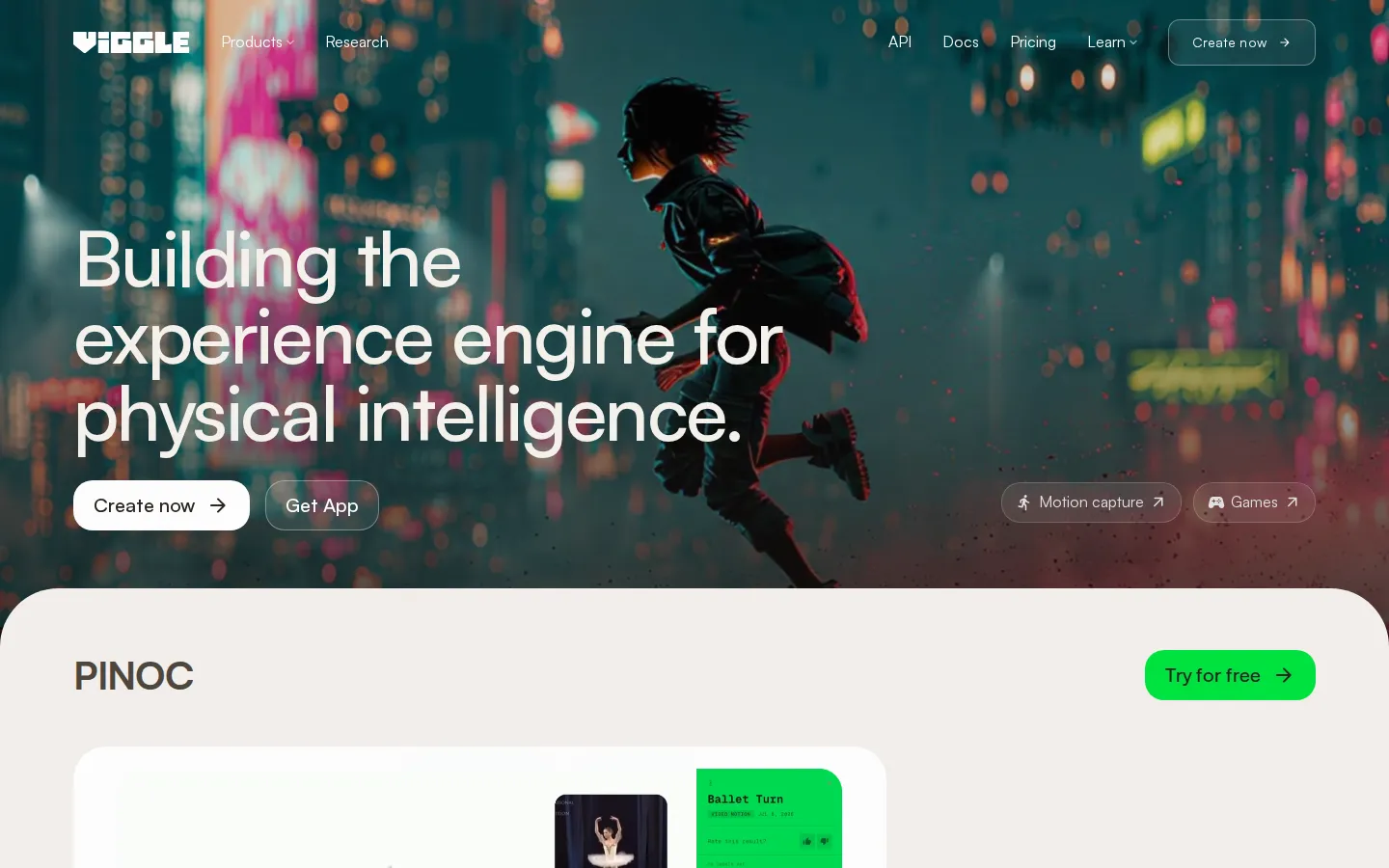
Viggle is a Spatial GenAI platform for character motion and animation. Turn a phone clip into production-ready motion with PINOC, swap any character into trending videos with Meme Maker, remix playable games, and integrate the same intelligence through Viggle's API. A free tier offers five videos a day, with paid plans from $7.99/month.
What is Viggle?
Viggle is a Spatial GenAI platform built on what the company calls a physics-native world model. Rather than generating video frames in isolation, Viggle says it generates characters, motion and scenes together in a shared 4D space, powered by its proprietary Joint Space-Time model. The company reports that more than 50 million people worldwide already use the product, and it positions itself across two very different ends of the market: fast consumer content creation on one side, and professional production and physical-AI research on the other. The product family has four main pillars. Meme Maker swaps characters into existing video. You pick a trending clip, drop in any character, and get a shareable video. It ships as a set of distinct tools: Mix for swapping a single character, Multi-Editor for scenes with several characters at once, motion control for adding movement to a character, and Viggle Live for swapping characters in real time. PINOC is the motion-capture product. It turns a phone video clip into production-ready motion in minutes, then lets you apply that movement to your own 3D character and export it directly into the game engines you already use, with no studio, suit or markers required. Viggle Games is a creative play space where you pick popular game templates and remix them with your own characters. The Viggle API exposes the same character and motion intelligence to developers, with endpoints for creating a character from a photo and kicking off a render, so character swapping, motion capture and interactive experiences can be built into games, creative tools and applications. Underneath these sits a model layer that the pricing page lists explicitly: Seedance, Kling, Veo, Wan, Happy Horse, ChatGPT and Nano Banana are available across the tiers, with Seedance restricted to the Live and Max plans. Credits drive usage, and different features consume different numbers of credits depending on the model and the output. The company also frames a longer-term ambition: extending Spatial GenAI beyond content creation toward an experience engine for physical AI, where models can reason and act in diverse simulated worlds at model speed. That research direction is documented on a dedicated research page, and it is why Viggle describes itself as a spatial platform rather than simply a video generator.
Viggle Core Features
Spatial GenAI model
A physics-native world model, the proprietary Joint Space-Time model, generates characters, motion and scenes together in a shared 4D space rather than layer by layer.
Meme Maker character swap
Insert any character into a trending clip to produce shareable videos, memes and social content quickly, using the Mix tool for a single character.
Multi-character scenes
Multi-Editor and multi-track sessions place several characters and tracks inside one video, with unlimited sessions on every paid tier.
Real-time character swapping
Viggle Live swaps characters while you stream, from a 5-minute allowance on Free up to unlimited sessions on the Max plan.
PINOC motion capture
Turn an ordinary phone video into production-ready 3D character animation and export it into the game engines you already use, with no studio, suit or markers.
Viggle Games
Play and remix a catalogue of game templates with your own characters, turning passive viewing into interactive, remixable experiences.
Developer API
Endpoints for creating a character from a photo and starting a render let teams embed character swapping and motion capture into games, social apps and branded campaigns.
Multi-model generation
Seedance, Kling, Veo, Wan, Happy Horse, ChatGPT and Nano Banana are selectable, with the full set unlocked on Live and Max plans.
Who is Viggle for?
Viggle is built for several overlapping groups of people, and the pricing page spells out who each tier is meant to serve. The first group is social creators and meme makers who need to publish fast. They work in Meme Maker, swapping a character into a trending clip, running multi-track scenes with several characters, or going live in Real-Time Swap during a stream. These users care about speed, the number of free videos per day, watermark removal, and how much storage their assets get, which is why the Free tier caps storage at seven days while Pro and above keep assets permanently. The second group is 3D animators, game developers and small studios who want motion without a traditional mocap pipeline. PINOC is aimed squarely at them: record a phone video, capture the movement, apply it to a rigged character, then export into the game engines they already use, with no studio, suit or markers. Indie developers on the GameDev track use Viggle to prototype locomotion and combat animation in minutes rather than days of hand keyframing, and they tend to sit on the Live or Max tiers because bigger uploads, more simultaneous generations and access to every model matter to them. The third group is developers and product teams who want motion inside their own software. The API exposes character creation and render endpoints, so engineers embed character swapping, avatar experiences, social apps and branded campaigns directly into games, creative tools and applications, and the portal and documentation are the entry points. The fourth group is brands, agencies and studios running campaigns or live activations. Coke Studio, Modelo, ZEPETO, Unity, NetEase Games, Salesforce, ByteDance and Google AI have all used Viggle for personalized video, interactive games and event experiences, and those teams usually need the API plus a commercial plan. Researchers and technical teams evaluating physics-native world models are a fifth audience, since Viggle publishes its research and frames its Joint Space-Time model as an experience engine for physical AI. Beginners can start free and never pay, hobbyists upgrade seasonally, and production teams commit monthly. The common thread is anyone who needs believable character motion, either as shareable content or as an engine inside a product, without owning a motion-capture stage.
Viggle Use Cases
Swap your favourite character into a trending clip and post it as a meme within minutes.
Create 3D character animation for a game prototype without booking a motion-capture studio.
Run live character swaps during a stream to keep an audience engaged and reactive.
Remix a popular game template with your own characters and share the result with friends.
Build character swapping or avatar experiences directly into your own app using the Viggle API.
Produce personalized branded videos for a campaign or live event activation at scale.
Add motion to a still character image to create expressive short-form social content.
Prototype locomotion and combat animation for an indie game before committing to full production rigs.
Viggle Pros and Cons
Pros
- Very generous free tier: five videos per day with no payment, enough to test every core tool before upgrading.
- Affordable entry price: Pro starts at $7.99 per month, so casual creators can remove watermarks and keep assets permanently for less than the cost of a takeaway coffee.
- Phone-to-3D pipeline: PINOC removes the need for suits, markers and a studio, which makes motion capture accessible to solo animators and small indie teams.
- Genuine developer offering: a documented API with character and render endpoints, plus a portal, docs and GameDev resources, so it is not only a consumer toy.
- Broad model choice in one place: Kling, Veo, Wan, Seedance, Nano Banana and others are selectable inside a single subscription.
Cons
- Credits are the real currency and different features burn them at different rates, so heavy users can run out well before the billing date renews.
- Seedance, arguably the strongest model on the page, is locked to the Live and Max tiers, and the Free plan caps storage at seven days.
- Quality and speed still depend on the source footage, and the most useful capabilities such as ten simultaneous generations or unlimited real-time swap sit on the $63.99 Max plan.
FAQ About Viggle
Viggle Pricing
Freemium. A Free plan gives 5 videos per day with 7-day storage and no payment. Paid tiers are Pro $7.99/month (80 credits), Live $15.99/month (200 credits, most popular) and Max $63.99/month (800 credits), each shown discounted from a higher list price and eligible for a further 20% off on yearly billing. Credits are shared across models and features, and API usage is billed separately through the developer portal.
Check official pricingFree
Start creating for free: 5 free videos/day, 1 generation at a time, limited multi-track sessions, limited Real-Time Swap, 7-day asset and generation storage.
Pro
Was $9.99. For creators who make more: 80 credits/month, faster generation, up to 4 generations at once, no watermark, permanent asset storage, unlimited multi-track, larger motion uploads, all models except Seedance.
Live
Was $19.99 and marked popular. For faster workflows: 200 credits/month, up to 6 generations at once, 6+ hours of Real-Time Swap streaming, no watermark, permanent storage, access to all models including Seedance.
Max
Was $79.99 and marked best value. For video production at scale: 800 credits/month, up to 10 generations at once, unlimited Real-Time Swap sessions, no watermark, permanent storage, access to all models.
API
Viggle's API powers character swaps, avatar experiences, social apps, game workflows and branded campaigns at scale; access and pricing are handled through the developer portal and docs.
Viggle Alternatives
Sartoris
Sartoris is a browser-based AI creative studio that generates premium still images and cinematic video from text prompts, with optional start and end frames plus image, video, and audio references. It runs on purchased credits rather than a subscription, keeps one library for both media types, and deletes finished generations twelve hours after they are created.

Reelina AI
Reelina AI is a web studio for generating video, images, voice and music with several hundred third-party and in-house models on a single coin balance. Weekly and monthly plans include coins that never expire, and coin packs can be added at any time. Generation costs appear before you run anything, so you can compare models without separate subscriptions.
Kenerate AI
An online AI creative studio for generating videos, images, voiceovers, and music from prompts or images.