
Tavily
Tavily is a search, extraction and research API built for AI agents and LLM applications. Developers call its Search, Extract, Crawl, Map and Research endpoints to retrieve live web results, pull clean chunked page content and run in-depth research, then feed that grounded context into models. It targets developers, startups and enterprises that need reliable, low-latency web access with built-in safety filtering.
What is Tavily?
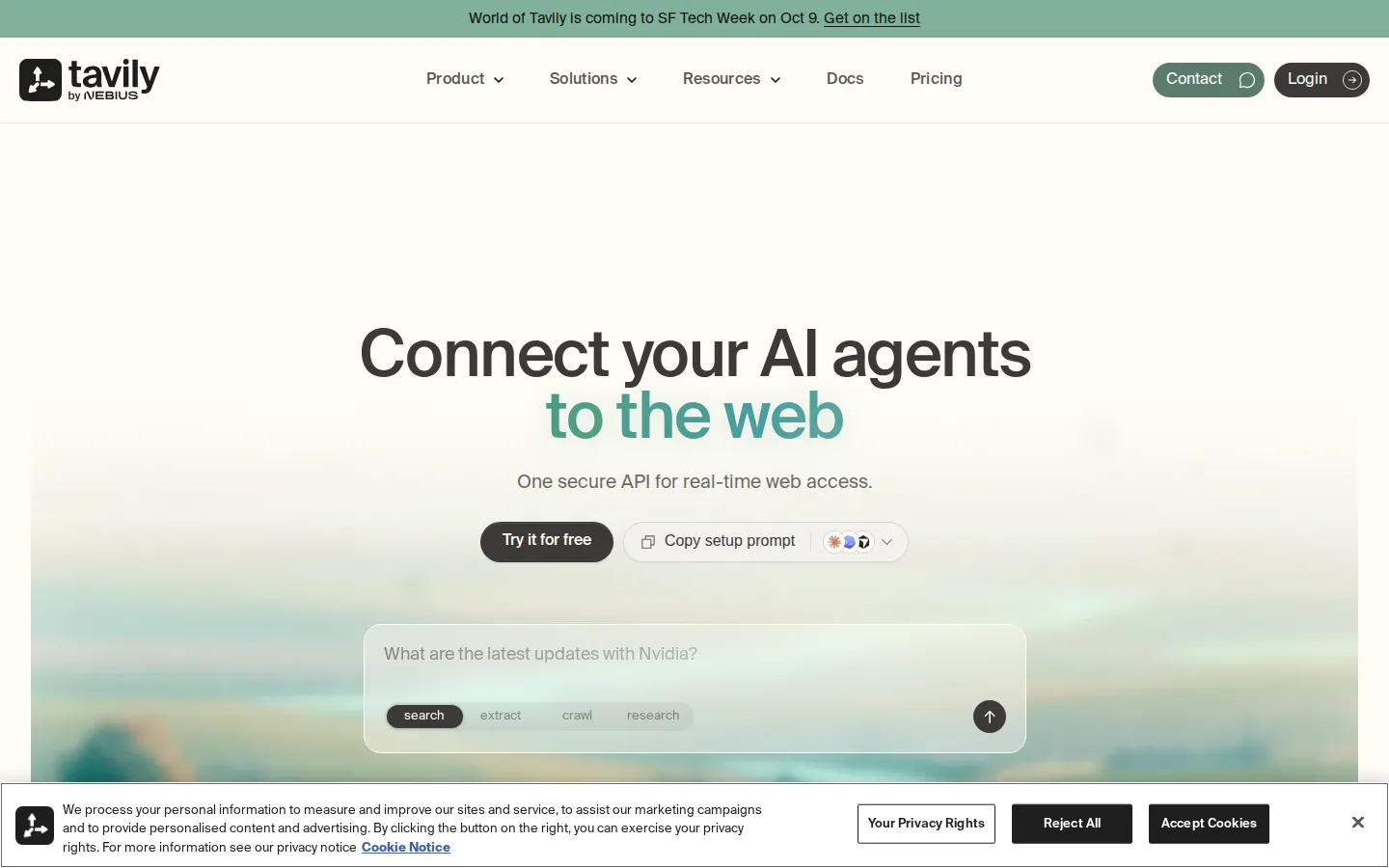
Tavily is a web access layer and API that connects AI agents and large language models to real-time information from the open web. Instead of scraping pages or wiring together a general-purpose search engine, developers send one authenticated request and receive relevant results, cleaned page content or a finished research answer that a model can consume directly. The company describes itself as building the retrieval stack for agents, and the brand is presented as Tavily by Nebius after the acquisition announced on its blog.
The platform is organised around five endpoints. Search returns fast, relevant web results for a query, with options such as search depth, maximum results and an included answer. Extract pulls clean, structured content from one or more URLs so a model reads text instead of raw HTML. Crawl walks an entire website and extracts content from its pages, while Map discovers the URLs that exist across any site, which is useful before a targeted crawl. Research runs an agent that performs in-depth, multi-step web research and returns a synthesised result.
Two themes run through the product. The first is grounding: retrieved content comes back structured and chunked for models so agents reason over facts and hallucinate less. The second is production readiness. Tavily advertises a retrieval stack with real-time search, intelligent caching and indexing that keeps latency predictable as traffic grows, and it publishes figures including 300 million monthly requests handled, a 99.99% uptime SLA, 180 ms p50 latency on /search and more than two million developers using the API.
Safety sits inside the request path. Requests pass through security, privacy and content validation layers that the company says block PII leakage, prompt injection and malicious sources. A redaction option detects and strips personal data such as email addresses before a query runs, returning a blocked-query error when personal data is found. Enterprise plans add custom call volumes, custom rate limits, enterprise-grade support with SLAs and enterprise security and privacy controls, and a separate trust centre documents the compliance posture.
Integration stays deliberately lightweight. Tavily ships Python and JavaScript SDKs, full API documentation, an MCP server and setup prompts for coding assistants such as Claude, Codex and Cursor, and it advertises drop-in integration with leading model providers including OpenAI, Anthropic and Groq. Its customer list includes IBM, JetBrains, MongoDB, Groq, LangChain, Mastercard, AWS and BMO. Developers sign up free, copy an API key from the dashboard and start calling endpoints with 1,000 free credits every month.
Tavily Core Features
Real-time web search
the Search endpoint returns ranked results with roughly 180 ms p50 latency.
Structured extraction
Extract cleans and chunks page content so models read text instead of HTML.
Whole-site crawling
Crawl walks a website and extracts content from its individual pages.
Site URL mapping
Map discovers every URL on a domain before you run a targeted crawl.
Deep research agent
the Research endpoint runs multi-step web investigation and returns a synthesised answer.
Built-in safeguards
PII redaction and prompt-injection blocking run inside the request path.
Framework integrations
SDKs, an MCP server and drop-in support for OpenAI, Anthropic and Groq.
Free monthly allowance
1,000 API credits every month with no credit card required to start.
Who is Tavily for?
Tavily serves technical teams that need to give software live access to the web. AI application developers building chatbots, copilots and assistants are the core audience: they add Tavily calls so their models answer with current facts instead of stale training data. Retrieval and RAG engineers use the Search, Extract and Crawl endpoints to build pipelines that fetch pages, chunk them and index grounded context for question-answering systems. AI agent builders working with frameworks such as LangChain, LlamaIndex or the Model Context Protocol use Tavily as the search tool their agents call at runtime, which is why the company publishes an MCP server and drop-in integrations for OpenAI, Anthropic and Groq. Startup teams and solo developers typically start on the free tier of 1,000 monthly credits, prototyping a product that answers questions about news, markets or niche domains, then move to the Project or pay-as-you-go plans as traffic grows. Product and data teams inside larger organisations use it to enrich internal records with public web data, monitor companies and markets, or add a research step to an existing workflow. Analysts and researchers use the Research endpoint to gather and synthesise sources without manual browsing. Financial services is the first industry solution Tavily markets, aimed at teams that need compliant, auditable retrieval. Teams that reach Tavily through partners behave similarly, since it is published on the Databricks MCP marketplace and integrated with IBM's WatsonX platform. Enterprises with strict security requirements fit as well: the platform advertises custom rate limits, SLAs, PII redaction and prompt-injection filtering, and its customers include IBM, Mastercard, AWS, JetBrains and BMO. Platform and compliance engineers at regulated firms evaluate it too, because the trust centre, privacy policy, terms and acceptable-use policy it publishes are the artefacts procurement reviews. Students also qualify for a free account, and the certification programme targets developers who want to prove they can build with the API.
Tavily Use Cases
Ground a customer support chatbot in current product documentation and release notes.
Build a RAG pipeline that extracts and chunks web pages before indexing them.
Equip a coding agent with web search so it can check API changes and library versions.
Monitor competitors by crawling their sites and mapping newly published URLs.
Enrich CRM and data records with public company information pulled from the live web.
Run financial or market research with the Research endpoint and cite the sources found.
Answer news and current-events questions inside an assistant that lacks recent training data.
Prototype an AI search product on free monthly credits, then scale onto paid plans.
Tavily Pros and Cons
Pros
- Generous free tier documented on the pricing page: 1,000 API credits every month with no credit card required.
- Published performance numbers: 180 ms p50 latency on /search, a 99.99% uptime SLA and 300M+ monthly requests handled.
- Five endpoints (Search, Extract, Crawl, Map, Research) cover retrieval and deep research behind one API key.
- Named enterprise customers including IBM, Mastercard, AWS, JetBrains, MongoDB and Groq, with public case studies.
- Safety features such as PII redaction and prompt-injection filtering are built into the request path, not bolted on.
Cons
- Pricing is credit-based and different request types consume different amounts, so spend is harder to forecast than a flat fee; the pricing page does not publish a full per-endpoint credit table.
- Credits reset on the first day of each month and requests stop when the allowance is exhausted, which can interrupt traffic on the free tier.
- It is an API-first product with no no-code end-user app, so non-developers need engineering help to integrate it, and support on lower tiers is email only.
FAQ About Tavily
Tavily Pricing
Freemium: a free tier with 1,000 API credits per month and no credit card, pay-as-you-go credits at $0.008 each, a $30 per month Project plan with 4,000 credits and higher rate limits, and custom Enterprise pricing; no annual discount is advertised.
Check official pricingFree
1,000 API credits each month, no credit card required and email support; free accounts are also offered to students.
Pay As You Go
Pay only for the credits you use, cancel anytime, email support included.
Project
4,000 API credits per month plus higher rate limits and email support; a slider adjusts the plan size.
Enterprise
Custom API call volumes and rate limits with enterprise-grade support, SLAs, security and privacy controls.
Tavily Alternatives

Ecommerce Data API
Amazon product, keyword, traffic and market research data through a REST API, remote MCP server and Agent Skill for developers and AI workflows.

FastRouter
FastRouter is a unified LLM gateway that gives developers one OpenAI-compatible API for 200+ models from providers such as OpenAI, Anthropic, Google, and xAI. It adds automatic model routing, fallbacks, caching, spend caps, role-based access, guardrails, and per-request observability, while passing provider token prices through with no markup on any plan, including the free tier.

MapGO
How far is this point from the sea? From the nearest border? Which country, region and district are it in? MapGO answers those in one click.