
Stably
Stably is an AI-powered web application testing platform that generates Playwright tests from plain-English descriptions. It runs tests in the cloud or your CI pipeline with screenshots, traces, and recordings, then proposes automatic fixes when tests drift. Teams can plan coverage, create test suites, run them, and repair broken tests through a CLI, a visual editor, or a no-code interface. Stably is backed by Y Combinator and also publishes Orca, an open-source agentic IDE.
What is Stably?
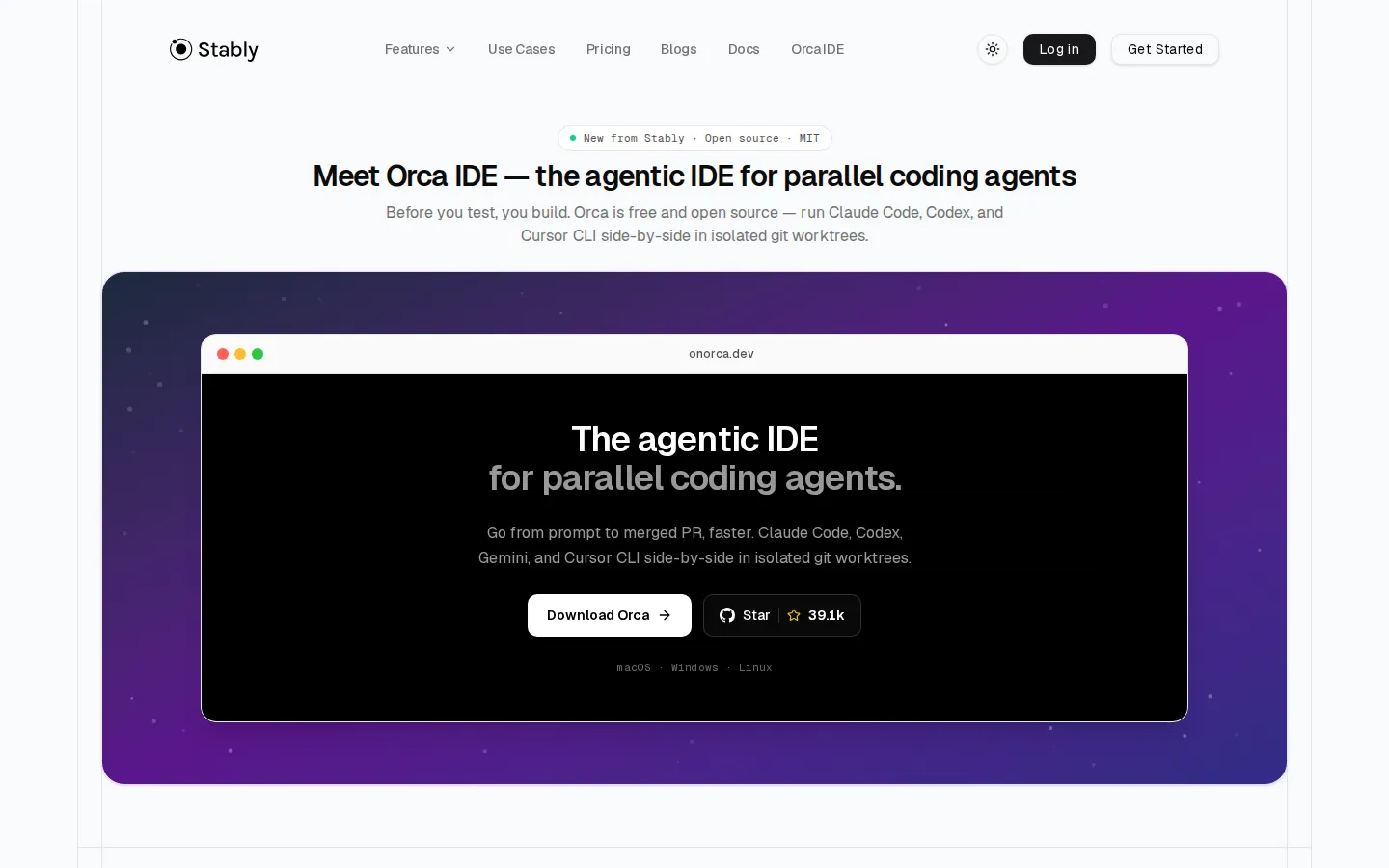
Stably is an AI-powered web application testing platform that generates, runs, and maintains Playwright tests from plain-English descriptions. Users describe the test they want in natural language, and Stably produces explicit, reviewable test steps that execute in real browsers. The workflow is organized around four commands: Plan, Create, Run, and Fix. Plan helps teams strategize testing coverage by turning test intent, documentation, and tickets into coverage ideas. Create generates Playwright suites with clear step-by-step actions. Run executes tests in Stably's cloud or in the team's CI pipeline, capturing screenshots, traces, and video recordings for debugging. Fix and Review proposes updates when tests drift due to UI changes, and flags likely real product bugs for engineer review. Stably can be used through an interactive CLI agent, a visual editor that syncs to reviewable Git changes, or a no-code web interface for non-engineers. Usage is metered with credits that cover both AI tokens and browser time, with a free Hobby tier that includes monthly credits and pay-as-you-go beyond that. The company is backed by Y Combinator and also maintains Orca, an open-source MIT-licensed IDE for running multiple coding agents side-by-side in isolated git worktrees, positioning Stably as part of a broader agentic development stack. The visual editor lets users build tests by recording their own steps in a browser preview, then syncs the result to Playwright code with reviewable changes in Git, keeping engineering in control of what ships. The no-code interface targets QA and product managers, letting them describe tests without writing code before handing off to developers. Stably's credits system meters both AI token usage, which varies by model from roughly $0.30 to $15 per million tokens, and browser time at $0.01 per minute, with monthly allowances included in each plan. The company is backed by Y Combinator and counts companies including Tesla, Samsara, ClickHouse, and OpenArt among its showcased customers. Stably also develops Orca IDE, an open-source MIT-licensed tool for running coding agents such as Claude Code, Codex, and Cursor CLI side-by-side in isolated git worktrees, positioning testing as the verification layer for agentic development workflows. Detailed documentation covers the CLI quickstart, cloud execution, and running tests locally, and the platform is designed to slot into existing workflows without a full process reset.
Stably Core Features
Plain-English test creation
Describe the test you want in natural language and Stably generates explicit, reviewable Playwright steps
CLI agent workflow
Plan coverage, create suites, run tests, and fix broken tests from the terminal with an interactive AI agent
Cloud and CI execution
Run tests in Stably's cloud or your CI pipeline with screenshots, traces, and video recordings
Autofix and drift detection
Stably proposes updates when tests drift and flags likely real product bugs for engineer review
Visual editor
Build tests visually with recorded steps and sync to reviewable Playwright code changes in Git
No-code platform
QA and product teams can write tests without writing code, then hand off to engineering
Credits-based usage
Pay-as-you-go credits cover AI tokens and browser time, with free monthly credits on the Hobby plan
Open-source Orca IDE
Run multiple coding agents side-by-side in isolated git worktrees before testing their output
Who is Stably for?
Stably serves engineering teams that want reliable end-to-end testing without the usual maintenance burden. QA engineers use it to draft test suites in plain English and spend their time reviewing flagged failures instead of writing brittle selectors. Software developers and engineering managers use it inside CI to catch regressions before merging, with autofix handling test drift as the product changes. Product managers and non-technical team members use the no-code interface to describe user journeys they want covered without touching code. Fast-moving startups use the free Hobby tier to stand up coverage quickly, while larger organizations use Team and Growth plans for concurrent browser execution and dedicated support. The platform also fits testing agencies and QA consultancies that need to generate suites for multiple client products. Stably is particularly useful for teams whose web apps change frequently, since its core value is keeping tests up to date automatically. Organizations adopting agentic development workflows can pair Stably with the open-source Orca IDE to test the output of parallel coding agents. Testing agencies and QA consultancies use Stably to generate and maintain suites across many client products, amortizing the cost of coverage. Engineering managers use it to reduce the time developers spend fixing flaky tests, freeing them for feature work. Startups use the free Hobby tier to stand up meaningful coverage early, then scale to Team and Growth as their test volume grows. Enterprises evaluating Stably can use the custom Enterprise plan for SSO, SLAs, and volume discounts. Teams adopting agentic coding workflows pair Stably with Orca IDE to verify the output of parallel coding agents before merging.
Stably Use Cases
Generate a full regression suite for a web app by describing key user journeys in plain English
Repair flaky tests automatically when the product UI changes and existing tests start drifting
Run end-to-end browser tests in CI on every pull request with traces for debugging failures
Let product managers draft test scenarios in a no-code builder without engineering help
Catch real product bugs by reviewing Stably's flagged failures before each release
Create test coverage for onboarding flows, checkout, and signup forms across browsers
Use Orca IDE to run parallel coding agents, then verify their merged changes with Stably tests
Scale QA capacity with concurrent browser execution on Team and Growth plans
Stably Pros and Cons
Pros
- Dramatically faster test creation: plain-English prompts become Playwright suites in minutes
- Self-maintaining tests with autofix reduce the chronic burden of test drift
- Flexible credits pricing with a free Hobby tier and pay-as-you-go scaling
- Backed by Y Combinator with an open-source Orca IDE and thorough documentation
Cons
- AI and browser usage credits can add up quickly for large, frequently run test suites
- AI-generated tests still need engineer review for complex, highly custom scenarios
- Enterprise features like SAML SSO and SLAs are only available on custom contracts
FAQ About Stably
Stably Pricing
Freemium: Hobby starts at $0/month with $10 of included credits, Team is $60/month, Growth is $250/month, and Enterprise is custom with SSO and SLAs.
Check official pricingHobby
$10/month included credits, up to 1 concurrent browser, basic agent access, pay-as-you-go afterwards
Team
$60/month included credits, up to 50 concurrent browsers, full agent access, priority support
Growth
$250/month included credits, up to 100 concurrent browsers, dedicated support
Enterprise
Volume discounts for teams spending over $1k/month, SAML/Enterprise SSO, SLAs, 24/7 support
Stably Alternatives

Prelint
Prelint is a pull-request reviewer that checks every PR against your product specs. As AI writes more code, it drifts from intent: pricing rules change, compliance is skipped, domain language fragments, and scope creeps. Prelint catches business logic, compliance, tooling, domain language, scope, and strategic drift before it ships, flagging inline findings with suggested fixes linked to your spec.

JavaScript Tools
JSTools.Space is a free, privacy-first developer utility platform featuring 80+ browser-based tools. Format JSON, HTML, CSS, XML, and SQL; generate passwords, API keys, UUIDs, JWT secrets, and nonces; encode/decode Base64 for text, images, audio, and files; edit Markdown and export to HTML, PDF, Word, Jira, Slack, Notion, Confluence; convert timestamps and time zones; validate YAML and XML; and much more. All processing stays in your browser — no accounts, no uploads, no ads.