
Soku AI
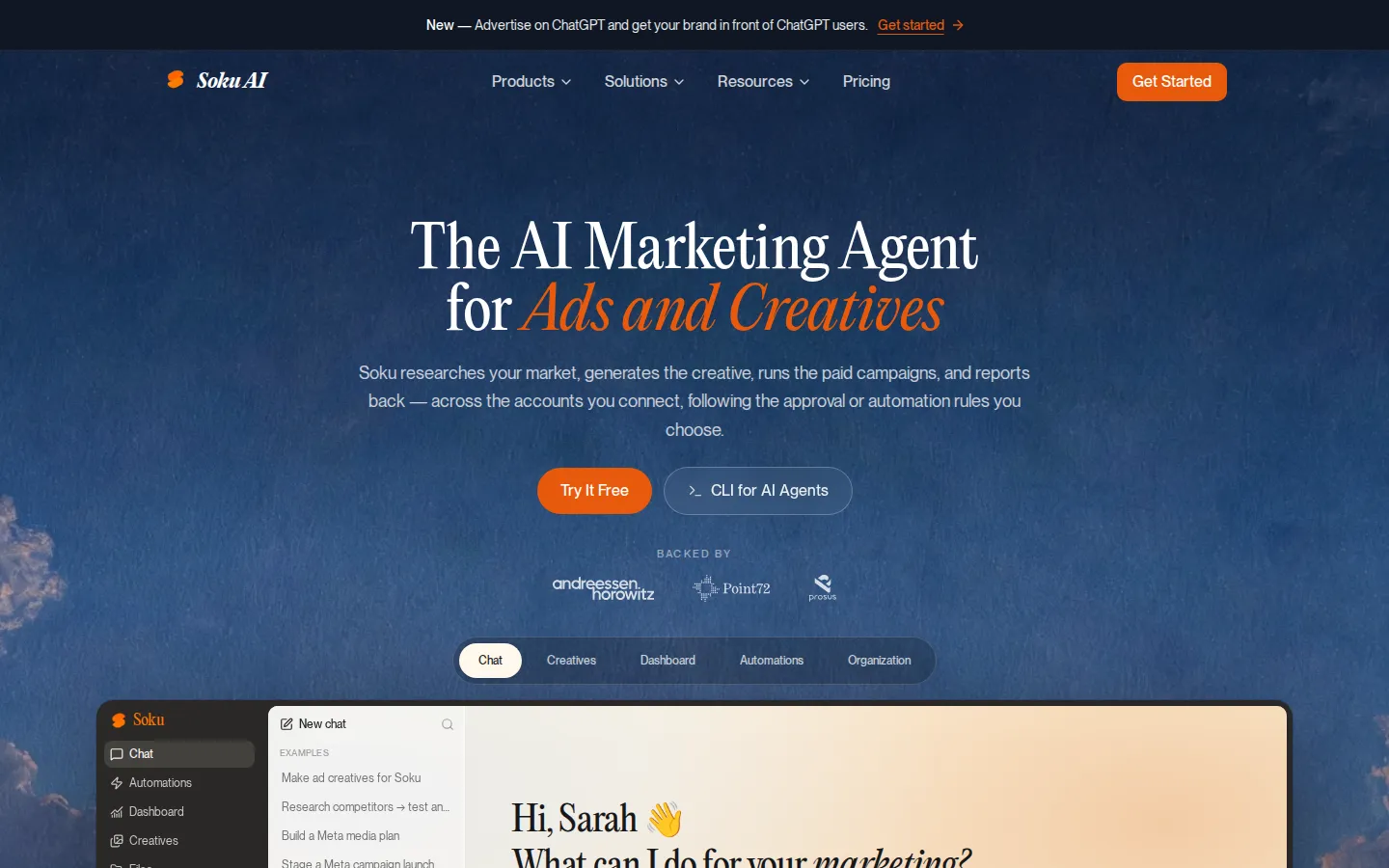
Soku AI is an AI marketing agent for paid advertising and analytics. It connects Meta, Google, TikTok and other ad accounts plus GA4, Shopify and Search Console, then monitors performance, generates creatives, publishes SEO pages and reports back. Workflows run under the approval or automation rules you set, supported actions are logged, and a free plan with 2,000 credits makes evaluation cheap.
What is Soku AI?
Soku AI is an AI marketing agent, built by About Intelligence Inc. and described on the site as a Nexad company, that runs paid advertising, SEO, social and analytics work through conversation rather than a dashboard. You connect the accounts you authorize — Meta Ads, Google Ads, TikTok Ads, LinkedIn Ads, Reddit, Pinterest, Snapchat, Microsoft, Amazon, Apple Search, Quora, Criteo, Taboola, Outbrain and Spotify Ads, alongside GA4, Shopify, Search Console and other data sources — and the agent audits them on day one, sets a strategy, arms monitors and schedules recurring automations.
The product describes its loop as perceive, decide, act. Soku watches ads, SEO, social and site performance for shifts that matter, judges routine changes inside guardrails you configure, and then acts — pausing, shifting budget, publishing pages or refreshing creatives when the action is safe. Every decision is written back to a live optimization log with the reason why, and supported agent and integration activity appears in the workspace Activity log.
Beyond monitoring, Soku produces work: ad creatives and video or image variants, landing pages and blog posts published through a reverse proxy on your own domain, weekly performance reports with revenue, blended ROAS and CAC, root-cause diagnoses, cross-channel comparisons, and alerts written as decisions you can act on.
Write-capable workflows are not enabled by default. They must be turned on separately and then follow the approval or automation rules configured for the workspace, so a budget increase can be routed to a one-tap approval. Teams can graduate from analysis-only access, to recommendations, to acting with approval, to full autopilot at their own pace. Agencies can ship client-ready reports under their own brand, with each direct customer or unrelated end client using a separate Organization.
Soku also exposes the same accounts to other AI tools: a CLI installed with npm, an MCP connection at api.soku.ai/mcp, and a published OpenAPI specification for the agent-facing API. Connections are permissioned and, where supported, revocable at the source platform through OAuth or partner authorization. Alongside the agent, the site hosts free single-task tools such as a URL-to-video generator, a design generator and a video maker, plus pages for models, prompts, skills and an ad library, and it promotes ChatGPT Ads as a newly supported channel. Pricing is credit-based, with a free tier and a monthly credit grant on every plan. The site states Soku is backed by Andreessen Horowitz, Point72 and Prosus.
Soku AI Core Features
Perceive-decide-act loop
Soku watches paid ads, SEO, social and site performance for shifts, judges routine changes inside your guardrails, acts on the safe ones, and logs every move with the reason why.
Paid ads management
Launch campaigns, ad sets and creatives from a brief, shift budget to winners, pause fatigued creative and tune bids and audiences against ROAS or CPA targets on Google, Meta, TikTok and other ad platforms.
Creative generation
Produce ad creatives, hooks, angles and video or image variants, then upload approved winners to connected ad accounts for the next test.
SEO publishing
Generate and publish landing pages and blog posts, track keyword coverage, submit new URLs to Google and serve pages through a reverse proxy on your own domain.
Social planning and publishing
Draft and schedule a weekly content calendar, publish posts on cadence across connected channels and spin up campaigns around trends and seasonal moments.
Cross-channel analytics
Read Meta, Google, TikTok and GA4 on the same spend and outcome scale, with weekly performance reports, root-cause diagnoses and alerts that arrive as decisions.
Approval and autopilot controls
Graduate from analysis-only access to recommendations, act-with-approval and full autopilot, with write workflows enabled separately and logged.
CLI, MCP and API access
An npm CLI, an MCP connection at api.soku.ai/mcp and a published OpenAPI specification let Claude Code, Codex, Cursor, VS Code and ChatGPT work against the same accounts.
Who is Soku AI for?
Soku AI is built for the roles that own a growth loop: performance marketers, campaign managers, Google Ads owners, SEO specialists, social media managers, email and CRM marketers, and CMOs or growth leads. The site frames their daily questions, such as why CPA spiked across Meta and Google, which campaigns spent with zero conversions, where to reallocate budget for the best ROAS, and which keyword gaps exist versus the top three competitors. Agencies are a first-class audience. Soku positions itself around agency-grade work: an analyst on every client account, client-ready reports published under your own logo so clients never log into a Soku dashboard, and write-capable workflows gated behind the approval or automation rules configured for the workspace. Each unrelated end client is expected to use a separate Soku Organization. In-house performance teams use it to run paid ads, creative testing and account monitoring in one loop, while campaign managers use it to move from a brief to live campaigns with budget pacing and experiment tracking. Email and CRM marketers get the same treatment for campaigns, subject lines and lifecycle flows, and CMO-level users ask for blended CAC, channel profitability and full-funnel conversion rates. Solo operators and individual creators fit the Creator and Starter plans, which cover AI video generation, a small number of brands and members, and 5 to 10 ad accounts per channel. Teams with frequent AI workflow execution fit Pro, which removes brand, member and ad-account limits and adds priority support. Developers and AI-native teams who prefer their own harness can drive Soku through the CLI or the MCP connection from Claude Code, Codex, Cursor, VS Code or ChatGPT. Organizations that need scale, security and control, including SSO, a security review and a dedicated success manager, are routed to the Enterprise plan. It is a poor fit for anyone without advertising or analytics accounts to connect, because the agent's value starts with authorized access to that data.
Soku AI Use Cases
Diagnose a CPA or ROAS spike across Meta and Google without assembling the comparison by hand.
Reallocate budget toward the best-performing channel, campaign or audience with approval rules in place.
Generate and test fresh ad creatives, then pause fatigued variants when performance drifts.
Publish SEO landing pages and blog posts and track keyword coverage and rankings over time.
Schedule and publish a weekly social content calendar across the channels you connect.
Produce client-ready performance reports under your own agency brand instead of a Soku dashboard login.
Connect Soku to Claude Code, Codex or Cursor so an existing AI agent can read marketing data and stage campaign changes.
Monitor ad accounts around the clock and route risky changes to a one-tap approval.
Soku AI Pros and Cons
Pros
- One agent covers paid ads, SEO, social and analytics across the accounts you connect, instead of separate reporting and automation tools.
- Credit-based pricing with a free tier and a low annual entry point, so light users can evaluate the agent before committing.
- Guardrails are explicit: write access is enabled separately, risky changes route to approvals, and supported actions are recorded in an Activity log.
- Open surface for builders, with a CLI, an MCP connection at api.soku.ai/mcp and a published OpenAPI specification for the agent-facing API.
- Agency-oriented reporting publishes client-ready reports under your own brand, with one Organization per client.
Cons
- Credits meter every analysis, creative generation and agent turn, so creative-heavy or automation-heavy months can exhaust the included monthly grant; additional credits cost $3 per 1,000.
- Capabilities are not uniform: write-capable workflows must be enabled separately and are only supported where available, and the coverage and retention of agent and integration activity vary by feature.
- The pricing page is inconsistent — the Creator plan card shows $15 per month billed yearly, while the FAQ describes Creator at $19 per month with 7,000 credits a month.
FAQ About Soku AI
Soku AI Pricing
Soku AI uses credit-based pricing. The Free plan costs $0 per month and includes 2,000 credits with no credit card required. Paid plans add a monthly credit grant: Creator shows $15 per month billed yearly ($180 per year, 84,000 credits per year), Starter $39 per month billed yearly ($468 per year, 240,000 credits per year), and Pro $199 per month billed yearly ($2388 per year, 2,400,000 credits per year). Annual billing gives a 20% discount, and Enterprise is a custom contract with unlimited credits. Extra credits cost $3 per 1,000 and can be bought in 10,000 to 100,000 credit packs by Starter and Pro admins.
Check official pricingEnterprise
For organizations requiring scale, security and control. Everything in Pro plus unlimited credits, SSO with a security review and a dedicated success manager. The site invites you to talk to the founders to scope it.
Soku AI Alternatives

Fuse AI
Fuse AI combines a large B2B contact database with AI research agents, buying-signal monitoring, and multi-channel outreach in one workspace. Teams can search for prospects, enrich records across dozens of data providers, watch target accounts for intent, and run email, LinkedIn, and phone sequences. It is aimed at revenue teams that want less tool switching and more consistent outbound execution.

AdStellar
AdStellar pairs an AI creative studio with an AI media buyer built for Meta advertisers. Paste a product URL and it generates image ads, video ads, and UGC avatar creatives; its AI Campaign Builder then assembles ad sets, audiences, copy, and budgets from your proven winners, launches them in one click, and keeps pausing waste while scaling what converts.

Lifetime QR Codes
Dynamic QR codes from $50 with a one-time payment. Edit destinations anytime, avoid recurring subscriptions, and save more with volume discounts