
Segmind
Segmind is a serverless AI model platform and gateway for image, video, audio and voice generation. It exposes 550+ models from Alibaba, Kling, OpenAI, Google, Black Forest Labs and ElevenLabs through a single REST API, plus PixelFlow, a visual canvas that chains models into reusable workflows and republishes them as production endpoints. Billing is pay-as-you-go credits, monthly subscriptions or dedicated GPUs.
What is Segmind?
Segmind is a serverless generative AI platform and AI gateway built for developers who need image, video, audio and voice models without managing GPUs. Rather than training its own foundation models, it aggregates more than 550 hosted models from leading labs, including Alibaba, Kling, Black Forest Labs, OpenAI, Google, Bria, Ideogram, ByteDance, Meta, ElevenLabs and Stability AI, behind one REST API, one API key and one billing account. The catalogue spans text-to-image, image editing, image-to-video, text-to-video, lip-sync, background removal, upscaling, faceswap, speech synthesis, transcription, music generation and 3D object creation.
The core developer product is the Segmind AI Gateway. A single endpoint at api.segmind.com accepts an x-api-key header and routes each request to the chosen model, so switching from Flux to Nano Banana, or from Kling to Seedance, means changing a model string instead of rewriting an integration. Supporting features include automatic failover between providers, bring-your-own-key at zero markup, list-price billing, asynchronous job submission for long video renders, and S3 delivery of finished assets.
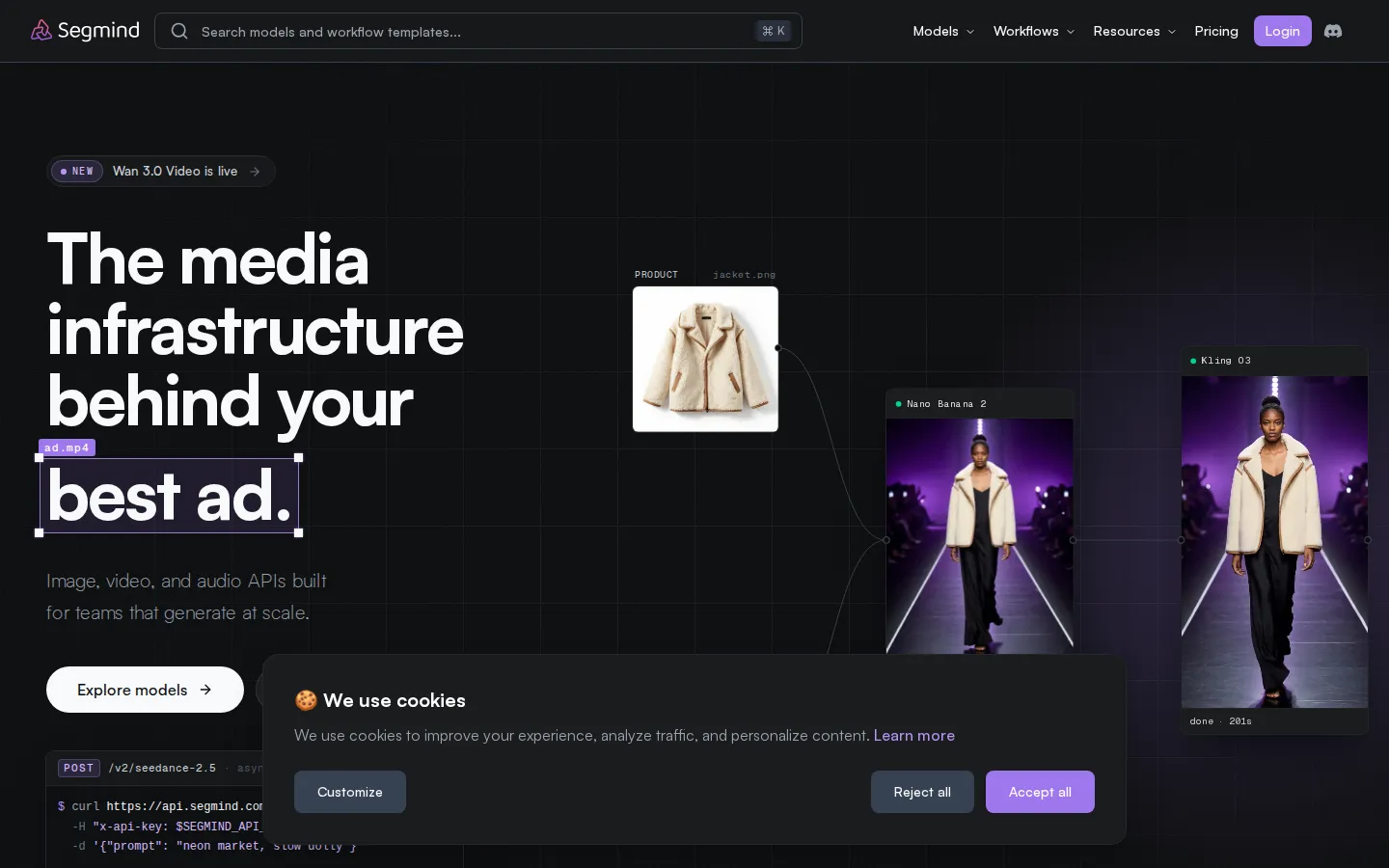
PixelFlow is the second pillar. It is a node-based visual canvas where users drag image, video and audio models onto a graph, connect inputs and outputs, and run the whole chain in one click. Any workflow can then be published as its own production REST API, letting teams turn a multi-step creative pipeline into a callable service without writing orchestration code. Segmind ships template flows for ecommerce listings, fashion imagery, home decor staging, marketing assets, advertising creatives, social media content, illustration and visual effects.
On the infrastructure side, Segmind offers dedicated endpoints billed by GPU hour or GPU second across H100, A100, L40, A40, A5000 and A6000 hardware, with unlimited requests and auto-scaling. Fine-tuning is available for supported image models using roughly twenty images, priced by GPU time and step count. Rate limits, storage, monthly credits and support response times scale across the Flexible, Pro, Business and Scale plans, while an Enterprise tier adds a 99.99% SLA, SOC 2 compliance and dedicated Slack support.
The platform is built for production reliability: workloads run on serverless infrastructure that Segmind operates, so there is no cluster to provision and no idle capacity to pay for. Usage is metered per generation, per second or per character depending on the model, and credits can be topped up at any time. Model documentation, ready-made code samples and a public community Discord sit alongside the console, so a developer can move from a documentation page to a working request in minutes rather than days.
Segmind Core Features
550+ models behind one API
Image, video, audio, speech and 3D models from Alibaba, Kling, OpenAI, Google, Black Forest Labs, ElevenLabs and more.
Segmind AI Gateway
A single api.segmind.com endpoint with an x-api-key header routes requests to any supported model without integration rewrites.
PixelFlow visual workflows
A node-based canvas that chains models into multi-step pipelines and republishes them as production REST APIs.
Automatic failover and BYOK
Requests reroute when a provider degrades, and bringing your own provider key is billed at zero markup.
Async jobs with S3 delivery
Long video and batch renders submit asynchronously and write finished assets straight to storage.
Dedicated GPU endpoints
H100, A100, L40, A40, A5000 and A6000 capacity with unlimited requests and auto-scaling, billed per second.
Model fine-tuning
Train supported image models on roughly twenty images, priced by GPU time and step count, from a $10 account balance.
Transparent pay-as-you-go billing
Credits meter every call per generation, second or character, with volume discounts and detailed usage analytics.
Who is Segmind for?
Segmind is aimed at developers and technical teams embedding generative media into products, not at casual users looking for a consumer chat app. Backend and machine learning engineers are the primary audience: they want a stable REST endpoint, an API key, predictable per-call pricing and no GPU fleet to operate. Startups and SaaS builders use it to add image, video or voice generation to an existing product quickly, because one integration unlocks hundreds of models and the billing sits on one invoice. Product teams comparing model providers value the ability to swap between Flux, Nano Banana, Kling and Seedance through configuration rather than a new contract. Agencies, creative studios and production houses use PixelFlow to standardise repeatable pipelines such as product photography, fashion shots, interior staging and ad creatives, then expose those flows to internal tools or clients as APIs. Ecommerce and marketing teams apply the same workflows to catalogue image generation and campaign video without a dedicated ML team. Platform builders and integrators choose the dedicated GPU endpoints when they need guaranteed throughput, while enterprises evaluating compliance go for the tier with a 99.99% SLA, SOC 2 reporting and dedicated Slack support. Researchers and independent builders fine-tune image models on the same account, paying only for the GPU seconds consumed. Content teams that run repetitive asset production are a secondary audience. Instead of subscribing to several single-model tools, they keep every image, video and audio task inside one dashboard and one credit balance, which simplifies cost tracking and access management for a small team. Anyone who needs breadth across model vendors, predictable per-call rates and an API-first workflow will find the fit strongest here.
Segmind Use Cases
Generate ecommerce product images and marketplace-ready listings from a handful of source photos.
Turn a still product or location shot into a cinematic clip with Kling, Seedance or Wan video models.
Produce styled fashion imagery and virtual try-on shots for campaign and lookbook pages.
Stage empty interiors with AI furniture and decor for real estate and home decor listings.
Create advertising creatives and social media video variants without a production crew.
Synthesize voiceover, music and sound effects for generated video using ElevenLabs and Google audio models.
Chain image, speech and video models in a PixelFlow graph and publish the result as an internal API.
Fine-tune an image model on a brand's own product set for consistent visual style at scale.
Segmind Pros and Cons
Pros
- One API key and one billing account cover more than 550 image, video, audio and speech models from many labs.
- Pay-as-you-go credits start at $10 with no minimum commitment, so experimentation cost stays low.
- PixelFlow turns multi-model pipelines into visual graphs that can be republished as production REST endpoints.
- Dedicated GPU endpoints and fine-tuning let teams scale beyond shared serverless rate limits.
- Documented SOC 2 compliance and a 99.99% SLA option suit enterprise procurement requirements.
Cons
- Segmind aggregates third-party models rather than building its own, so its roadmap and quality depend on external providers.
- The cheapest entry point still requires a $10 credit purchase, and there is no permanent free tier advertised.
- Dedicated endpoint and support add-ons are priced separately, so predictable high-volume costs need a sales quote.
FAQ About Segmind
Segmind Pricing
Segmind starts with a $10 pay-as-you-go credit balance, then scales through Pro at $39, Business at $99 and Scale at $599 per month, with custom Enterprise pricing, dedicated GPU endpoints billed hourly and optional support packages.
Check official pricingFlexible (Pay as you go)
Buy credits and pay only for what you use across all model APIs, with 1 GB storage, 5 Pixelflows, 60 requests per minute and community support.
Pro
For professionals and small teams: $50 monthly credits, 10 GB storage, 120 RPM, Pixelflows basic and support within 5 business days.
Business
For production environments: $99 monthly credits, 100 GB storage, 500 RPM, 2 business day support and PixelFlow premium templates.
Scale
For large companies: $599 monthly credits, 1 TB storage, 1000 RPM pooled, 1 business day support and detailed usage analytics.
Enterprise
Custom solutions with a 99.99% SLA, dedicated Slack support, SOC 2 compliance, private deployment and white-glove onboarding.
Serverless model pricing
Pay-as-you-go rates per model, for example Nano Banana at $0.04 per generation with an average cost near $0.002; volume discounts available.
Dedicated endpoints
Billed per GPU rather than per call on A5000, A40, A6000, L40, A100 and H100 hardware, with auto-scaling from $0.00024 per second.
Fine-tuning
Train supported image models using roughly twenty images on A100, H100 or L40S GPUs, with Flux-Pro runs priced from $3 depending on steps.
Segmind Alternatives

Ecommerce Data API
Amazon product, keyword, traffic and market research data through a REST API, remote MCP server and Agent Skill for developers and AI workflows.

FastRouter
FastRouter is a unified LLM gateway that gives developers one OpenAI-compatible API for 200+ models from providers such as OpenAI, Anthropic, Google, and xAI. It adds automatic model routing, fallbacks, caching, spend caps, role-based access, guardrails, and per-request observability, while passing provider token prices through with no markup on any plan, including the free tier.

MapGO
How far is this point from the sea? From the nearest border? Which country, region and district are it in? MapGO answers those in one click.