
Scite
Scite is an AI-powered research platform built on 1.6B+ Smart Citations and 317M+ full-text scholarly articles licensed from 35+ publisher partners, including paywalled content. It combines a literature-grounded AI Assistant, full-text citation search, citation Reports, Collections, and Reference Check so researchers can verify claims, see whether findings are supported or contrasted, and cite evidence with confidence in one place.
What is Scite?
Scite is an AI research platform that helps people find, read, and evaluate scientific literature. Instead of returning raw citation counts, Scite classifies how each citing paper treats the paper it references: whether it supports the claim, contrasts with it, or merely mentions it. Those labels, called Smart Citations, are produced by a deep learning model trained over 1.6B+ citation statements, and they sit at the centre of every Scite product.
The platform has grown into a suite. Scite Assistant answers natural-language research questions using 317M+ indexed articles and 42M+ full-text sources, and every sentence in an answer links back to the exact statement in the paper it came from, so answers are grounded rather than generated. Scite Search matches queries against citation statements extracted from full text rather than only titles, abstracts, and keywords, which surfaces findings and methods that ordinary academic search misses. Scite Reports lay out every citation a paper has received with the surrounding context text, filterable by classification, section, year, and source type. Collections let users upload a DOI list or sync Zotero and Mendeley libraries, then monitor new citations, retractions, and editorial notices over time. Reference Check accepts a manuscript PDF and shows how every reference has been cited, which is useful before submission and during peer review.
Scite is built on licensing agreements with 35+ publishers including Wiley, SAGE, the Royal Society, BMJ, and IOP, plus the open access corpus, so it can read paywalled full text that general-purpose AI tools cannot reach. Coverage extends beyond journal articles to preprints, books, patents, clinical trials, grants, datasets, and regulatory data, and Scite publishes tallies for journals, institutions, and funders through its Scite Index metrics.
Integration is a large part of the pitch. A hosted MCP server connects Scite to ChatGPT, Claude, Gemini, Copilot, and other MCP-compatible assistants, and it has logged more than 18 million uses. A free browser extension adds citation badges on Google Scholar and PubMed and lets users right-click to ask the Assistant. A Zotero plugin brings Smart Citations into reference management, and a REST API exposes tallies, search, assistant answers, and reference checks as structured JSON. For libraries, Scite Holdings links an institution's subscriptions so users reach more full text.
Scite is now part of Research Solutions, is used by more than 2 million researchers, students, and industry experts, and is trusted by organizations such as Harvard, Stanford, Oxford, Johns Hopkins, Mayo Clinic, and Cornell. The promise is simple: move beyond finding papers to understanding whether the evidence inside them actually holds up.
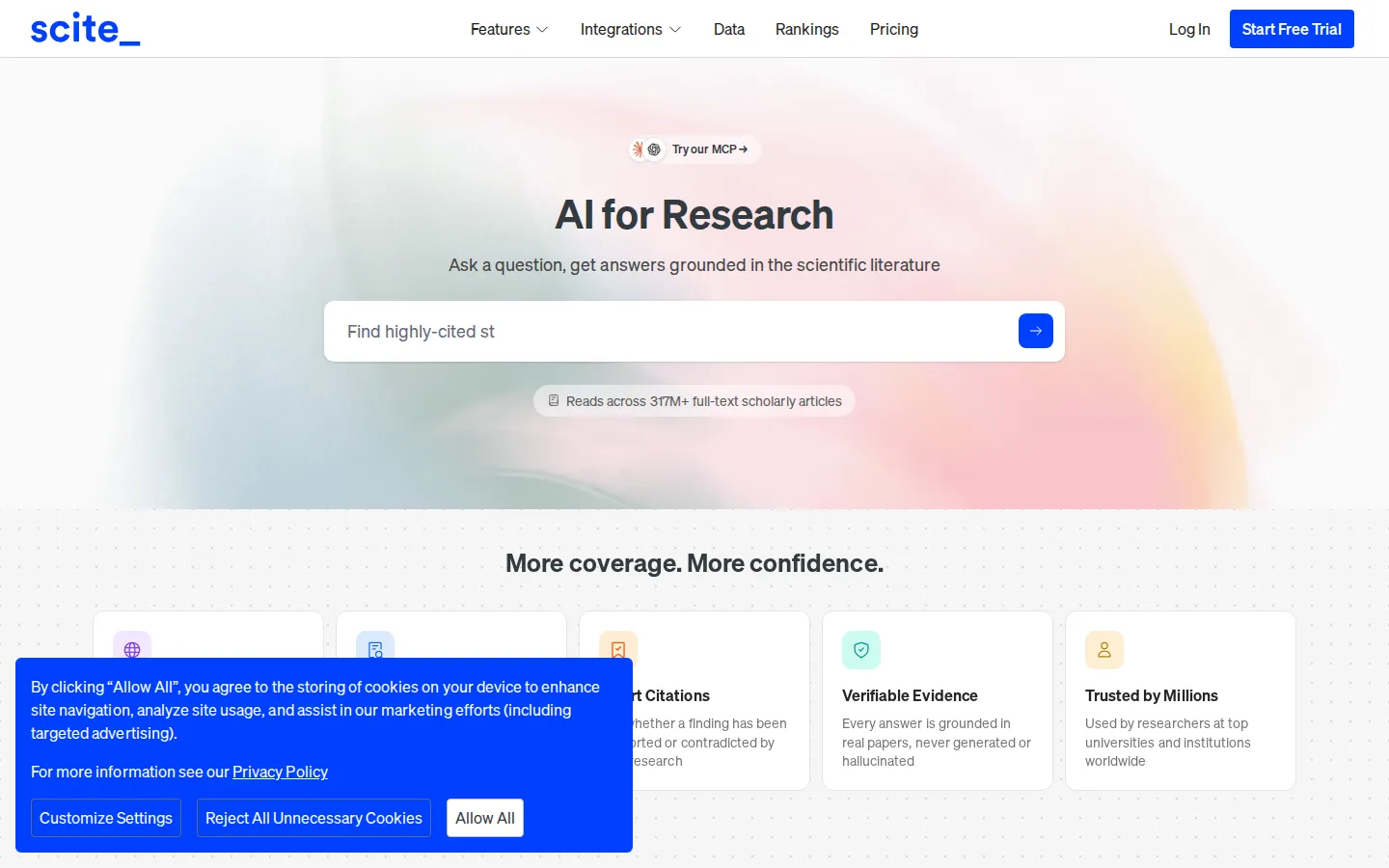
Scite Core Features
AI Assistant answers research questions from 317M+ full-text scholarly articles instead of open web content
Smart Citations classify every citation as supporting, contrasting, or mentioning the cited claim
Full-text citation search matches statements inside papers, not just titles and abstracts
Citation Reports show each citing paper with context text, tallies, year, and section filters
Collections organise papers from Zotero, Mendeley, or DOI lists and monitor new citations
Reference Check scans a manuscript PDF for retractions, editorial notices, and contrasting evidence
MCP server brings Scite into ChatGPT, Claude, Gemini, Copilot, and other AI assistants
REST API returns tallies, search results, assistant answers, and reference checks as structured JSON
Who is Scite for?
Scite is aimed at anyone who has to trust the scientific record rather than just find it. The core audience is academic researchers: PhD students and postdocs building literature reviews, principal investigators tracking how their own papers are cited, and faculty who need to know whether a widely quoted finding has been replicated or challenged. Because every answer links back to the source sentence, it suits people who must defend a claim in a thesis, grant application, or journal submission. Medical and clinical users are a natural fit. Clinicians, epidemiologists, and health technology assessors use Smart Citation tallies to see whether a treatment claim has been contradicted by later trials, while pharmacovigilance and regulatory teams use the patent, clinical trial, and grant datasets to trace an idea from funded proposal to published finding and commercial application. Librarians, research support staff, and bibliometricians use Scite to audit citation quality, catch retractions and editorial notices, and benchmark journals, institutions, and funders with Scite Index metrics. Journal editors and peer reviewers use Reference Check to screen a manuscript's reference list in minutes instead of manually reading every cited work. Industry R&D groups in pharma, materials, energy, and food science use Collections and citation alerts to monitor a competitor's output or a fast-moving field, while students and early-career writers use the Assistant to get oriented in an unfamiliar topic without leaving the peer-reviewed literature. Finally there is a technical audience: developers and AI teams that want scholarly grounding inside their own products. Through the MCP server and the REST API, builders can add citation intelligence to ChatGPT and Claude workflows, internal chatbots, and analytics dashboards. The free Connect plan and free browser extension make it easy for casual users to try Scite inside the AI tools they already use, while Basic and Pro target individuals doing serious literature work and Team and Enterprise plans target universities, hospitals, and companies that need seats, holdings integration, and procurement support.
Scite Use Cases
Literature reviews that need evidence on whether findings were replicated or contested
Fact-checking draft manuscripts before submission by reviewing every cited reference
Systematic reviews screening large citation sets for supporting or contrasting results
Editorial and peer review checks for retracted papers and problem citations
Bibliometrics and research analytics on journals, institutions, and funders
Monitoring a competitor's publication output or retractions in a fast-moving field
R&D and pharma teams tracking clinical trials, patents, and grants alongside publications
AI builders grounding agent answers in licensed scholarly literature through MCP or API
Scite Pros and Cons
Pros
- Reads paywalled full text through publisher agreements, which most AI research tools cannot do
- Every AI answer links to the specific sentence in the specific paper it came from
- Smart Citation tallies add context that raw citation counts never show
- Works inside ChatGPT, Claude, Zotero, and a browser extension without changing your workflow
- A free Connect plan and 7-day trial make it easy to test before paying
Cons
- The free Connect plan excludes Assistant and Search, offering only 25 MCP credits per month
- Advertised $20 and $50 prices assume yearly billing, and team pricing is quote-only
- API access and the widest datasets are limited to the $50 per month Pro plan
FAQ About Scite
Scite Pricing
Scite is freemium: the free Connect plan includes 25 MCP credits per month, Basic costs $20 per month and Pro costs $50 per month on annual billing with API access reserved for Pro, and Team or Enterprise pricing is available on request.
Check official pricingConnect
Free plan, no credit card required: 25 MCP credits per month, use inside ChatGPT, Claude, and other MCP tools, grounded in 300M+ papers, with no Assistant or Search access.
Basic
Billed yearly, saving $96, with a 7-day free trial: full Assistant and Search access, 250 MCP credits per month, article Smart Citation reports, collections up to 1,000 papers, and citation alerts and dashboards.
Pro
Billed yearly, saving $120, with a 7-day free trial: everything in Basic plus API access, 2,500 MCP credits per month, collections up to 10,000 papers, and patent, clinical trial, and grant datasets.
Team & Enterprise
Custom plans for institutions and organizations, including Scite Holdings full-text integration; request a demo or contact sales for pricing.
Scite Alternatives

NexusAi
AI discovery and comparison platform for finding, researching, and evaluating AI tools, apps, agents, models, prompts, and software.

Lexplug
Lexplug is a legal-education platform for law students, pairing a deep research foundation with interactive study tools. It offers 40,000+ case briefs, subject outlines, practice exams, flashcards, videos and podcasts, plus 1L Attack Sheets and a free reference library. Its AI features include Gunnerbot, a case-specific study companion, ELI5 plain-English explanations, and AI-generated briefs for over four million cases.

MaxAsk
MaxAsk is a free search engine run by Maxthon Limited. A query returns web results and image results on one page, and adding a question mark at the end of a query requests an AI answer. It runs in the browser, needs no account, and can be set as a browser default search engine. The same search service is built into the Maxthon browser.