RunInfra
RunInfra, from RightNow, is a hosted inference platform that serves open models behind one API key compatible with both the OpenAI and Anthropic SDKs. It publishes per-token pricing with cached-input discounts, keeps each agent session on the replica that already holds its context, and reports cache hits in usage, so effective input rates land far below list price.
What is RunInfra?
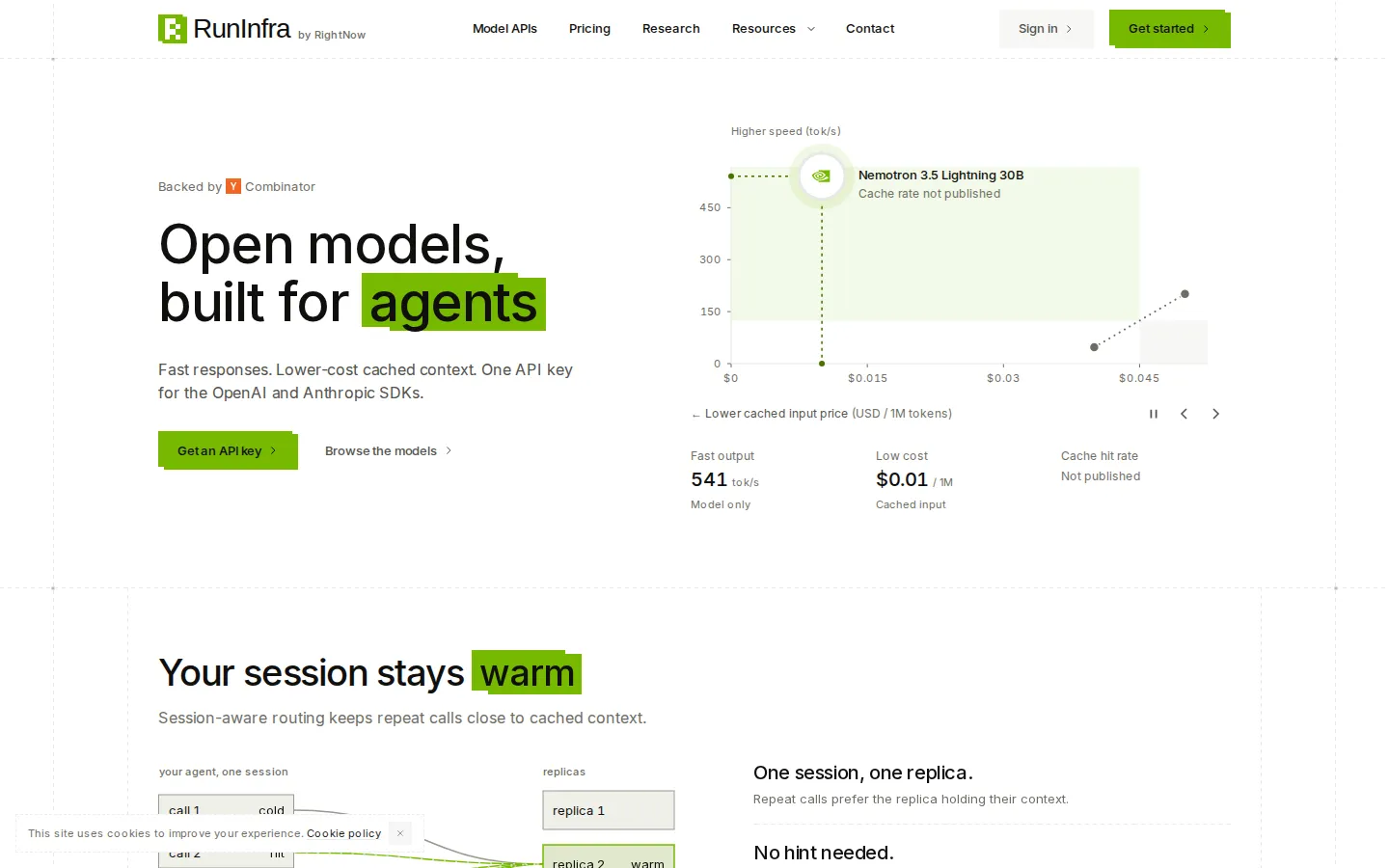
RunInfra is the hosted inference platform from RightNow that sells access to open models under the banner 'Open models, built for agents.' Instead of renting GPUs or wiring up a self-hosted server, developers put credit on one prepaid balance and call a single API key that speaks both the OpenAI chat completions and Anthropic Messages formats at api.runinfra.ai/v1, so existing SDK code keeps working. RunInfra's Model APIs catalogue lists five chat models - Nemotron 3.5 Lightning 30B, Qwen3.8 27B, Ornith 1.5 35B, GLM 5.3 Flash and DeepSeek V4.1 Flash - each publishing input, cached-input and output prices per million tokens, measured output speed and the capabilities it supports, such as tool calling, JSON mode, streaming and image input. Model pages also list limits and availability, prices are shown only for the dimensions that are billed, and a request-a-model route lets buyers ask for a model the catalogue does not host yet. Two ideas carry the product. The first is cached context: on supported models, repeated prompt prefixes are billed at a cached input price as low as $0.01 per million tokens, and cache hits appear in usage. The second is session-aware routing, which sends the repeat calls of one agent session to the replica that already holds its context instead of a random one, so a warm session stays warm. The site reports cache-hit rates over the last 24 hours, up to 99.8%, and an effective input rate per million tokens based on billed agent traffic, with the method published. Setup is self-serve: top up from $5, take a $1 free credit to test, or buy a coding plan from $10 a month for Claude Code, Codex, OpenCode and other agents, with usage that resets every five hours and every week. Security is part of the pitch: TLS in transit, AES-256 at rest, workspace isolation, zero data retention and no training on prompts or completions. Keys are created per workspace and chat models require a workspace key, streaming is supported, and a model that needs a specific reasoning effort publishes that value alongside its capabilities. Every response header shows whether a plan, credits or Standby paid for the request, the usage page shows billed figures, and an optional auto-recharge tops the balance up when it runs low. A Business account adds audit logs and role-based access control at no extra cost, while Enterprise moves to dedicated infrastructure with a shared balance and custom controls. RunInfra sits inside RightNow next to a trust centre that carries the AICPA SOC 2 Type II report, and the site also publishes benchmarks, research, news, a GPU versus API cost calculator, a public status page and the brand assets developers need. Underneath it is a narrow promise: fast responses, lower-cost cached context and one key for the SDKs teams already ship with.
RunInfra Core Features
One key, two SDKs
A single RunInfra key serves OpenAI-compatible chat completions and Anthropic-compatible Messages, so existing client code runs without a rewrite.
Session-aware routing
Repeat calls from one agent session are routed to the replica that already holds its context, so replays land warm instead of one time in four.
Cheap cached context
On supported models, repeated prompt prefixes bill at a cached input price as low as $0.01 per 1M tokens, and cache hits appear in usage.
Published per-token pricing
Every model lists input, cached-input and output prices per million tokens in USD, with no seats and no per-user fees.
Measured model library
The catalogue shows output speed, the cache-hit rate over the last 24 hours and capabilities such as tool calling, JSON mode, streaming and image input.
Self-serve credits and plans
Top up from $5 with a $1 free credit to test, or choose a coding plan from $10 a month with usage resetting every five hours and weekly.
Coding-agent setup
A paste-in prompt lets Claude Code, Codex, OpenCode and other agents configure RunInfra themselves, reviewing each connection before it is applied.
Security by default
TLS in transit, AES-256 at rest, workspace isolation, zero data retention and no training on prompts, with SOC 2 Type II available under NDA.
Who is RunInfra for?
RunInfra is built for teams and developers who call open models in production rather than in a notebook. It suits AI product engineers shipping chat, coding and tool-calling agents that want fast, cheap, repeatable inference behind an API they already know how to use, because one key drives both the OpenAI and Anthropic SDKs. Startups that would rather not rent GPUs, tune batching or babysit replica warm-up get a per-token bill instead of idle capacity, and they can begin with a single $5 top-up. Coding-agent users are a first-class audience: Claude Code, Codex, OpenCode, Cline, Droid, Aider, Goose, Continue, OpenHands and Hermes Agent are among the nineteen agents the site lists as ready, and coding plans start at $10 a month with usage that resets every five hours and every week. Agent builders working with long context and many replayed turns benefit most, because session-aware routing keeps repeat calls on the replica that already holds their context and cached input is billed at the cached rate, so effective input rates drop far below list price. Teams evaluating inference vendors against self-hosting can lean on the published methodology, the per-model cache-hit rates, the measured output speeds and the GPU-versus-API calculator. Engineering leaders who need governance get workspaces with roles and row-level security, zero data retention by default, encryption in transit and at rest, and a SOC 2 Type II attestation available under NDA. Larger organisations with procurement and compliance requirements are served through Enterprise, which adds audit logs, RBAC, custom volume and terms, private infrastructure, SLAs up to 99.99%, a dedicated CSM and a private Slack channel. Solo builders and hobby projects are welcome too: a $5 top-up is the whole commitment, there are no seats or per-user fees, and the $1 free credit covers early experiments. Small teams without a dedicated platform engineer are the sweet spot: there is nothing to provision, no cluster to keep warm and no capacity to forecast, only a key and a balance. Evaluation and research groups also fit, because RunInfra publishes benchmarks, research notes and a cache measurement method, so teams can check the numbers instead of taking a marketing page at its word. It is less suited to teams that only need occasional one-off completions, or that depend on a model outside the five currently listed, since the catalogue is deliberately small and pay as you go runs on prepaid credits.
RunInfra Use Cases
Route an agent's repeated turns to a warm replica so cache hits stay high and input cost stays low.
Run chat completions from existing OpenAI SDK code by swapping the base URL and the API key.
Serve Claude Code, Codex or OpenCode through a $10 coding plan instead of metered pay-as-you-go usage.
Cut the cost of long-context prompts by letting repeated prefixes bill at the cached input rate.
Compare output speed and cache-hit rate across five open models before choosing a production default.
Adopt an Enterprise plan when you need audit logs, RBAC, custom SLAs and SOC 2 Type II reporting.
Check pay-as-you-go token costs against renting GPUs using the published cost calculator.
RunInfra Pros and Cons
Pros
- One API key drives both the OpenAI and Anthropic SDKs, so migration is mostly a base-URL change.
- Per-token, cached-input and output prices are published per model, along with measured speeds and cache-hit rates.
- Session-aware routing and cached-input discounts push effective input cost far below the list price.
- Self-serve setup starts at a $5 top-up with $1 free to test, and there are no per-seat fees.
Cons
- Only five chat models are listed, so alternative open models have to be requested.
- Pay as you go is prepaid from credits, and unused top-ups expire after one year.
- SOC 2 Type II is Enterprise-only, and pay as you go carries no contractual SLA.
FAQ About RunInfra
RunInfra Pricing
RunInfra uses two models: pay as you go for Model APIs, funded by prepaid credits from a $5 top-up ($1 free to test, credits last a year), and monthly coding plans. Per-token prices per 1M tokens - Nemotron 3.5 Lightning 30B: $0.05 input / $0.01 cached / $0.15 output; Qwen3.8 27B: $0.10 / $0.01 / $0.40; Ornith 1.5 35B: $0.10 / $0.01 / $0.40; GLM 5.3 Flash: $0.11 / $0.03 / $0.45; DeepSeek V4.1 Flash: $0.14 / $0.03 / $0.58. Coding plans: Starter $10/mo (about $12 usage), Pro $29/mo (about $35), Team $99/mo (about $119), shared by workspace with limits resetting every 5 hours and weekly. Enterprise is custom pricing. lowest_price is the $5 minimum credit top-up.
Check official pricingEnterprise
Dedicated infrastructure with audit logs and RBAC, custom volume and contract terms, custom SLAs up to 99.99%, SOC 2 Type II attestation, a dedicated CSM and a private Slack channel.
RunInfra Alternatives

Ecommerce Data API
Amazon product, keyword, traffic and market research data through a REST API, remote MCP server and Agent Skill for developers and AI workflows.

FastRouter
FastRouter is a unified LLM gateway that gives developers one OpenAI-compatible API for 200+ models from providers such as OpenAI, Anthropic, Google, and xAI. It adds automatic model routing, fallbacks, caching, spend caps, role-based access, guardrails, and per-request observability, while passing provider token prices through with no markup on any plan, including the free tier.

MapGO
How far is this point from the sea? From the nearest border? Which country, region and district are it in? MapGO answers those in one click.