
Router One
Router One is an OpenAI- and Anthropic-compatible LLM API gateway that lets developers route GPT, Claude, Gemini, Grok and other frontier models through a single endpoint by changing only a base URL and key. It adds eligible same-model fallback when a provider route fails, per-request cost traces, key-level spend caps, and flexible billing through a prepaid wallet or Pro, Max and Ultra subscriptions.
What is Router One?
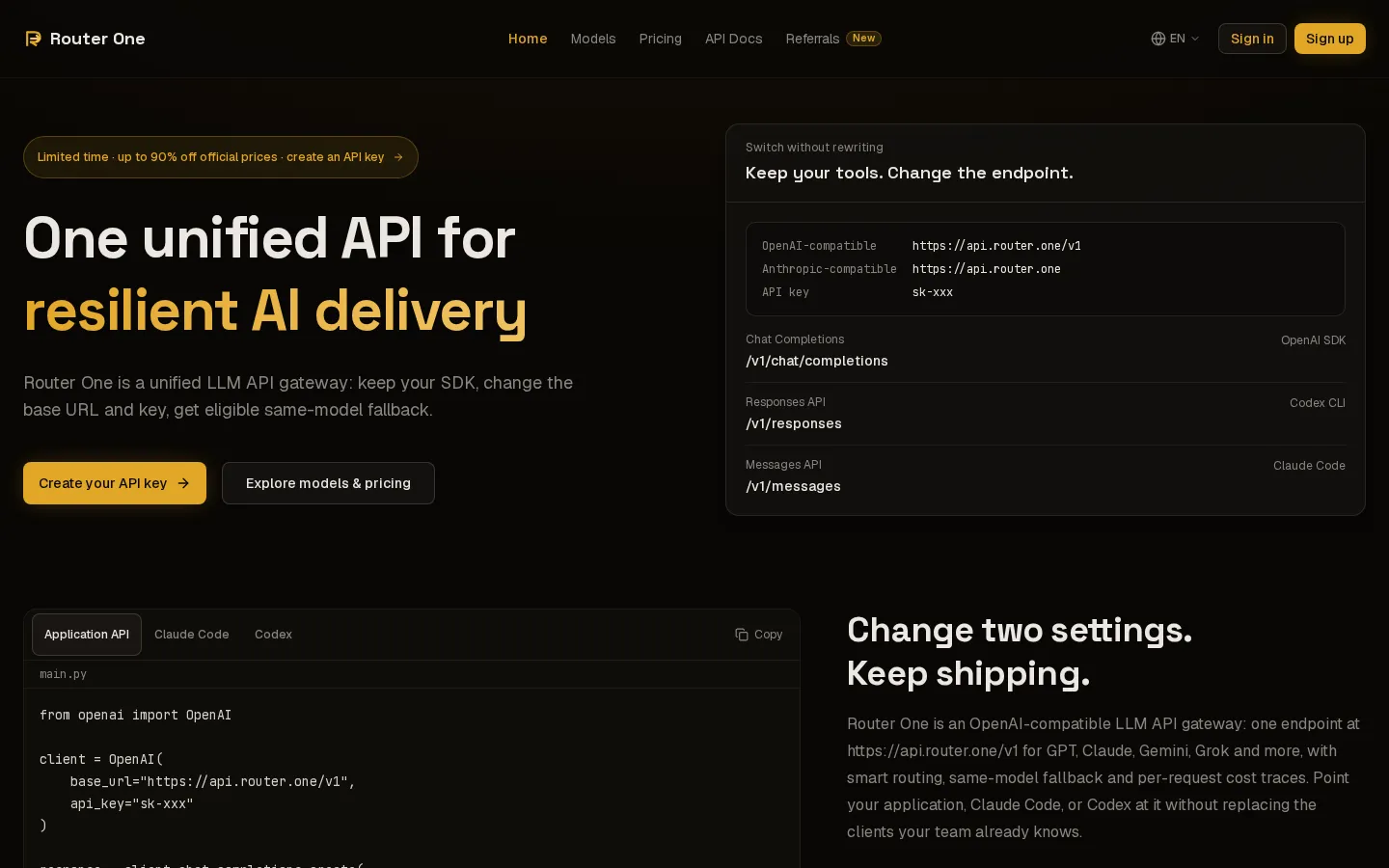
Router One is a unified LLM API gateway for teams that build on frontier models. Instead of opening separate accounts, keys and SDKs for OpenAI, Anthropic, Google and xAI, you point your existing client at one base URL, https://api.router.one/v1, and keep shipping. The gateway is both OpenAI- and Anthropic-compatible: Chat Completions, the Responses API and the Messages API all work, so applications, Claude Code and Codex CLI can be redirected with a couple of environment variables or a few lines of configuration. Routing is the core product. A request names one exact model, and the gateway selects a healthy provider route for it; if that route returns a retryable error, Router One can try another eligible route serving the same requested model and record the final result, without implying cross-model substitution. Everything is observed: each request gets an ID, and Customer Logs show the model, tokens, settled cost, recorded latency and status, with upstream supplier identities kept internal. You control spend per key with a maxSpend cap and optional expiry, while rate and token limits follow platform defaults that can be raised on request. Billing is flexible. Top up a prepaid USD wallet by card, Alipay, or USDT/USDC on six chains, then pay each model's posted per-token rate, with select models as low as 10% of official list prices. Alternatively, Pro, Max and Ultra subscriptions grant shared monthly request quotas per model tier, and calls outside coverage draw on the wallet. The catalog holds 30+ models from GPT, Claude, Gemini and Grok families, the platform is reachable from mainland China without a VPN, and no prompt or response bodies from direct API calls are retained. Router One also ships a playground, integration guides for Cursor and desktop clients, image-generation endpoints, a cost calculator, a public China latency benchmark, a status page and a documented pricing methodology, so teams can verify claims before moving production traffic. The gateway is not an agent runtime: workflows, state and tool execution stay in your application. Subscriptions and wallet billing can run together, invoices are issued automatically for card and Alipay payments, wallet top-ups never expire, and unused subscription requests do not roll over between cycles.
Router One Core Features
Unified endpoint
one OpenAI-compatible base URL and key reaches GPT, Claude, Gemini, Grok and other catalog models
Anthropic compatibility
a Messages API endpoint on the same host lets Claude Code and Anthropic SDKs connect unchanged
Same-model fallback
retryable provider errors trigger another eligible route serving the same requested model
Per-request cost traces
every call returns an ID, and Customer Logs show model, tokens, settled cost, latency and status
Per-key spend controls
each key carries its own maxSpend cap and optional expiry so one workload cannot drain the account
Pay-as-you-go wallet
top up by card, Alipay or USDT/USDC, then pay each model's posted per-token rate
Subscription quotas
Pro, Max and Ultra plans grant shared monthly request allowances by model tier
Transparent evidence
model rate pages, a cost calculator, a China latency benchmark and a public status page
Who is Router One for?
Router One is built for developers and startup teams who already ship on LLMs and want one integration instead of many. If your code speaks the OpenAI API or your tooling speaks the Anthropic API, you keep the client you know and change a base URL and key, which suits product engineers who treat models as swappable components. It fits teams that need eligible same-model fallback so a provider hiccup does not end a request, and platform owners who must reconcile model spend per workload and cap it per key. It is a good match for teams building coding assistants, chat products, RAG pipelines and internal tools that mix expensive flagship models with cheaper workhorses, since routing and quotas let you keep one endpoint while varying the model behind it. It also serves mainland China teams that need frontier models without a VPN, plus anyone funding AI usage with Alipay, USDT or USDC rather than a US credit card. Solo builders and small teams can start with a prepaid wallet top-up and pay only for tokens used, while heavier users move to Pro, Max or Ultra subscriptions for predictable monthly request quotas. Agencies and resellers running their own AI API service on a managed upstream are another natural fit. If you only ever call a single provider's flagship model directly, a gateway adds a layer you may not need.
Router One Use Cases
Route GPT, Claude, Gemini and Grok calls through one endpoint without rewriting your SDK code
Keep Claude Code or Codex CLI working from mainland China without a VPN or proxy
Survive provider outages by letting a failed route retry on another route for the same model
Reconcile per-workload model spend by matching request IDs with your own application logs
Cap runaway usage by giving each project, tool or environment its own key and budget
Cut API costs by using discounted per-token rates on select flagship and workhorse models
Prototype on a prepaid wallet before committing to a Pro, Max or Ultra monthly subscription
Top up AI spend with Alipay or USDT/USDC when a US credit card is not an option
Router One Pros and Cons
Pros
- OpenAI- and Anthropic-compatible endpoints mean existing SDKs, Claude Code and Codex CLI work after a base-URL change
- Eligible same-model fallback protects requests from single-route provider errors without changing client code
- Entry cost is low: wallet top-ups start around $5 and token rates run from $0.06 per million tokens
- Card, Alipay and USDT/USDC funding plus mainland China reachability remove common payment and access blockers
- Documented pricing and routing methodologies, a latency benchmark and a status page make product claims checkable
Cons
- Prepaid credits are non-refundable once added to your wallet, and bonus credit cannot pay for a plan
- Subscription request quotas do not roll over, so bursty teams must keep wallet balance as a buffer
- It is a gateway, not an agent runtime: workflows, state and tool execution stay in your own application
FAQ About Router One
Router One Pricing
Two ways to pay. Pay-as-you-go tops up a prepaid USD wallet from about $5 by card, Alipay or USDT/USDC on six chains, then bills per token at posted rates running from $0.06 to $40.00 per 1M tokens across 60 priced models, with select models up to 90% below official list prices and balance that never expires. Or subscribe monthly: Pro $20.19, Max $47.99 and Ultra $149.00 per 30-day cycle, each granting shared request allowances per model tier, with usage beyond plan coverage drawn from the wallet. The lowest paid entry point is the $5 wallet top-up; subscription plans start at $20.19 per month.
Check official pricingPro
Shared monthly allowances of 5,000 standard, 1,200 mid-tier and 300 premium model calls per 30-day cycle; usage beyond plan coverage is billed to the wallet.
Max
8,000 standard, 4,500 mid-tier, 1,000 premium and 150 flagship model calls per cycle, positioned as the power-user standard tier.
Ultra
25,000 standard, 15,000 mid-tier, 5,000 premium and 450 flagship model calls per cycle, aimed at enterprise and SaaS platform workloads.
Pay-as-you-go wallet
Prepaid USD wallet topped up from about $5 by card or Alipay, or with USDT/USDC on six chains, billed per token at posted rates; unspent balance never expires.
Router One Alternatives

Ecommerce Data API
Amazon product, keyword, traffic and market research data through a REST API, remote MCP server and Agent Skill for developers and AI workflows.

FastRouter
FastRouter is a unified LLM gateway that gives developers one OpenAI-compatible API for 200+ models from providers such as OpenAI, Anthropic, Google, and xAI. It adds automatic model routing, fallbacks, caching, spend caps, role-based access, guardrails, and per-request observability, while passing provider token prices through with no markup on any plan, including the free tier.

MapGO
How far is this point from the sea? From the nearest border? Which country, region and district are it in? MapGO answers those in one click.