
Prime Intellect
Prime Intellect is an open AI research platform: train and fine-tune open-weights models with reinforcement learning on hosted infrastructure, build and share verifiable environments, run hosted evaluations, serve models through an OpenAI-compatible inference API, and rent GPU capacity from a global marketplace. Pricing is pay-as-you-go credits, with sandboxes, GPU hours and training tokens billed separately. Signup is free and two training models cost $0 per million tokens.
What is Prime Intellect?
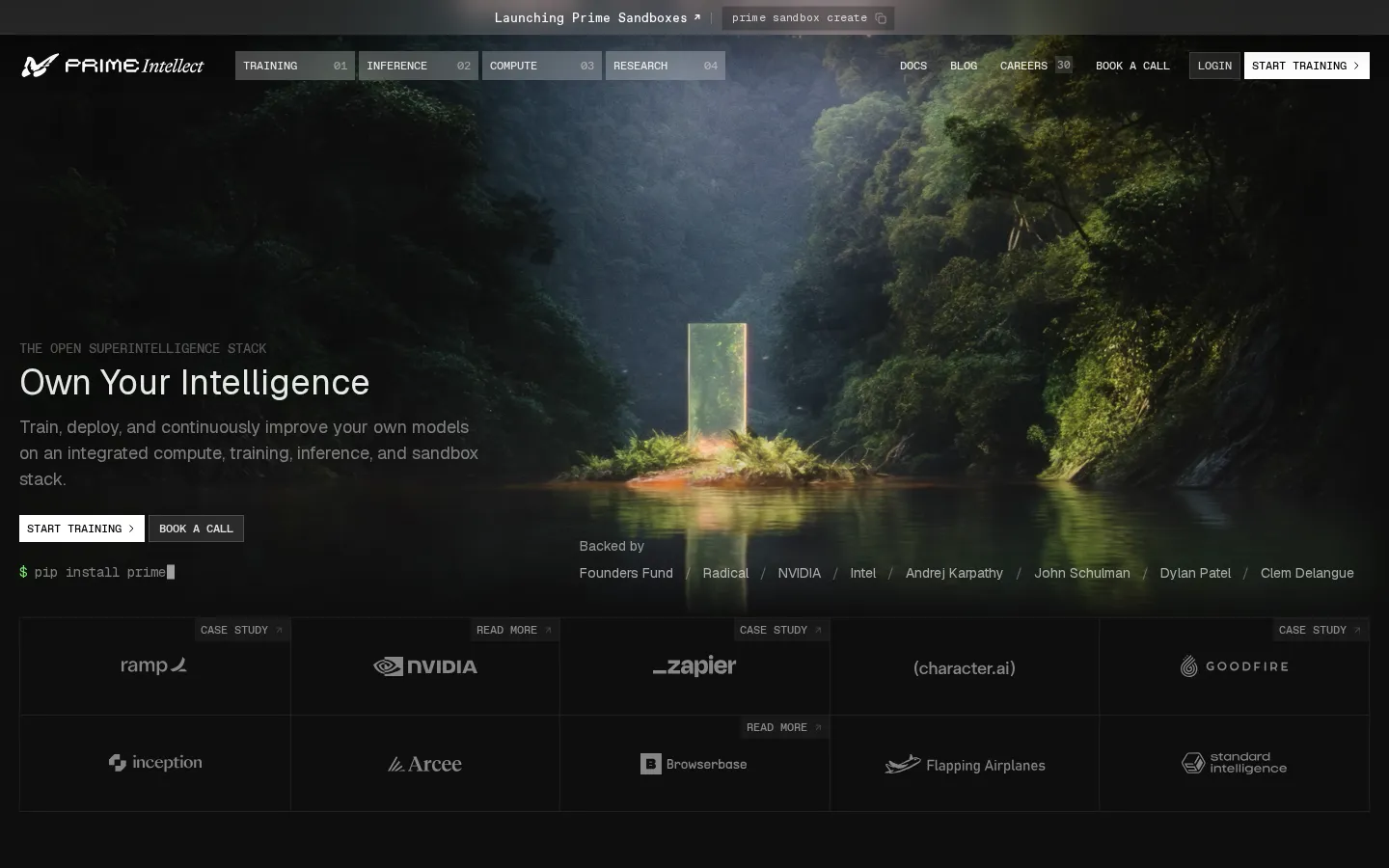
Prime Intellect is a research company and platform built around what it calls the open superintelligence stack: one place to turn tasks into reinforcement learning environments, post-train open-weights models, evaluate them, serve them, and rent the GPU capacity to do it. The company is Prime Intellect, Inc., based in San Francisco with remote team members, and it has raised a $130M Series A with backing from Founders Fund, Radical, NVIDIA and Intel plus angel investors including Andrej Karpathy, John Schulman, Dylan Patel and Clem Delangue.
Lab is the training side. You install the Prime CLI, run prime lab setup to create a workspace, then launch RL training runs from TOML configs with prime train run. Runs use LoRA adapters on shared multi-tenant deployments priced per million tokens, so teams pay for token volume rather than for an idle cluster. The Environments Hub is the registry that feeds those runs: an environment is a self-contained Python module built with the open-source verifiers library, combining a dataset of tasks, a harness for the model with tools and sandboxes, and a rubric that scores performance. The site advertises more than 2,500 community environments, and the sandboxes page mentions access to over 365,000 prebuilt environments for software engineering, terminal and search workloads.
Hosted Evaluations run any published environment on Prime-managed infrastructure from the dashboard or with prime eval run --hosted, using Prime Inference or your own OpenAI-compatible endpoint, and results are stored in Prime Evals with aggregate metrics and per-sample outputs. Prime Inference is an OpenAI-compatible chat completions API at api.pinference.ai/api/v1, documented for large-scale evaluations, with token-based billing deducted from the account balance.
Compute is the third leg and the oldest part of the business: a marketplace aggregating GPUs from dozens of providers and datacenters so one account can deploy a single GPU or a multi-node cluster. On-demand instances are non-interruptible and metered by the minute, while spot instances use unused capacity at discounts of up to 90% and can be interrupted. Reserved clusters are quoted from more than 50 datacenters within 24 hours, spanning H100, H200, B200, B300 and GB300 NVL72, and operators can resell idle GPUs onto the spot market.
Prime Sandboxes shipped in September 2026 as disposable microVMs for agentic RL and untrusted code, with Docker image support, network allow and deny lists, encrypted secrets, labels and first-class integration with verifiers and prime-rl. They are billed by the running hour for vCPU, memory and disk.
The company also publishes its own research: the INTELLECT-1 and INTELLECT-3 models, the SYNTHETIC data series, Recursive Language Models, Prime Agent, TOPLOC verifiable inference, prime-rl and the verifiers library. Customer case studies include Ramp, Zapier, Goodfire and Mixedbread training small models that beat frontier systems on narrow workflows.
Prime Intellect Core Features
RL environments
Turn any task into a trainable environment with the Verifiers library and one develop-eval-push CLI loop.
Environments Hub
Browse and share thousands of community RL environments, with secrets, collaborators and versioned releases built in.
Hosted training
Run large-scale agentic RL with LoRA on managed GPU clusters, paying per million tokens.
Hosted evaluations
Benchmark open-source models against Hub environments with no infrastructure setup and results saved.
GPU marketplace
Rent 1 to 256 GPUs on demand or spot from dozens of providers in one platform.
Reserved clusters
Request quotes for H100 to GB300 clusters, or resell idle GPUs back to the spot market.
Sandboxes
Launch isolated microVMs for agent code execution, billed by vCPU, memory and disk hour.
Open-source inference API
Serve base models, LoRA adapters and custom deploys through an OpenAI-compatible endpoint.
Who is Prime Intellect for?
Prime Intellect is aimed at teams that post-train their own models rather than only calling someone else's API. That means AI research labs, applied research groups and startups building agentic products, along with applied ML and infrastructure engineers who already know what a rollout, a reward function and a LoRA adapter are. The clearest examples are the published case studies: Ramp trained a small RL subagent for spreadsheet search that beat frontier models at lower cost, Zapier turned its AutomationBench evaluations into a continuous improvement loop, Goodfire uses hosted evaluations to catch models cheating, and Mixedbread used prime-rl to beat frontier models in deep search. The platform also fits reinforcement learning practitioners who care about environments. Environment authors, benchmark builders and academic groups can write an environment once with the verifiers library, push it to the Environments Hub, then reuse it for local evaluation, hosted evaluation and hosted training without rewriting it. Researchers who want the underlying libraries rather than a black box get the same open-source tooling the platform itself runs on. On the compute side the audience is broader: startups and labs that need one GPU for a weekend or 256 H100s for a training run, teams that want spot pricing on interruptible jobs, and organizations that need reserved capacity with a dedicated solutions engineer. GPU owners form a separate audience, because providers can list capacity on the marketplace and operators can resell idle nodes onto the spot market. Enterprise buyers tend to be AI platform leads and engineering managers who need private routing, dedicated deployments, team accounts with shared billing, SSO review and audit logs. Inference customers include teams that trained an adapter on Lab and want to serve it without copying the base model, plus teams who simply want OpenAI-compatible access to open models. Individual developers and students fit as well. Signup is free, the CLI installs with one uv command, documentation and environments are public, Discord hosts community support, and two training models are priced at $0.00 per million tokens, which keeps small experiments cheap. People who only want a chat product, or who need a contractual uptime guarantee, are not the target: the docs state that no formal SLA is offered, and reliability depends on choosing secure providers or reserving capacity.
Prime Intellect Use Cases
Cut a frontier model's cost by training a small RL subagent for one narrow workflow.
Turn production traces and recurring failures into evaluation environments, then retrain adapters.
Benchmark open-weights models on math, coding, tool use and agent tasks before deploying them.
Rent H100 or B200 instances for fine-tuning bursts instead of committing to a cloud contract.
Run thousands of concurrent code sandboxes for agent RL rollouts and automated grading.
Publish your own RL environment to the Hub and share it with collaborators or the community.
Serve a fine-tuned LoRA adapter to production through an OpenAI-compatible inference endpoint.
Reserve a large GPU cluster for a training run, then resell idle capacity when it finishes.
Prime Intellect Pros and Cons
Pros
- One stack covers the whole post-training loop, from environments and RL training to evaluations, inference and the compute underneath, instead of stitching together a cloud account, a training framework and a separate eval harness.
- The tooling is genuinely open source: verifiers, prime-rl, the Environments Hub and models such as INTELLECT-3 are published, so work is portable and can be self-hosted on your own GPUs.
- Billing is pay-as-you-go with no subscription: GPU pods meter credits by the minute, sandboxes by the running hour and training by tokens, and two training models are priced at $0.
- Compute is a broad marketplace with live per-provider pricing, spot discounts up to 90%, quotes from more than 50 datacenters and a resale path for idle GPUs.
- Enterprise validation is concrete, with case studies from Ramp, Zapier, Goodfire and Mixedbread and backing from Founders Fund, NVIDIA and Intel.
Cons
- Costs are usage-based and vary by GPU model, provider, token volume and sandbox hours, so there is no simple monthly plan to budget against and auto-top-up is recommended to avoid pods being deleted when credits run out.
- Hosted Training is still narrow and evolving: it supports LoRA-based agentic RL on a list of around a dozen open-weights models, with full fine-tuning marked as a beta.
- The main site has no conventional pricing page, since primeintellect.ai/pricing returns a 404, so buyers must read the documentation and the live dashboard, and reserved or enterprise capacity goes through a quote or a sales call.
FAQ About Prime Intellect
Prime Intellect Pricing
Prime Intellect does not sell subscriptions. Work is billed against prepaid account credits, deducted per minute for GPU pods and per running hour for sandboxes, with auto-top-up available in billing settings. Training and inference are token-based. Hosted Training prices per million tokens for input, output and training separately: Qwen3.5-0.8B and Llama-3.2-1B-Instruct at $0.02 input, $0.06 output and $0.06 training; Qwen3.5-35B-A3B at $0.25 input, $0.75 output and $1.00 training; gpt-oss-20b at $0.10, $0.30 and $0.40; and two models, poolside/Laguna-XS.2 and sprints/Llama-3.2-1B-Instruct, at $0.00, which gives the platform a genuine free entry point alongside a free account and free Hub access. Compute is hourly and varies by provider: the site and live dashboard list examples from around $0.47 per hour for an H200 offer and $0.54 per hour for an RTX A6000 up to $4.99 per hour for a B300, with spot instances discounted up to 90%. Multi-node H100 SXM5 clusters are documented at roughly $40.80 per hour for the value configuration and $52.80 per hour for the premium configuration. Prime Sandboxes cost $0.02 per vCPU hour, $0.0125 per GiB memory hour and $0.0002 per GiB disk hour, with those launch rates valid through December 22, 2026. Reserved clusters and enterprise agreements are quote-based.
Check official pricingFree tier
Free account, free Environments Hub access and two training models priced at $0.00 per million input, output and training tokens: poolside/Laguna-XS.2 and sprints/Llama-3.2-1B-Instruct.
Hosted Training
Token-based RL training billed separately for input, output and training. Small models cost $0.02 input, $0.06 output and $0.06 training per million tokens; Qwen3.5-35B-A3B costs $0.25, $0.75 and $1.00; gpt-oss-20b costs $0.10, $0.30 and $0.40.
Prime Inference
Token-based pricing for the OpenAI-compatible inference API, with input and output tokens billed at rates that vary by model and deducted from your Prime Intellect balance. Hosted evaluation sandbox runtime is not billed separately when Prime Inference is used.
Prime Sandboxes
Billed while running: $0.02 per vCPU hour, $0.0125 per GiB memory hour and $0.0002 per GiB disk hour. A 1 vCPU, 2 GiB, 32 GiB sandbox costs about $0.0514 per hour. Launch rates are valid through December 22, 2026.
On-demand and spot GPUs
Live per-provider hourly pricing, from CPU nodes at $0.06 per hour and RTX A6000 at $0.54 per hour to B300 offers near $4.99 per hour, with spot instances discounted up to 90% on interruptible workloads. Multi-node H100 clusters are documented around $40.80 to $52.80 per hour.
Reserved clusters and enterprise
Quotes from more than 50 datacenters within 24 hours for reserved capacity from H100 and H200 to B200, B300 and GB300 NVL72. A published example lists B300 SXM6 x512 on a three-year reservation at $5.00 per GPU hour, with idle capacity resellable on the spot market.
Prime Intellect Alternatives

FastRouter
FastRouter is a unified LLM gateway that gives developers one OpenAI-compatible API for 200+ models from providers such as OpenAI, Anthropic, Google, and xAI. It adds automatic model routing, fallbacks, caching, spend caps, role-based access, guardrails, and per-request observability, while passing provider token prices through with no markup on any plan, including the free tier.

RouteMarket AI
RouteMarket AI is a unified creative marketplace for AI models, workflows, provider routing, and developer APIs. It brings 125+ image, video, audio, text, and 3D models from 23+ providers into one workspace, with a model playground, reusable workflows, an OpenAI-compatible API, and BYOK key support. A free Personal tier unlocks every model, and new accounts earn free daily login credits.

Segmind
Segmind is a serverless AI model platform and gateway for image, video, audio and voice generation. It exposes 550+ models from Alibaba, Kling, OpenAI, Google, Black Forest Labs and ElevenLabs through a single REST API, plus PixelFlow, a visual canvas that chains models into reusable workflows and republishes them as production endpoints. Billing is pay-as-you-go credits, monthly subscriptions or dedicated GPUs.