pensiv
pensiv is a focused writing workspace for long-form storytellers. It pairs a fast, distraction-free editor with a plotboard, canvas, character sheets, timelines, and a relationship graph, then adds AI review, rewrite, and an agent that reads your existing drafts. Desktop, web, and mobile apps sync the same project, and you can export to DOCX or EPUB.
What is pensiv?
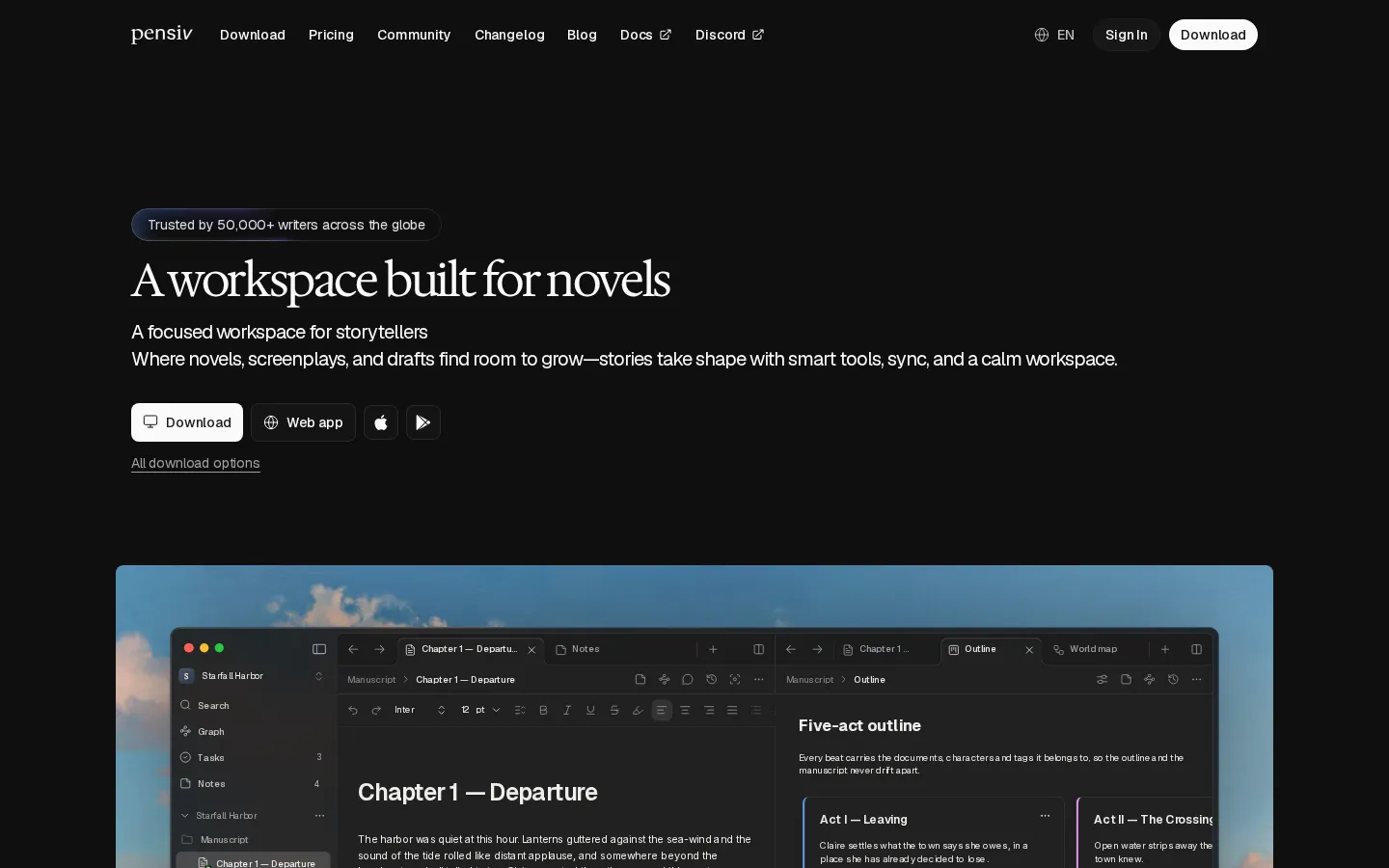
pensiv is a writing workspace built for long-form stories, made by Raum Labs, Inc. and used, by the site's own count, by more than 50,000 writers. Instead of stacking a word processor on top of a separate outliner, it keeps the manuscript, the outline, the character sheets, and the world notes in one project, with the links between them live. The editor is the centre of that project: it responds instantly, offers typography and line-height controls, a page view with page setup, headers, footers, and draggable margin rulers, and folding headings so a long chapter can collapse to its sections. A daily goal widget tracks total words against a target and separates words added today from words removed today.
Around the manuscript sit the structural tools. The plotboard turns acts, chapters, and scenes into cards, and each card carries the documents, characters, and tags it belongs to, so the outline does not drift away from the draft. The canvas is a freeform surface for world maps, beat lists, and image references, arranged wherever they make sense. Sheets hold characters and locations as properties, and they can fill their own fields from the page they describe. A timeline, a world map, and an interactive relationship graph, including a circular view, show how people, places, and threads connect. Backlinks let a note reference Alice or act one and jump straight to it, tasks with dates live beside the work, and version history records every saved revision of every file.
The AI layer is deliberately optional and invoked rather than ambient. AI review returns scores and written feedback across story, style, pacing, emotion, character, marketability, and worldbuilding in a panel beside the draft. AI rewrite revises a selection against your own character sheets and shows the edit inside the document. Spell check comes in two forms: a native checker that runs on the device and sends nothing, and an AI checker that sends only the paragraph being checked. An agent can search for a scattered detail, build a mindmap from settings you have already written, or stand up a plotboard from existing chapters, and prose and structure stay synchronized as you work.
The workspace runs as a web app, a desktop app, and iOS and Android apps, with the same files and boards opened where you left them. Projects can be set to local-only, so nothing syncs; cloud storage is AES encrypted on SOC 2 infrastructure, and AI requests go to Google and Anthropic enterprise APIs whose terms forbid training. Work imports from Scrivener and from DOCX, EPUB, TXT, MD, and RTF, and exports to DOCX, PDF, EPUB, HWP, Markdown, and plain text. Editor presets match Munpia, Novelpia, KakaoPage, Joara, and Naver Series typesetting and count characters by each platform's rules. Widgets, templates, themes, and community plugins extend the interface, and an MCP connection lets Claude or ChatGPT work with a project.
pensiv Core Features
High performance editor
A fast, distraction-free editor with typography controls, page view, headers and footers, folding headings, and a daily word goal.
Plotboard
Acts, chapters, and scenes live as cards that keep their attached documents, characters, and tags, so outline and manuscript stay aligned.
Canvas and world map
Spread beats, notes, and images freely across an infinite canvas to map places, factions, and how they relate.
Sheets, timeline, and graph
Character and location sheets with properties, a story timeline, and an interactive relationship graph keep continuity visible.
AI review
A scored report across story, style, pacing, emotion, character, marketability, and worldbuilding, shown in a panel beside the draft.
AI agent and MCP
Find a scattered detail, build a mindmap, or create a plotboard from written chapters, or connect Claude and ChatGPT over MCP.
Version history and export
Per-file version history plus export to DOCX, PDF, EPUB, HWP, Markdown, and plain text, with Scrivener and DOCX import.
Privacy controls
Local-only projects, AES-encrypted cloud storage, on-device native spell check, and enterprise AI APIs that forbid training on your writing.
Who is pensiv for?
pensiv is aimed at people who write long fiction and need the surrounding material to stay in view: novelists working through a multi-book series, web-novel authors publishing serially on Korean platforms, webtoon writers and teams, screenwriters, and studios running several writers on one property. The site describes its audience as long-form story creators and says content studios already use it to run multi-writer pipelines with stronger consistency. If you currently outline in one app, draft in another, and keep character notes in a third, the appeal is that pensiv merges those jobs into a single project where a scene card, a chapter, and a character sheet point at each other. That suits plotters who build five-act structures before drafting, and equally suits writers who draft first and then use the plotboard and graph to see what they have actually built. It also fits authors who are wary of AI in their manuscripts. AI features only run when invoked, the native spell checker stays on the device, projects can be local-only, and the company states that writing is never used for training. Writers who want structural critique rather than line-level generation get a scored review across seven dimensions without handing over the whole draft. Writers migrating from Scrivener are an obvious fit, since Scrivener projects import directly and the binder-style structure has a close equivalent. Students and educators get 50% off Plus and higher plans for twelve months with a verified school email. Less suited: copywriters, marketers, and anyone writing short pieces where a plotboard, timeline, and story bible would never earn back the setup time.
pensiv Use Cases
Draft a serialized web novel while matching Munpia, Novelpia, or KakaoPage typesetting and character-count rules.
Outline a five-act screenplay and see which characters appear on each scene card.
Migrate a Scrivener project into a workspace where outline, manuscript, and character sheets stay linked.
Run a scored AI review on a finished draft before sending it to beta readers.
Keep a shared story bible consistent when several writers work on one series.
Diagram factions, locations, and timelines for a fantasy world on a single canvas.
Track daily word goals, writing sessions, and revision tasks without leaving the manuscript window.
Let Claude or ChatGPT query your project through the MCP connection while you revise.
pensiv Pros and Cons
Pros
- Editor, plotboard, canvas, and sheets share one project, so structure and prose rarely drift apart.
- Unusually explicit privacy stance: local-only projects, AES-encrypted storage, on-device spell check, and no training on your writing.
- Genuinely web-novel aware, with typesetting presets and per-platform character counting for five Korean publishing platforms.
- Free tier covers light drafting, and paid plans scale from $4 to $160 a month instead of jumping straight to team pricing.
Cons
- AI reviews, rewrites, and agent credits are tightly metered, so steady AI use pushes you toward the $48 or $160 plans.
- No public REST API; outside assistants only get in through the MCP connection, which starts on the Plus plan.
- The free plan keeps 10 versions per file for 60 days, caps image uploads at 5 MB, and allows 10 AI reviews a month.
FAQ About pensiv
pensiv Pricing
Freemium with a free tier and five annual-billed paid plans from $4 to $160 per month, priced by AI review volume, rewrite limits, version retention, and model access.
Check official pricingFree
3 AI reviews per day (10 per month), 3 AI rewrites per day, 1,000 AI spell-check paragraphs per day, last 10 versions per file kept 60 days, 5 MB image uploads, standard AI models.
Basic
Billed annually. 20 AI reviews per day (60 per month), 6 AI rewrites per day, 3,000 spell-check paragraphs per day, last 100 versions per file kept 120 days, 50 MB image uploads, standard support.
Plus
Billed annually. Adds MCP access so Claude, ChatGPT, and other assistants can connect, with 200 versions per file kept indefinitely, on Basic's AI limits.
Pro
Billed annually. 50 AI reviews per day (200 per month), 200 AI rewrites per day, 10,000 spell-check paragraphs per day, 200 versions per file kept indefinitely, premium models including GPT-5 and Claude Sonnet and Opus, plus MCP.
Pro+
Billed annually. 5x Pro's AI agent credits, 100 AI reviews per day (500 per month), unlimited AI rewrites and spell check, 500 versions per file kept indefinitely, priority support and a dedicated support channel.
Ultra
Billed annually. 20x Pro's AI agent credits, unlimited daily AI reviews (1,200 per month), unlimited AI rewrites and spell check, 500 versions per file kept indefinitely, and everything in Pro+.
pensiv Alternatives

Citizen Mirror
Citizen Mirror is a free, private place to write down the thing you can't stop thinking about — and have something read it back to you clearly.

Spiral
Spiral is an AI writing partner from Every that learns your personal writing style through stylometry analysis. Give it samples of your work, connect your channels, and it builds a style fingerprint, then drafts tweets, blog posts, LinkedIn updates, and essays that sound unmistakably like you. It serves writers, marketers, and teams who need consistent on-brand content.

FicWeave
Create Chapter 1 without an account, then continue with Story Memory that keeps characters, relationships, facts, and plot threads consistent.