
PackyAPI
PackyAPI is an enterprise AI gateway that connects Claude, GPT, Gemini, Grok, DeepSeek, Qwen and other providers behind one OpenAI-compatible and Anthropic-compatible endpoint. Teams prepay wallet credit, pick a token group whose multiplier sets the billing rate, then track calls, errors and spend in the console. The pricing page lists 68 models on pay-as-you-go token billing or pay-per-view image and video billing.
What is PackyAPI?
PackyAPI is an enterprise AI gateway operated by PackyMe LLC that puts many model providers behind a single domain, key and billing account. Instead of signing up separately with Anthropic, OpenAI, Google, xAI, DeepSeek, Alibaba and others, a team creates one API key and swaps its base URL, because the gateway exposes familiar routes such as /v1/chat/completions, /v1/responses, /v1/messages, /v1/embeddings, /v1/rerank, /v1/images/generations and /v1beta/models. The public catalogue lists 68 models across twelve providers, including Claude, GPT, Gemini, Grok, DeepSeek, Qwen, Kimi, GLM, MiniMax, Hunyuan, MiMo and TypeSafe entries.
Access is organised around token groups. Each group carries a multiplier that sets the billing rate: a group marked x0.3 or x0.5 is a discount, while x2.5 or x7 adds a surcharge, and leaving the group unset uses the default rate. Pricing is usage based rather than subscription based. Sixty-one of the listed models are billed pay as you go per token, with separate input, output, cache-read and cache-write rates, while seven image and video models are billed per view. Balances are prepaid in the console wallet at a one-to-one ratio between Chinese yuan paid and US dollar quota.
The control plane is the other half of the product. Real-time scheduling switches between channels using health and latency weighting, the marketing pages advertise 7 regional points of presence and a 99.9% monthly uptime target, and the console centralises call volume, errors, spend and per-request consumption logs. Operators can apply multidimensional rate limits, alerts, model restrictions and IP allowlists per key, and every charge is attributed to the model that produced it.
PackyMe backs the service with commercial terms, a data processing addendum incorporating standard contractual clauses, a usage policy, a supported countries and regions list, and service-specific terms covering team and enterprise plans, beta services, fine-tuning, and cloud-hosted deployments on Amazon Bedrock and Google Vertex AI. The documentation walks through registering, buying quota and creating tokens, then wiring the gateway into Claude Code, Codex, Grok Build, Kimi Code, CC-Switch and desktop clients.
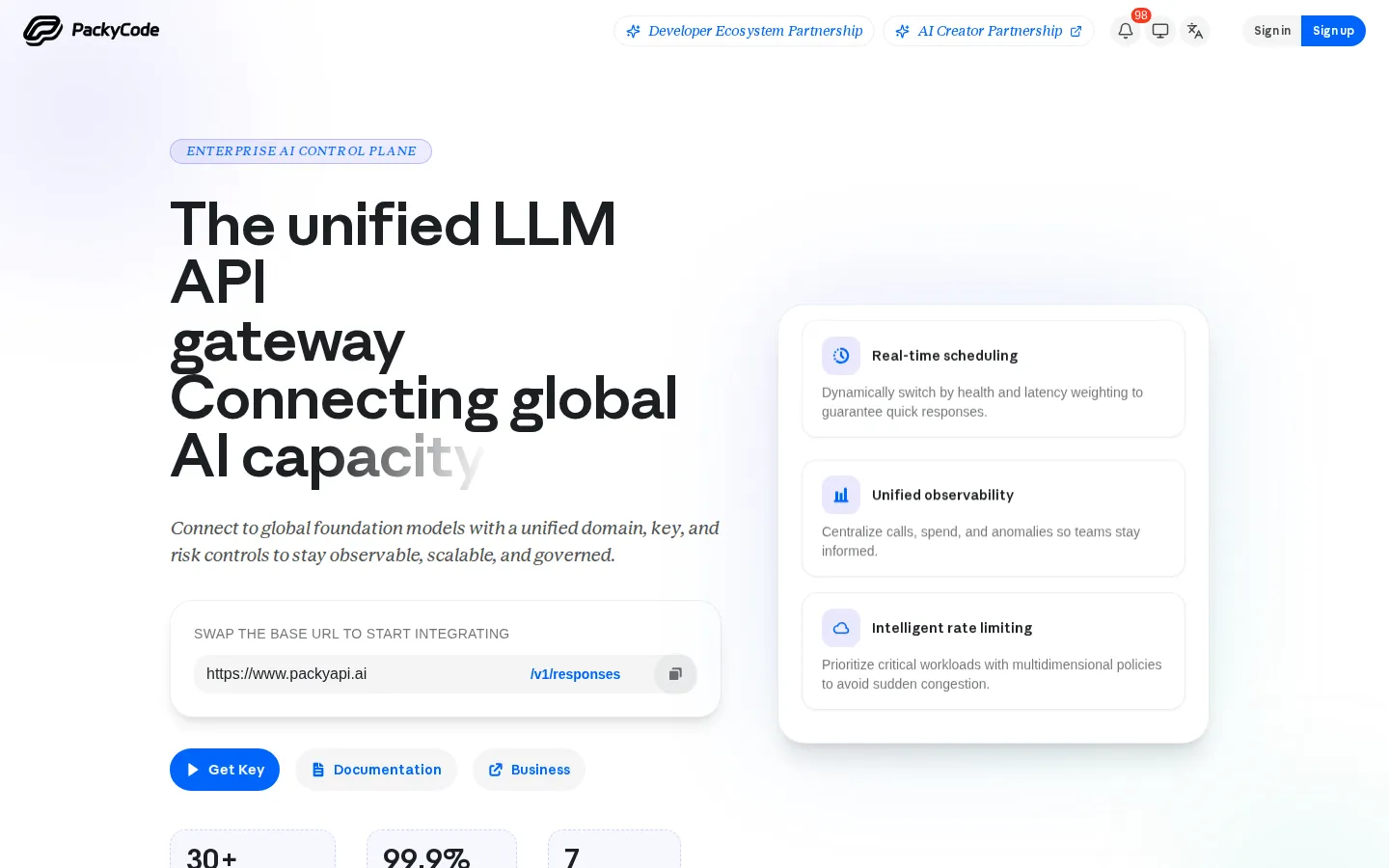
PackyAPI Core Features
Unified entry point
one domain and key replace separate credentials for Claude, GPT, Gemini, Grok, DeepSeek, Qwen and Kimi.
Multi-protocol compatibility
OpenAI chat and responses routes, Anthropic messages, Gemini model routes, embeddings, rerank and images.
Token groups with multipliers
pick a group such as aws-q at x0.3 or claude-officially at x7 to set billing rates.
Health-based scheduling
requests fail over between channels using health and latency weighting so workloads keep running.
Real-time observability
the console centralises call volume, error rates, spend and per-request consumption logs for each key.
Rate limiting and risk controls
multidimensional throttles, alerts, model restrictions and IP allowlists can be set per token.
Two billing modes
61 models meter per token, while 7 image and video models charge per view.
Deployment guides
documentation covers Claude Code, Codex, Grok Build, Kimi Code, CC-Switch, Claude Desktop and popular editors.
Who is PackyAPI for?
PackyAPI targets developers and engineering teams that need several frontier models without maintaining several vendor accounts. The strongest fit is a team already running CLI coding agents such as Claude Code, Codex, Grok Build or Kimi Code, because the documentation is built around pointing those tools at the gateway base URL and selecting the matching token group. Product teams building AI features are the second audience. A single OpenAI-compatible endpoint lets them add chat, embeddings, reranking, image generation and audio routes, then change the underlying model without rewriting client code. Because access is sold as prepaid token credit, it suits teams that want usage-based spend, centrally billed keys and per-project quotas and IP allowlists, especially where Alipay or WeChat Pay top-ups are more practical than a foreign card. Enterprises with governance requirements fit the commercial tier: team and enterprise plans, a data processing addendum, an invoicing and support path, and cloud-hosted deployments on Amazon Bedrock and Google Vertex AI. The terms state that the services are not for consumer use, so individuals wanting a personal chatbot subscription are not the intended audience, and buyers in countries outside the supported regions list cannot sign up. Anyone expecting a fixed monthly price or free credits will be disappointed, because the model is strictly pay as you go with rates that move with the token group multiplier.
PackyAPI Use Cases
Route Claude Code or Codex CLI traffic through one key instead of several provider accounts and balances.
Compare live per-model prices and token group multipliers before committing a workload to a channel.
Give an engineering team centrally billed model access with quotas, spend caps and IP restrictions per key.
Generate images and video through the same account and balance that already serves text models.
Investigate an unexpected charge using per-request consumption logs that name the model that handled it.
Keep production traffic running through automatic failover when one upstream provider has an outage.
Add LLM features to a product without signing separate commercial contracts with every model vendor.
Serve users in regions where local payment methods and invoicing matter more than a foreign card.
PackyAPI Pros and Cons
Pros
- One endpoint, key and balance for twelve model providers, with OpenAI, Anthropic and Gemini compatible routes.
- Group multipliers make the billing rate explicit before you spend: anything below x1 is a discount on the published rate.
- Console controls that enterprises ask for: consumption logs, spend tracking, alerts, throttles and IP allowlists per key.
- Documented 99.9% monthly uptime target, cloud hosting through Amazon Bedrock and Google Vertex AI, and a published data processing addendum.
- Setup guides for the CLI agents and desktop clients teams already use reduce the guesswork in switching base URL.
Cons
- Prepaid only with no free tier or trial documented, so the wallet must be funded before the first call.
- Consumption logs are deleted after 180 days, so teams needing longer audit trails must export the records themselves.
- Documentation is written mainly in Chinese, and the terms restrict access to the supported regions list while excluding consumer use.
FAQ About PackyAPI
PackyAPI Pricing
Usage-based pricing with no subscription and no documented free tier: you prepay wallet credit at a one-to-one yuan-to-dollar ratio, then pay per token or per view at each model's published rate multiplied by the multiplier of the selected token group, from x0.3 discounts up to x7 surcharges.
Check official pricingPay as you go
Prepaid balance metered per token with separate input, output, cache-read and cache-write rates; 61 of the 68 listed models use this billing type, with discounts shown up to 96% off list.
Pay per view
Per-call billing for the 7 image, video and moderation models, including GPT Image, Grok Imagine, MiniMax video and omni-moderation, priced per generation.
Credit top-up
Balances are bought in the console wallet at a one-to-one ratio, so one yuan of payment equals one US dollar of usable API quota, paid by Alipay or WeChat Pay.
Team and enterprise
The service-specific terms cover a work edition with team and enterprise plans; business, developer ecosystem and creator partnership enquiries go through PackyMe forms and support.
PackyAPI Alternatives

Ecommerce Data API
Amazon product, keyword, traffic and market research data through a REST API, remote MCP server and Agent Skill for developers and AI workflows.

FastRouter
FastRouter is a unified LLM gateway that gives developers one OpenAI-compatible API for 200+ models from providers such as OpenAI, Anthropic, Google, and xAI. It adds automatic model routing, fallbacks, caching, spend caps, role-based access, guardrails, and per-request observability, while passing provider token prices through with no markup on any plan, including the free tier.

MapGO
How far is this point from the sea? From the nearest border? Which country, region and district are it in? MapGO answers those in one click.