MuleRouter
MuleRouter is a high-performance API gateway that unifies access to large language models, diffusion models and AI utilities behind a single authentication layer. Developers reach premium models such as Alibaba's Wan and Qwen families, OpenAI's GPT models, Google's Nano Banana, KlingAI and MiniMax through one reliable, cost-effective API, while MuleRouter's fine-tuned Spark video models deliver similar quality at a lower price.
What is MuleRouter?
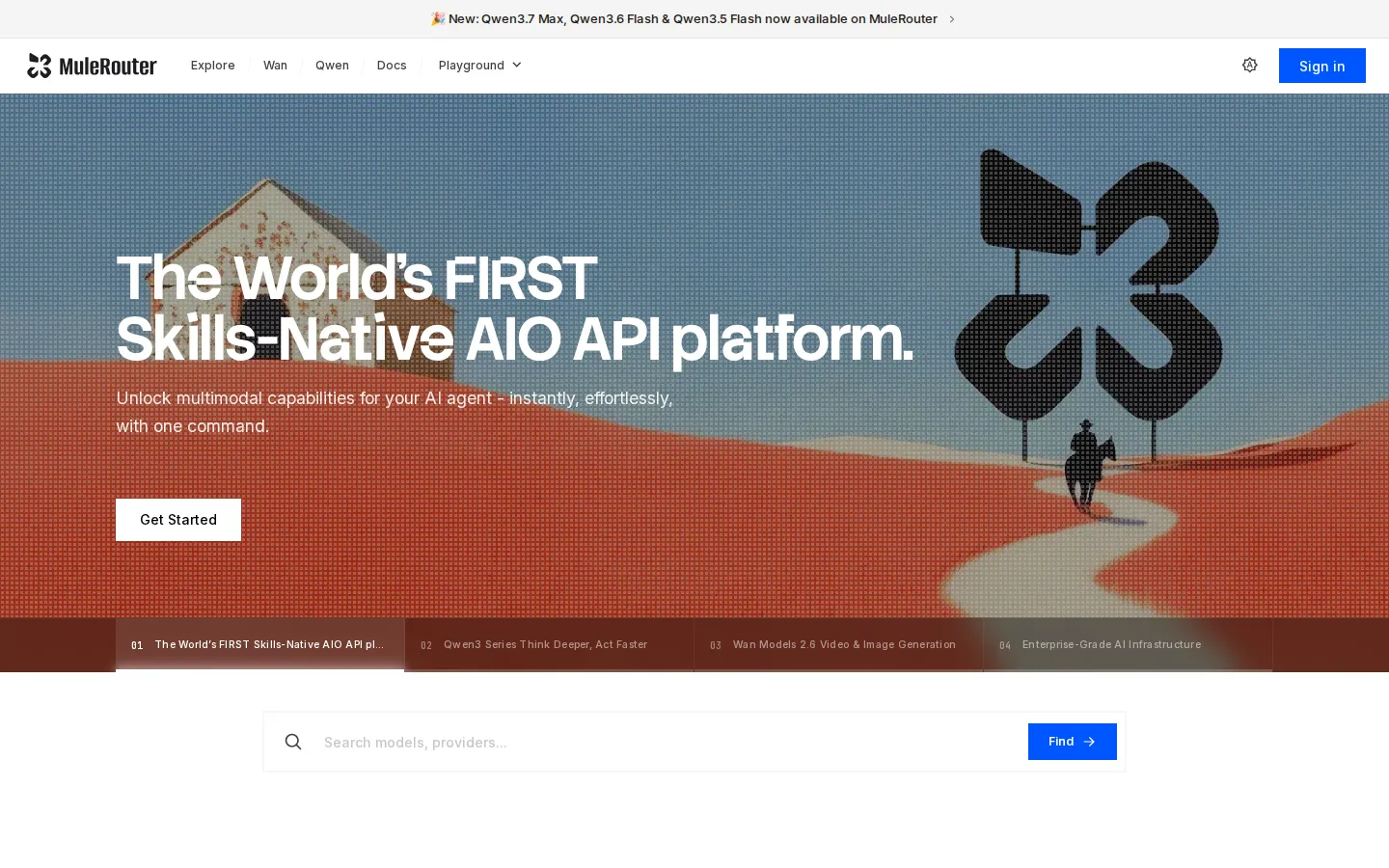
MuleRouter is a high-performance API platform and routing gateway for generative AI, letting developers unlock multimodal capabilities for AI agents instantly, effortlessly, with one command. It positions itself as the world's first skills-native, all-in-one API platform, unifying large language models, diffusion models and AI utilities behind a single authentication layer so teams call many providers without maintaining separate accounts, keys or billing relationships.
The catalogue spans several model families. Under Alibaba's Qwen collection, MuleRouter exposes flagship, balanced and flash tiers including Qwen3.7 Max, Qwen3.6 Flash, Qwen3.5 Plus, Qwen3 Max, Qwen Image Max and vision-language and omni models with long context windows and cache-aware pricing. The Wan collection covers Alibaba's video and image generation series, from Wan 2.6 Text-To-Video and Image-To-Video down to Wan 2.5 previews, Wan 2.2 Plus and Flash tiers and Wan 2.1 Video Ace and keyframe tools. Beyond Alibaba, the platform lists OpenAI's GPT 5.5, GPT Image 2 and GPT-5.4 Mini and Nano, Google's Nano Banana 2 and Nano Banana Pro image models, X.AI's Grok 4 and Grok Code Fast 1, Z.ai's GLM 5.1, Kuaishou's Kling V3 and Kling V3 Omni video models, and MiniMax's Speech 2.8 and Music 2.5 audio models. That makes MuleRouter a single front door to text, image, video, speech and music generation.
A distinctive part of the offering is the MuleRouter Spark collection: fine-tuned video generation models that promise similar quality at a fraction of the price, spanning Wan 2.6 and Wan 2.5 text-to-video and image-to-video with 720P or 1080P support, up to 15-second durations and multi-shot generation. The platform highlights tiered, cache-aware pricing on its LLM endpoints and markets itself as a cost-effective alternative to calling each provider directly.
On top of raw model access, MuleRouter ships an OpenMule skills package hosted on GitHub, so AI coding agents and assistants can call its APIs with one command rather than bespoke glue code. A web playground lets users try models before wiring them into production, and documentation, model exploration pages and collections help teams compare capabilities. Reliability and enterprise-grade infrastructure are emphasised, with a routing layer that abstracts provider complexity.
In short, MuleRouter aggregates premium generative AI models behind one unified, reliable and cost-effective API. Developers get consistent authentication, a browsable model catalogue, tiered pricing and agent-ready skills, while the Spark models and cache-aware billing target teams that care about cost. The result is faster integration, fewer vendor relationships and a single endpoint for multimodal and large language model workloads.
MuleRouter Core Features
Unified API gateway
one authentication layer and endpoint reach LLMs, diffusion models and AI utilities
Skills-native agent access
an OpenMule GitHub skills package lets agents call MuleRouter with one command
Wan video collection
text-to-video, image-to-video, keyframe and face-editing models up to 15 seconds
Qwen LLM collection
flagship, balanced and flash tiers with long context and cache-aware pricing
Spark fine-tuned models
cheaper Wan video generation that targets similar quality at a lower price
Multi-vendor image models
GPT Image 2, Nano Banana Pro, Qwen Image and Qwen Image Edit Max
Audio and speech models
MiniMax Speech 2.8 and Music 2.5 for voice and music generation
Playground and documentation
try and compare models before integrating them into production
Who is MuleRouter for?
MuleRouter targets developers and teams who build with generative AI and want many premium models without signing up to each provider separately. If you are an application developer shipping a product that switches between LLMs, image generators and video or audio models, MuleRouter's single authentication layer means one key and one endpoint instead of a patchwork of SDKs and invoices, which reduces integration and billing overhead. AI engineers and ML practitioners comparing model quality, latency or cost across GPT, Qwen, Wan, Grok, GLM, Kling, Nano Banana and MiniMax can browse the catalogue, try models in the playground and benchmark them through a consistent API rather than juggling provider dashboards. Startups and indie builders on tight budgets are a strong fit, because tiered and cache-aware pricing plus the fine-tuned Spark video models aim to deliver similar quality at lower cost, helping small teams get more output from limited spend. Product and growth teams prototyping multimodal features like text-to-video, image editing or speech and music generation can validate ideas quickly before committing engineering time to direct provider integrations. Teams building AI agents and automation are another core audience. MuleRouter ships a skills package so coding agents and assistants can call its APIs with one command, which suits developers wiring autonomous workflows, tool-using agents and pipelines that need reliable, multi-model access. Agencies and studios producing marketing video, social images, voiceovers and music at volume benefit from having generation, editing and audio models behind one gateway with predictable per-use billing rather than many subscriptions. Enterprise and platform teams evaluating vendor consolidation are also addressed, since MuleRouter markets enterprise-grade infrastructure, a routing layer and a contact-sales path for custom volume and support. Finally, researchers, students and hobbyists exploring state-of-the-art models can start in the playground and scale up as their needs grow. In short, anyone who values one key, one bill and one reliable endpoint across multimodal and LLM workloads is the intended user.
MuleRouter Use Cases
Power AI agents with multimodal capabilities through one command
Generate marketing videos with Wan text-to-video and image-to-video models
Compare and route LLM requests across Qwen, GPT, Grok and GLM tiers
Create and edit product images with Nano Banana, GPT Image and Qwen Image models
Add text-to-speech and music generation to apps with MiniMax audio models
Cut video generation costs by switching to fine-tuned Spark models
Prototype multimodal features quickly in the web playground before coding
Route production workloads through a single authentication layer and endpoint
MuleRouter Pros and Cons
Pros
- One API key and authentication layer unify LLMs, image, video and audio models from many vendors
- Skills-native design lets coding agents call the platform with one command via the OpenMule GitHub package
- Fine-tuned Spark video models and cache-aware LLM pricing target lower cost without sacrificing quality
- Broad, well-organised catalogue spans Wan, Qwen, GPT, Grok, GLM, Kling, Nano Banana and MiniMax
- Playground, docs and collections make models easy to explore and compare before integration
Cons
- No public pricing is listed on the website, so costs must be confirmed after signing in or via sales
- As an aggregator, availability, limits and rates ultimately depend on upstream model providers
- Support and documentation beyond Discord, email and docs are relatively limited
FAQ About MuleRouter
MuleRouter Pricing
MuleRouter does not publish a public price list; the platform describes its unified API as cost-effective and pay-as-you-go, with tiered, cache-aware pricing on LLM endpoints and cheaper fine-tuned Spark video models, with per-model rates and enterprise volume pricing available after sign-in or through Contact Sales.
Check official pricingPay-As-You-Go Credits
Credit-based access billed per use; per-model rates for LLMs, images, video and audio are shown in the dashboard after signing in.
Enterprise
Volume pricing, higher rate limits and support for high-usage teams, arranged through the Contact Sales form linked in the site footer.
MuleRouter Alternatives

Ecommerce Data API
Amazon product, keyword, traffic and market research data through a REST API, remote MCP server and Agent Skill for developers and AI workflows.

FastRouter
FastRouter is a unified LLM gateway that gives developers one OpenAI-compatible API for 200+ models from providers such as OpenAI, Anthropic, Google, and xAI. It adds automatic model routing, fallbacks, caching, spend caps, role-based access, guardrails, and per-request observability, while passing provider token prices through with no markup on any plan, including the free tier.

MapGO
How far is this point from the sea? From the nearest border? Which country, region and district are it in? MapGO answers those in one click.