
Modelflare
Modelflare is a pay-as-you-go LLM API gateway that gives developers one OpenAI-compatible endpoint for 76+ text, image and video models. Each model exposes several routing groups priced between roughly 1.5% and 20% of official API list rates, so teams can trade cost against stability per request. A built-in dashboard tracks API keys, request logs, latency, token usage, cost and cache-hit guarantees in one place.
What is Modelflare?
Modelflare is an LLM API gateway, operated by Havenbyte LLC, that gives developers a single OpenAI-compatible endpoint for 76+ models sourced from OpenAI, Anthropic, Google, DeepSeek, Moonshot AI, Zhipu AI, xAI, Meta, Alibaba Cloud, MiniMax and Xiaomi, plus its own TypeSafe family. Instead of holding separate keys and balances with each provider, a team creates one Modelflare key, points its existing client at the base URL https://modelflare.dev/v1, and selects a model ID from the catalogue. The homepage frames the product as the model layer for every production workflow, routing text, image and video models through one reliable gateway while tracking model choice, fallback, usage and cost in one place.
The central idea is model groups, which the site also calls routing groups. A single model such as gpt-5.6-sol is exposed through several groups, each trading price against stability and cache-hit behaviour. openai-award is a price-priority route with a 65% cache-hit guarantee at about 3% of the official API list price; openai-stable targets everyday developers at roughly 8%; openai-premium prioritises continuity at roughly 13%. A limited-time openai-first-topup group at about 1.5% unlocks once any single top-up reaches US$20, and a claude-first-topup group follows a US$50 top-up. On the pricing page the same model shows input and output rates per million tokens beside the struck-through official price, so the saving is visible at a glance.
Billing is pay-as-you-go: there is no required monthly subscription, and users top up a balance that model calls draw down. The pricing page also offers optional 28-day subscription plans from $99.99 to $1,499.99 that bundle bonus credits, issued in four weekly installments, which can be spent across all routes on GPT, Claude and Gemini while other models draw on remaining credits. Around the routing core, Modelflare ships API keys, request logs, a usage and cost dashboard, fallback groups that switch automatically when a primary group is unavailable, a Cache Hit Guarantee with compensating credit, and documentation covering OpenAI-compatible clients such as Codex and Claude Code. Service is advertised across 171 supported countries and regions, with 12 interface languages.
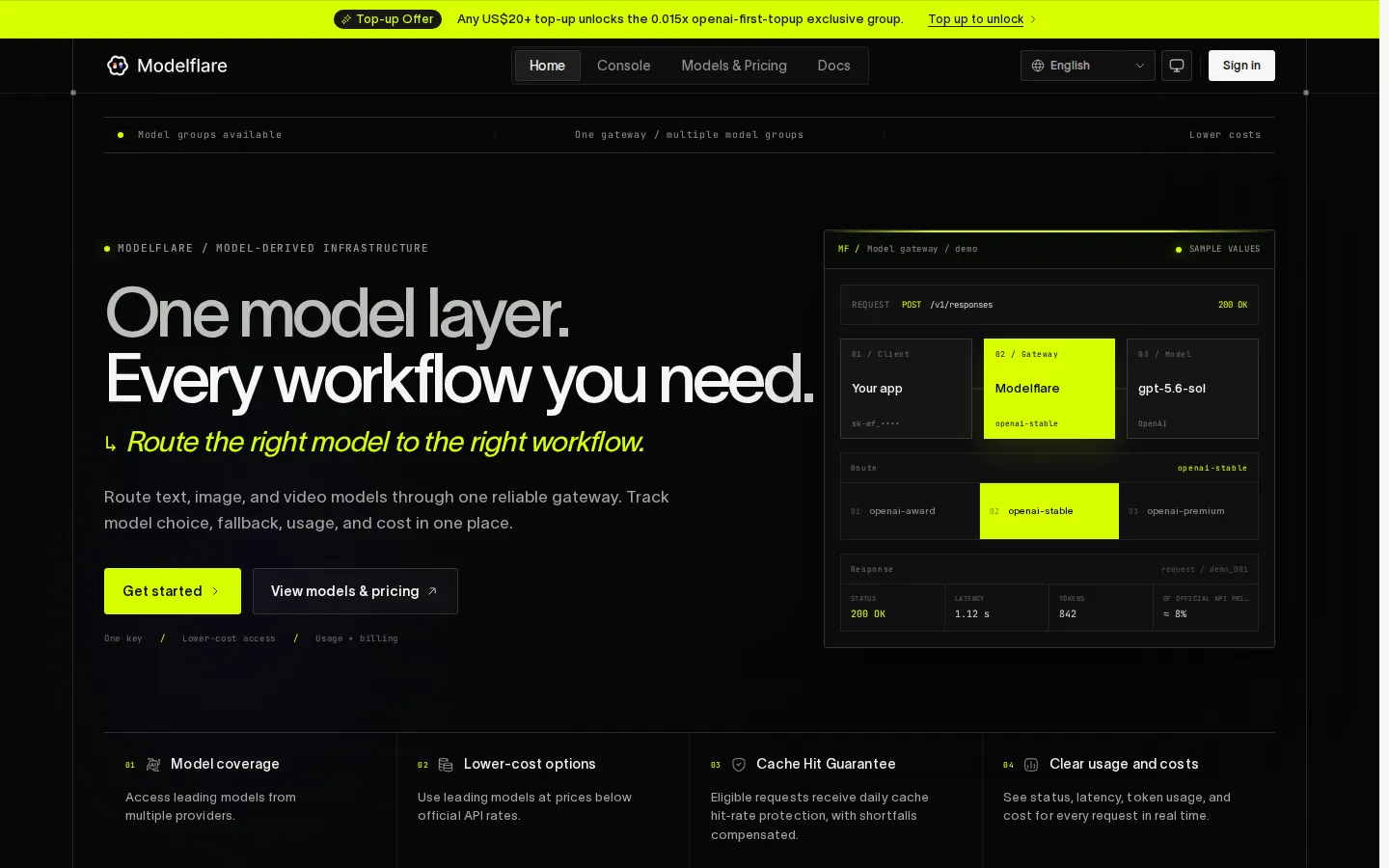
Modelflare Core Features
One OpenAI-compatible gateway
a single key and base URL reach 76+ models across OpenAI, Anthropic, Google, DeepSeek, Moonshot, Zhipu, xAI, Meta, Alibaba and MiniMax.
Multiple routing groups per model
price-priority, stable and premium tiers let you trade cost against stability and cache-hit guarantees for the same model ID.
Fraction-of-list pricing
routing groups are billed as a share of official API rates, from roughly 1.5% to 20%, shown as per-million-token input and output prices.
Cache Hit Guarantee
eligible requests receive daily cache hit-rate protection, with shortfalls compensated and reviewable in the usage dashboard.
Usage and cost visibility
see API keys, request logs, status, latency, token usage and cost for every request in real time.
Fallback routing
add fallback groups in priority order so requests switch automatically when the primary group is unavailable.
Pay-as-you-go billing
top up a balance with no required subscription, plus optional 28-day plans that carry bonus credits in four weekly installments.
Global coverage and compatibility
available across 171 supported countries and regions with documentation for Codex, Claude Code and other OpenAI-compatible clients.
Who is Modelflare for?
Modelflare targets developers and teams who already build against an OpenAI-compatible API and want cheaper access to frontier models without opening a separate account with every lab. The core user is a backend or product engineer who writes code with the OpenAI SDK, since switching to Modelflare means changing one base URL and one API key rather than learning a new client. Because the same endpoint spans OpenAI, Anthropic, Google, DeepSeek, Moonshot, Zhipu, xAI, Meta, Alibaba and MiniMax, it suits polyglot teams that route different jobs to different model families. Solo builders and indie developers are a second audience. Modelflare is pay-as-you-go with no required monthly subscription, so a hobby project can top up a small balance, call cheap routing groups such as openai-award at a fraction of list price, and pay nothing when idle. Coding-agent users are a third group: the site publishes setup flows for Codex and Claude Code, letting people point those tools at Modelflare and run GPT or Claude models through one key at reduced rates. Startups pushing high request volumes are a fourth fit. Cost-sensitive, retryable workloads such as testing, batch generation and flexible background jobs map naturally onto the cheapest award-tier routes, while production traffic that prioritises continuity can use stable or premium groups at higher fractions of list price. Teams that need visibility are another: the dashboard exposes per-request status, latency, token usage and cost, plus a Cache Hit Guarantee that compensates eligible requests for shortfalls, which appeals to operators watching unit economics. It is less suited to non-technical users who want a chat app, because Modelflare is developer infrastructure rather than a consumer product, and to organisations needing a guaranteed enterprise SLA, which the site handles through an enterprise inquiry channel instead.
Modelflare Use Cases
Route GPT and Claude coding agents such as Codex and Claude Code through one Modelflare key at reduced rates.
Cut production LLM costs by sending high-volume, retryable work to price-priority routing groups.
Compare input and output prices per model and routing group before committing a workload.
Keep traffic flowing by adding fallback groups in priority order for automatic failover.
Track per-request status, latency, token usage and cost in one usage dashboard.
Test frontier text, image and video models from many providers without opening separate vendor accounts.
Protect cache-heavy workloads with the Cache Hit Guarantee and its compensating credit.
Start pay-as-you-go with a small balance and scale up, or buy a 28-day plan for predictable weekly usage.
Modelflare Pros and Cons
Pros
- Cheap access to frontier models: routing groups are priced from roughly 1.5% to 20% of official API list rates, with prices shown per million tokens.
- Breadth under one key: 76+ models from ten or more providers share one OpenAI-compatible endpoint and billing account.
- Real routing choice: several groups per model let you pick price, stability or cache-hit guarantees without changing client code.
- Transparent usage: per-request logs expose status, latency, token usage and cost, and the Cache Hit Guarantee is verifiable in the dashboard.
- No mandatory subscription: pay-as-you-go top-ups mean idle projects cost nothing, with optional 28-day plans for steady weekly workloads.
Cons
- The cheapest routing groups are limited-time offers gated behind minimum top-ups, US$20 for openai-first-topup and US$50 for claude-first-topup, so they are not open to everyone.
- Unused subscription credits do not carry over between 28-day periods, and subscription credits apply only to the GPT, Claude and Gemini model families.
- Prices and the model catalog update in real time and can change without notice, and many models offer only a single routing group, so cost estimates may shift.
FAQ About Modelflare
Modelflare Pricing
Pay-as-you-go LLM API gateway billing: top up a balance and pay per million tokens on routing groups priced from roughly 1.5% to 20% of official API list rates (gpt-5.6-sol input from $0.15 per 1M tokens), with optional 28-day subscription plans from $99.99 to $1,499.99 that bundle bonus credits issued in four weekly installments.
Check official pricingPay as you go (openai-award)
Cheapest routing tier, the price-priority openai-award group on gpt-5.6-sol: input $0.15 and output $0.9 per 1M tokens, about 3% of the official price, with a 65% Cache Hit Guarantee.
openai-stable
High-stability route for everyday development: gpt-5.6-sol input $0.4 and output $2.4 per 1M tokens, about 8% of the official API price, with a 75% Cache Hit Guarantee.
openai-premium
Premium route for continuity-focused workloads: gpt-5.6-sol input $0.65 and output $3.9 per 1M tokens, about 13% of the official price, with an 85% Cache Hit Guarantee.
Subscription plan (28 days)
Optional plan returning $110 in credits, including a $10.01 bonus, issued in four weekly installments of $27.50; credits apply to the GPT, Claude and Gemini families across all routes, and top tiers reach $1,499.99 for $1,800 in credits.
Modelflare Alternatives

Ecommerce Data API
Amazon product, keyword, traffic and market research data through a REST API, remote MCP server and Agent Skill for developers and AI workflows.

FastRouter
FastRouter is a unified LLM gateway that gives developers one OpenAI-compatible API for 200+ models from providers such as OpenAI, Anthropic, Google, and xAI. It adds automatic model routing, fallbacks, caching, spend caps, role-based access, guardrails, and per-request observability, while passing provider token prices through with no markup on any plan, including the free tier.

MapGO
How far is this point from the sea? From the nearest border? Which country, region and district are it in? MapGO answers those in one click.