
Minicart
Minicart is an AI-powered storefront builder for makers, resellers and collectors. Upload a product photo and it generates your listing and store, then three named AI teammates draft marketing posts, manage inventory, prepare shipping labels and write customer replies for your approval. It imports from Etsy, Shopify and eBay, charges no listing fees, and runs on a free tier.
What is Minicart?
Minicart is an AI-powered online store builder from Neurox Inc., positioned as a way to create a store that runs itself. The pitch is literal: you upload a product photo and describe what you sell, and Minicart generates the product listing and a working storefront, including themes, product pages, checkout and payment setup. From there the platform assigns three named AI teammates, Sloane for the storefront, Milo for marketing and Logan for logistics and support, which draft work and queue it for your approval rather than acting silently.
Sloane creates listings, builds and updates the store, manages products, variants and collections, and can apply bulk changes across a catalog when you ask in plain language. Tell it to raise every red necklace by five dollars and it returns a checklist of matched products with old and new prices for you to confirm. Milo generates product and marketing images against a credit system, drafts Instagram captions and social posts, schedules campaigns, builds discount codes and runs abandoned checkout recovery. Logan tracks inventory, prepares shipping labels at discounted carrier rates, handles made-to-order and pre-order sales, sends automated order and delivery emails, and drafts replies to customer questions for you to review.
Everything runs through a chat interface, which Minicart summarizes as: if you can text, you can run your store. Underneath the conversational layer sits a conventional commerce stack. That means unlimited product listings, digital downloads, print-on-demand through Printful, custom domains, SSL, sales tax calculation plus filing and remittance, revenue dashboards, and Google Analytics and Meta Pixel tracking. Payments are processed on-platform with card rates that improve from 6% plus 30 cents on Free down to 2.5% plus 30 cents on Director. The business model is transactional: no listing fees, and the company says it earns when you earn.
Migration is a first-class feature. Read-only imports pull listings, photos, prices and variations from Etsy, Shopify or eBay in minutes while the original shop keeps selling, so sellers can test Minicart without shutting anything down. There is no public developer API and no plugin ecosystem, which is a deliberate choice: the product is closed and opinionated, aimed at sellers who want the outcome rather than a toolkit. The free tier includes the full store and all three teammates under daily AI credit limits, while paid tiers mainly buy lower card rates, more users, more image credits, a custom domain and priority support.
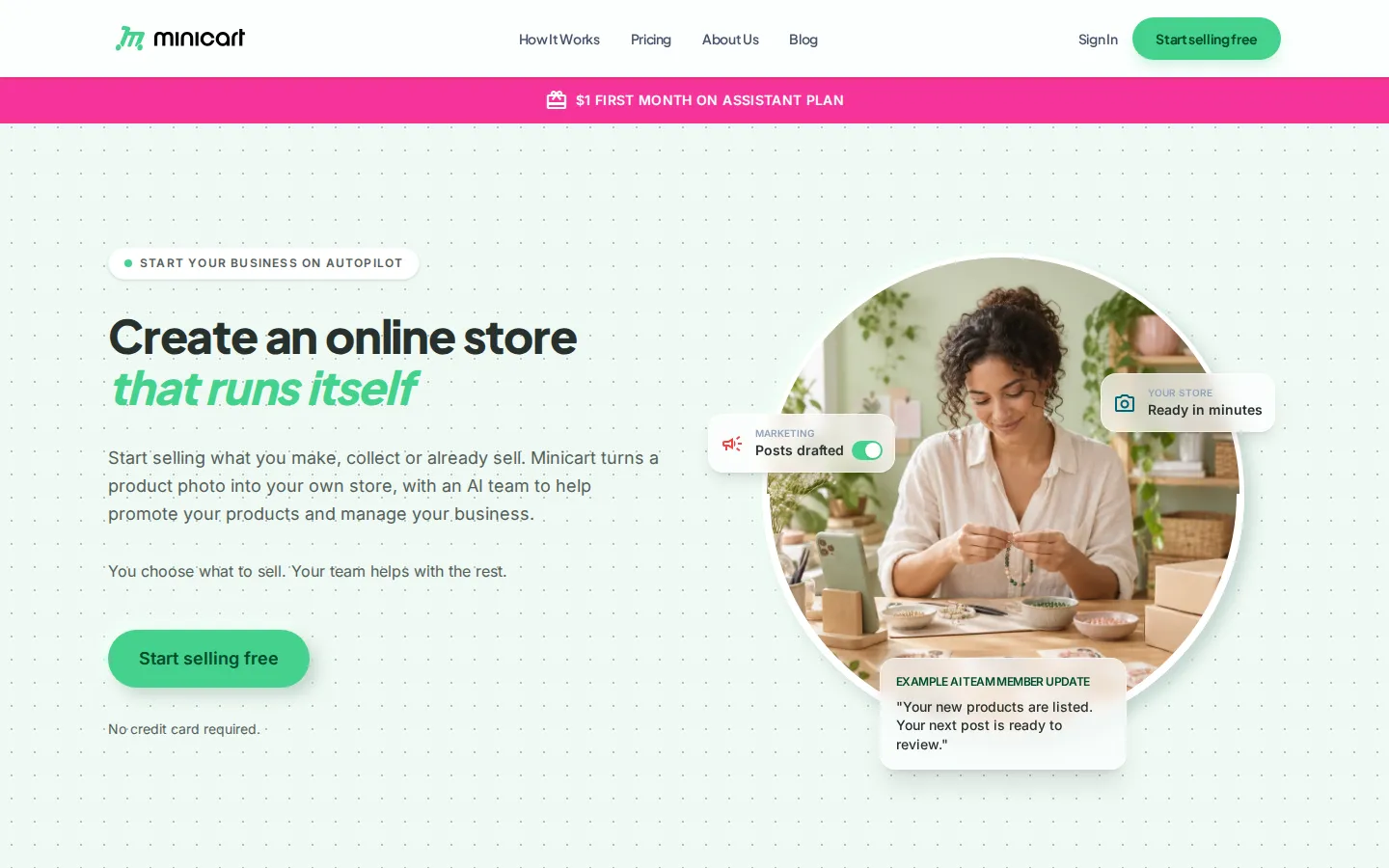
Minicart Core Features
Store generated from a single product photo, with listings, pages and checkout built automatically
Three named AI teammates for storefront, marketing and logistics work, each queuing drafts for approval
Bulk catalog edits by plain-language chat, such as repricing every matching product at once
AI product images, titles and descriptions generated on a monthly credit allowance
Read-only product import from Etsy, Shopify and eBay while your old shop keeps selling
AI-drafted social posts, scheduled campaigns, discount codes and abandoned checkout recovery
Inventory tracking, discounted shipping labels, automated order emails and drafted customer replies
Custom domain, unlimited hosting, SSL, sales tax filing and revenue dashboards included
Who is Minicart for?
Minicart is built for independent sellers who want their own storefront without hiring a developer, an agency or a marketing assistant. That includes handmade makers such as jewelers, candle pourers and clothing designers who currently list on Etsy and feel squeezed by listing fees and rented audiences. It also suits resellers and collectors, including trading card dealers, sneaker flippers, vintage pickers and diecast model sellers, who already move inventory through eBay or Instagram messages and want a branded home for it. Shopify merchants who find the admin panel heavy for a small catalog are another fit, since Minicart imports products in minutes and lets them run catalog updates by chat instead of clicking through settings. The product assumes you are a solo operator or a very small team. You make or source the goods, you decide prices, and you ship. Everything around that, from writing listings and generating product photos to drafting captions, tracking stock and answering buyers, is where the AI teammates are meant to help. People who need deep customization, complex B2B pricing, multi-warehouse fulfillment or enterprise integrations will find it thin compared with Shopify or WooCommerce. Anyone selling at real volume with a large catalog and a support team should look at the Manager or Director tiers, because the free plan caps users and AI image credits. It is a weaker match for businesses needing custom checkout logic, native ERP connections or a developer API, since Minicart is a closed, chat-first platform. It is also not a marketplace: you bring your own traffic. Sellers who rely entirely on Etsy or eBay search traffic must plan their own marketing, and Minicart itself notes that sales still depend on product, offer and audience. Best fit overall is a first-time or side-hustle seller with one to fifty products who wants a real domain, keeps their customer list, and would rather approve AI-prepared work than learn another dashboard.
Minicart Use Cases
Launch a branded storefront for handmade jewelry in minutes from one product photo
Move an Etsy catalog onto your own domain without pausing existing Etsy sales
Generate product and social imagery for a card or collectibles shop on a credit budget
Reprice an entire product category by chatting instead of editing items one by one
Draft Instagram captions and schedule promo campaigns for a clothing line
Track stock and prepare discounted shipping labels for made-to-order items
Write faster replies to buyer questions about materials, sizing and shipping times
Test a side-hustle store idea on the free tier without a credit card
Minicart Pros and Cons
Pros
- Genuinely AI-driven: listings, store build, images, posts and replies are all drafted for you
- Free tier includes the full store and all three AI teammates, with no listing fees
- Read-only imports from Etsy, Shopify and eBay let you migrate without shutting down
- You keep your own domain, brand and customer list instead of renting marketplace traffic
- Card rates drop meaningfully on paid plans, from 6% plus 30 cents down to 2.5% plus 30 cents
Cons
- No public API, plugin ecosystem or deep checkout customization, so it stays a closed platform
- AI image work is credit-metered, and free-plan users hit daily limits quickly
- No marketplace traffic of its own, so sellers must bring their own audience and marketing
FAQ About Minicart
Minicart Pricing
Minicart is free to start with the full store and all three AI teammates, then upgrades to Assistant at $25/month, Manager at $69/month and Director at $259/month, with lower card rates and more AI credits as you climb.
Check official pricingFree
Full online store, all three AI teammates, unlimited products and hosting, Etsy/Shopify/eBay import, 6% + 30c card rate, 2 users, 1,000 AI image credits.
Assistant
$1 for the first month, then $25/month. Custom domain, 2.9% + 30c card rate, 3 users, 2,000 AI image credits, free payouts and better top-up rates.
Manager
For growing businesses: 2.7% + 30c card rate, 5 users, 6,500 AI image credits, priority support and cheaper credit top-ups.
Director
For scaling stores: 2.5% + 30c card rate, 15 users, 30,000 AI image credits, priority support and the best top-up value.
Minicart Alternatives

GoDaddy Airo AI Builder
GoDaddy Airo AI Builder is a prompt-driven site builder from GoDaddy. Describe a business or idea and it drafts pages, sections and copy, then lets you refine layout, tone and visuals with guided controls before publishing to GoDaddy hosting with SSL, forms and analytics included. Plans start free with credits, and paid tiers add custom domains, payments, bookings and more sites.

Oxygen
Oxygen is a WordPress site builder with two ways in: an MCP-connected AI agent that builds pages, post types and templates from a prompt, and a visual editor with one-to-one CSS control for doing it by hand. The agent's work lands as native, editable elements rather than locked markup, so you can keep prompting or open the canvas and finish the job yourself.

AliDropship
AliDropship is an AI-assisted dropshipping platform for launching an online store fast. Beginners get a free turnkey storefront built, designed and stocked for them, with hosting, domain, SSL and payments included. Its WordPress and WooCommerce plugins import products in one click, automate pricing and orders, and add AI-driven marketing tools, while a product catalogue and fulfillment network handle sourcing and shipping.