
MegaNova
MegaNova is an AI digital-human engine built on Libra OS, sold both as enterprise digital employees that run inside your own environment and as cloud characters anyone can create. Teams get multi-agent orchestration, a 3-tier AI firewall, private knowledge bases and 100+ models behind one OpenAI-compatible API, while creators build and share characters on the same engine.
What is MegaNova?
MegaNova is an AI platform built around one engine, Libra OS, that is sold in two directions. The first is enterprise digital employees: multi-agent systems that run inside a customer's own environment, including air-gapped networks, so sensitive data never leaves the perimeter. The second is cloud characters: creator-facing AI personas, built in Character Studio, that anyone can create, test, share and talk to. MegaNova describes itself as an AI inference cloud that powers living AI characters and enterprise AI workflows.
The enterprise product is Libra OS, shipped as a single 59MB Go binary with no dependencies for Mac, Linux and Windows. Its modules include the Libra Kernel for multi-agent orchestration with DAG-based task planning, a three-tier AI Firewall that screens traffic with regex rules, ML risk scoring and an LLM judge, multi-provider routing across 100+ frontier and open-source models, a knowledge DB with a drag-and-drop Knowledge Pack Builder and cross-session observational memory, digital employees backed by more than 20 built-in skills such as PDF, Excel, web, OCR, email and SQL, and an apps and MCP layer where tools register as managed agents.
The cloud side exposes the same model catalogue through OpenAI-compatible endpoints at api.meganova.ai, with serverless pay-per-token billing, a native Model Context Protocol server, managed web search and dedicated GPU endpoints. Character Studio adds structured character creation, benchmark testing, image and voice assets and export in open formats such as CCv3 and PNG character cards.
MegaNova publishes performance numbers it says are certified across three runs: a +18.9 point GAIA lift over the same model without Libra OS, 256 grounded digital employees per 8xH100 node, and a drop in AgentDojo attack success rate from 26.8% to 17.3% with defences enabled. The company targets regulated industries, naming legal, insurance and finance, and reports outcomes such as 5x faster contract review and a 40% claims cost reduction. It is operated by Nebula Nova Inc. in Delaware, USA and Montreal, Canada. Cloud usage is priced per token, per image or per second of video next to a free registration tier, while on-premise deployment is arranged through a demo call and a commercial licence.
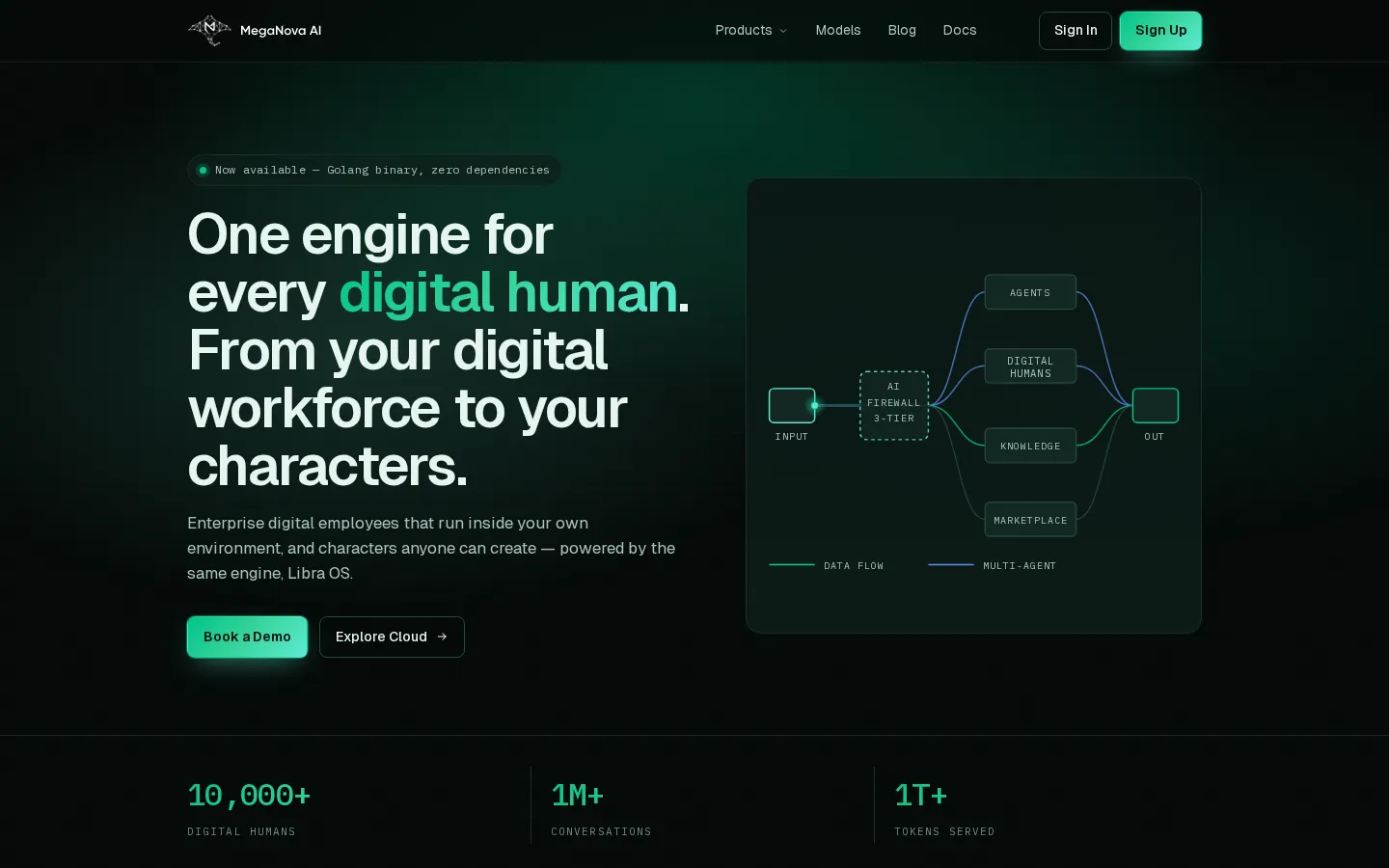
MegaNova Core Features
Multi-agent orchestration
The Libra Kernel plans tasks as a DAG, routes trivial chat past the LLM and returns knowledge-gated answers in about one second, running the model only when needed.
100+ models behind one API
Frontier and open-source text, vision, image, video, audio, embedding and rerank models from OpenAI, Anthropic, Google, xAI, DeepSeek, Qwen, Moonshot and others share one OpenAI-compatible endpoint.
3-tier AI Firewall
Inbound and outbound screening runs regex rules, ML risk scoring and an LLM judge to catch prompt injection, jailbreaks and PII before content reaches a human.
Private knowledge base
A drag-and-drop Knowledge Pack Builder with hybrid search indexes PDFs, Word documents and Markdown, and observational memory lets agents recall context across sessions.
On-premise or air-gapped deployment
One 59MB Go binary with zero dependencies runs on Mac, Linux and Windows, so documents and prompts never leave the customer's environment.
Digital employee skills
More than 20 built-in skills cover PDF, Excel, web, OCR, email and SQL for document analysis, email handling and compliance workflows.
Character Studio
The same engine creator-facing, with character creation in minutes, blueprint and expert editing modes, benchmark testing and shareable characters.
MCP and managed apps
A native Model Context Protocol server exposes inference as agent tools, and apps register as managed agents with auth, routing and multi-tenancy handled.
Who is MegaNova for?
MegaNova serves two main audiences from one engine. The first is regulated enterprises that cannot send sensitive data to a vendor cloud: legal, insurance and finance teams running contract review, claims processing, compliance and document question answering, plus the IT and platform engineers who have to deploy and govern those systems. For them the pitch is a self-hosted binary, a multi-tenant knowledge base, OIDC single sign-on and SOC2 or HIPAA support, with a stated two-week deployment instead of a six to twelve month build. The second audience is developers and creators. Developers use the inference cloud as an OpenAI-compatible endpoint and point existing OpenAI SDKs, chat front-ends, MCP clients, SillyTavern or Janitor AI at it for text, vision, image, video, speech and embedding work. Creators use Character Studio to build roleplay and storytelling characters, test them against quality benchmarks and share them with a community, and studios or hosts use the higher account tiers for heavier generation limits. Small teams and solo builders can start without a credit card, which makes the platform practical for evaluation. It is less suited to buyers who want published on-premise pricing or a fully self-service enterprise contract, because the on-premise Libra OS path is arranged through a demo call and a commercial licence, and free daily quotas apply only to eligible models and are described as intended for evaluation rather than production load. Both audiences can however test the platform on the free tier before committing to a paid tier or an enterprise demo.
MegaNova Use Cases
Review contracts at scale with source-cited extraction across NDAs, MSAs and amendments, which the site reports as 5x faster review for legal teams.
Triage, summarize and route insurance claims with on-premise retrieval so PII stays inside the perimeter, an approach the site links to a 40% cost reduction.
Answer compliance and risk questions from your own policies with a full audit trail and every response screened by the three-tier AI Firewall.
Build AI characters for roleplay and storytelling, test them against benchmark scenarios and share or export them in open formats.
Ship chat, vision, image, video, speech and embedding features from one OpenAI-compatible endpoint instead of integrating several vendor SDKs.
Host fine-tuned or open-weight models on dedicated GPU endpoints that you start and stop from the web portal, billed per minute.
Connect desktop agents such as Claude Desktop to MegaNova inference and model catalogues through the native MCP server.
Deploy a self-hosted assistant over private documents with per-user isolation, admin oversight and OIDC single sign-on.
MegaNova Pros and Cons
Pros
- Runs where your data lives: Libra OS deploys as one 59MB binary on your own hardware, including air-gapped environments, with SOC2 and HIPAA support stated.
- One OpenAI-compatible API covers 100+ models, so switching between providers does not require rewriting application code.
- The free entry point is real: no credit card at registration, a daily free message quota on eligible models, and free Manta, DeepSeek V3 and embedding models.
- Safety depth is unusual for this category, with a three-tier AI firewall and benchmark results published as three-run certified numbers.
- Serves both audiences from one engine, taking a team from creator characters to regulated digital employees without a second platform.
Cons
- The on-premise enterprise path is sales-led: Libra OS commercial pricing is not published, only a demo booking link and a contact email.
- Free daily quotas apply only to eligible models, and MegaNova's own documentation describes free models as intended for evaluation and interactive use rather than production workloads.
- Higher account tiers are unlocked by deposits or cumulative spend thresholds of $1, $10 and $100, so the largest quotas and fastest support require upfront spending.
FAQ About MegaNova
MegaNova Pricing
MegaNova runs a freemium model across cloud and on-premise. Cloud registration is free with no credit card and eligible models carry a daily free quota: 550 messages per day on the free Explorer tier, 1,600 after a $1 deposit (Creator), 2,900 after $10 of spend (Hero) and 5,200 after $100 of spend (Legend), with response SLAs tightening from community to 12 hours. Serverless models are billed per 1M tokens, per image or per second of video, with some models free. Dedicated GPU endpoints are charged per minute from $0.007. Libra OS is free for personal use, with a commercial licence available on request.
Check official pricingExplorer
Free registration with no credit card required. 550 free messages per day on eligible models plus community support, aimed at new testers and early explorers.
Creator
$1 deposit to unlock. 1,600 free messages per day on eligible models, 72-hour response SLA and 1% referral commission for active creators.
Hero
$10 of spend required. 2,900 free messages per day on eligible models, 24-hour response SLA and 2% referral commission for professional creators and model hosts.
Legend
$100 of spend required. 5,200 free messages per day on eligible models, 12-hour premium response SLA and 3% referral commission for community builders.
Serverless Models
Text, embedding and rerank models are billed per 1M tokens, for example Mistral-Nemo-Instruct at $0.02 in and $0.04 out; image models are billed per image and video models per second. Several models, including the Manta series, DeepSeek V3 and Qwen embeddings, run on a free daily quota.
Dedicated Endpoints
Reserved GPU time for fine-tuned or self-hosted models, started and stopped from the web portal. Rates range from $0.007 per minute for 1x4090 24GB to $0.047 for 1xH200 141GB.
Libra OS Enterprise
On-premise or air-gapped deployment of the Libra OS binary. Free for personal use; commercial licensing and volume pricing are arranged by emailing contact@meganova.ai or booking a 30-minute demo.
MegaNova Alternatives

Velozity
Velozity is a multiplayer AI office for remote teams that puts people and AI agents in the same shared workspace. Persistent presence, video and audio calls, transcripts, tasks, notes, calendars and guest passes live in a single window, while built-in and bring-your-own agents take on real work across more than 100 integrations and a cloud computer.
Cindy
Cindy is an open-source desktop AI agent from XD Inc. that unifies Claude Code, Codex and Pi harnesses with 20+ tools, persistent memory and reusable skills. Use it free with your own API key or existing Coding Plan, or pay for the optional managed model service that works the moment you sign in. No setup project required.

Migoo
Migoo turns a single chat window into a small AI department: a general assistant plus named specialists for video ads, design, slides, brochures, research, data analysis, photo editing, writing, websites and job applications. It reads the Google Workspace context you connect, then drafts reports, files expenses, builds decks and produces publishable assets, charging through a monthly points allowance rather than per-seat licences.