Hyperdream
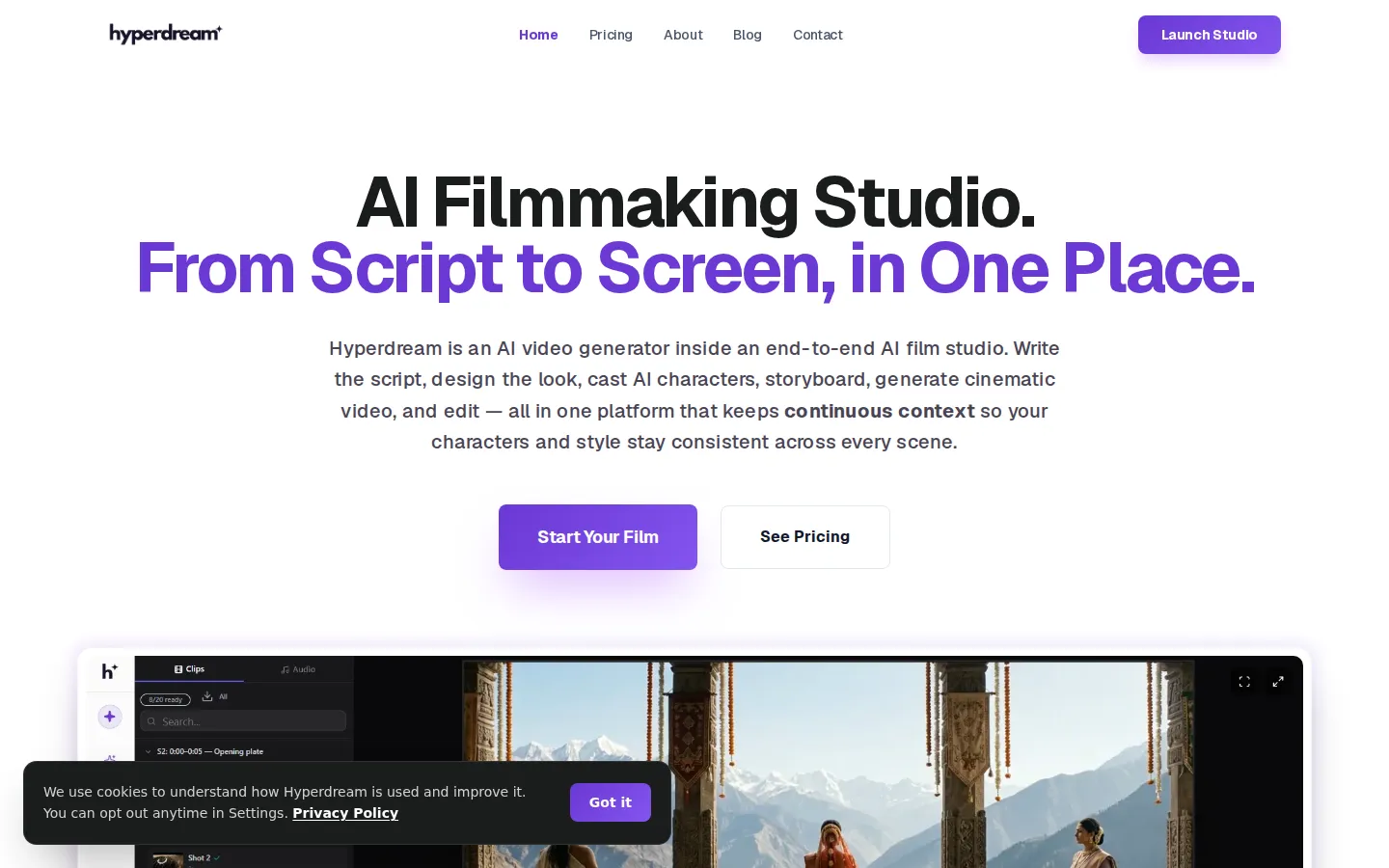
Hyperdream is an AI film studio in a browser tab: it writes a screenplay from a logline, locks a cinematic style, casts AI actors with cloned voices, storyboards every shot, generates directed video, and cuts the finished film on a built-in timeline. The real product is continuity, one shared context that keeps every scene looking like the same production.
What is Hyperdream?
Hyperdream is an AI filmmaking studio that runs an entire production inside one browser tab, from a written script to an exported final cut. The company behind it, Hyperdream Technologies Pvt. Ltd., frames the product less as another clip generator and more as the connective tissue a real production needs: a single thread of context that starts with the screenplay and survives every stage that follows.
That context is the actual pitch. Most AI video workflows break at the handoffs — one tool for the script, another for character consistency, a third for generation — and every switch loses what the story already knew. Hyperdream keeps the screenplay, the locked visual style, the cast, the storyboard, and the timeline inside the same project, so a shot generated in scene nine still knows which character is in frame, what they wear, how their voice sounds, and what the scene is meant to do emotionally.
The pipeline is laid out in six connected stages. Pre-production happens in an AI scriptwriter that turns a prompt or logline into a structured screenplay with acts, scenes, and editable dialogue. An aesthetic stage locks the cinematic look — lighting, color grade, and film grain — so the film reads as graded rather than stitched together from different models. Casting creates persistent AI actors with consistent faces and cloned voices. Storyboarding generates a shot-by-shot board from the script, using your cast and framing, so you can see the film before spending credits. Production is deliberately directable: virtual camera control, shot blocking, and lens choices mean you re-direct a shot instead of re-rolling a prompt and hoping. Post happens in a built-in non-destructive editor where shots land on a timeline for sound, pacing, and final export.
Billing runs on two currencies. Credits pay for images and video; agent tokens run the in-studio AI assistant, and the site says credits convert into tokens at no extra cost. Plans start free, then move through Starter at $29 a month, Creator at $49, Pro at $99, and Business at $199, layering on bonus credits, agent-token multipliers, faster generation, premium models, custom watermarks, and — from Pro upward — custom models.
What Hyperdream is not matters too. It publishes no API, no resolution or clip-length specifications on its marketing pages, and no native desktop app. The offer is a web studio for people who want the continuity problem solved, and the trade-off is a workflow opinionated toward narrative filmmaking rather than disposable clips for a feed.
Hyperdream Core Features
AI scriptwriting
turns a prompt or a one-line logline into a structured screenplay with acts, scenes, and dialogue you can edit before production starts.
Style and look lock
defines lighting, color grade, and film grain once, then carries that same cinematic grade through every shot in the project.
AI characters and casting
creates persistent AI actors with consistent faces and cloned voices that hold across scenes, not just inside a single clip.
AI storyboarding
generates a shot-by-shot board from the script using your actual cast and framing, so the film is planned before any credits are spent.
Directed video generation
exposes virtual camera control, shot blocking, and lens choices, so regenerating a shot changes the thing you asked it to change.
Built-in non-destructive editor
generated shots land on a shared timeline for sound, pacing, and final export without a trip to a separate editing app.
Continuous context
script, style, cast, and story stay linked from first page to final cut, which is the mechanism behind cross-scene consistency.
Credit and agent-token billing
credits pay for images and video while agent tokens run the AI assistant, and credits convert into tokens at no extra cost.
Who is Hyperdream for?
Hyperdream is aimed at people who want a finished piece rather than a folder of clips. The company names indie filmmakers, content creators, marketers, and studios as its core audience, and the pricing page splits that audience the same way: Starter for someone getting started with AI video generation, Creator for people who need premium models and faster generation, Pro for high-volume content production, and Business for teams that want custom models and the largest credit pool. The clearest fit is the solo auteur with a script and no crew. Someone who can write a short film, a music video, or a trailer but cannot afford a cast, a camera package, and an edit suite gets the whole pipeline in one subscription, and the continuity that used to require a production department is handled by the platform's shared project context. The second fit is the marketing or brand team producing ads, product videos, and social spots at volume. Recurring characters and a locked visual style matter more than any single shot when you are shipping a campaign, and reusing a cast across videos is cheaper than recasting every time. Small studios and agencies scaling AI production are the third group, which is why Business adds custom models and more capacity. Less obvious fits: novelists and comic artists prototyping scenes, educators building narrative explainers, and pitch or game teams that need a cinematic proof of concept before committing budget. Anyone who only needs one five-second clip for a feed is over-served here — a plain text-to-video tool asks less of them.
Hyperdream Use Cases
Write a short film from a one-line logline, then board and generate it without leaving the browser studio.
Produce a music video where one recurring performer looks and sounds identical in every scene.
Build a product ad campaign that reuses the same cast and color grade across several spots.
Storyboard a client's commercial before generation, so framing and shot blocking get approved first.
Cut a cinematic trailer from generated shots and finish picture and sound on the built-in timeline.
Prototype a feature concept as a proof-of-concept scene for investors or a pitch deck.
Teach narrative structure by scripting and boarding a scene end to end with a consistent cast.
Turn a written explainer into a narrated multi-shot video using cloned character voices.
Hyperdream Pros and Cons
Pros
- Consistency is structural rather than a prompt trick: script, cast, and style live in one project, so shots from different scenes actually cut together.
- The whole pipeline ships in one place — script, style, casting, storyboard, generation, edit — which removes the handoffs where context normally dies.
- Direction goes past a prompt box: camera moves, blocking, and lens choices make a regeneration a creative decision instead of a lottery roll.
- Pricing is published and credit-based, with a free start, tiered monthly plans from $29, and agent tokens bundled rather than sold as a separate AI add-on.
Cons
- No public API, no documented integrations, and no desktop app, so the studio is web-only and cannot be scripted into an existing production pipeline.
- Marketing pages publish no resolution, clip-length, or export-format specifications, which makes output hard to judge against a delivery spec before subscribing.
- Public proof is thin: the footer links only LinkedIn, with no X, YouTube, Discord, or email address, and no named customer films or third-party reviews on site.
FAQ About Hyperdream
Hyperdream Pricing
Hyperdream uses a credit model with a free start and four monthly tiers: Starter at $29 for 390 credits, Creator at $49 for 1,000 credits plus 50 bonus, Pro at $99 for 2,000 plus 100 bonus, and Business at $199 for 4,000 plus 200 bonus. Credits pay for images and video, agent tokens run the AI assistant, and credits convert into tokens at no extra cost. All tiers list fast generation, premium models, priority Discord support, and custom watermarks, with custom models added from Pro upward.
Check official pricingFree
The site advertises a free start and lists a $0 offer in its structured data; the free allowance itself is not published on the pricing page.
Starter
390 credits for images and video, access to agent tokens for the AI assistant, fast generation speed, premium AI models, priority Discord support, and custom watermarks.
Creator
1,000 credits plus 50 bonus, 1.5x Starter's agent tokens, fast generation, premium AI models, priority Discord support, and custom watermarks; marked as the popular plan.
Pro
2,000 credits plus 100 bonus, 2x Creator's agent tokens, premium models, priority Discord support, custom watermarks, and custom models for high-volume production.
Business
4,000 credits plus 200 bonus, 2x Pro's agent tokens, premium models, priority Discord support, custom watermarks, and custom models, positioned for teams.
Hyperdream Alternatives

GenjutsuLite
Independently operated. 150+ AI video templates. Cast your photos. 480p $7.99 or 720p $11.99 one-time. No account.

A2O LITE NEON AI Dance
Make 15-second fan-made dance videos from permitted adult or pet photos using Human Duo, Pet Duo, and Solo templates.

IntroVideo
IntroVideo is an AI logo intro generator that turns any logo into a unique 8-second cinematic intro in minutes.