
GPTHuman
GPTHuman is a web-based AI writing platform for humanizing existing drafts and generating new content from prompts. It combines adjustable tones and processing modes with multilingual writing and an integrated AI detector. A limited free trial lets users evaluate the workflow, while paid subscriptions increase output allowances and a documented API supports automated content processing.
What is GPTHuman?
GPTHuman is an AI writing platform that rewrites machine-generated drafts into more natural prose and also creates new content directly from prompts. Its official website describes a workflow for text produced by ChatGPT, Claude, Gemini, and other large language models. Users can paste existing material, choose writing settings, generate a revised version, and assess the result with the platform's included AI detector. The product is available through a browser-based application, with a separate developer API for programmatic integration.
The writing controls include selectable tones and processing modes. The homepage gives Standard, College, and PhD as tone examples, and Balanced and Enhanced as mode examples. It also describes broader professional, casual, academic, and creative writing styles. These options position the service as a rewriting and voice-adjustment tool rather than simply a spelling checker. Users remain responsible for verifying facts, citations, and the meaning of any revised passage before using it.
Multilingual writing is another advertised capability. The homepage states support for 80 languages, including English, Chinese, Spanish, French, and German, while the pricing page and API page use the more conservative description of over 50 languages. Because these official descriptions differ, users who need a particular language should confirm its availability in the relevant interface rather than assuming identical coverage across every product surface.
The subscription system distinguishes total monthly output from the maximum size of an individual result. Free access provides a 300-word humanizer trial and limited AI detector use. Paid plans increase the monthly allowance and single-output ceiling, and include the advertised Shield Guard protection layer. Unlimited access still has a 2,500-word maximum per output and is subject to abuse guardrails. Larger documents may therefore require multiple requests even on that plan.
For developers, GPTHuman publishes REST API documentation covering authentication, a humanization endpoint, credits, and response metadata. API credit packages are managed in the application dashboard rather than presented as the same subscription allowance. The website makes strong claims about detection avoidance and originality, but these are vendor claims, not independently verified guarantees in this directory entry. Its responsible-use policy explicitly prohibits academic dishonesty, concealed unauthorized assistance, and fabricated research, while recommending careful review and disclosure wherever required.
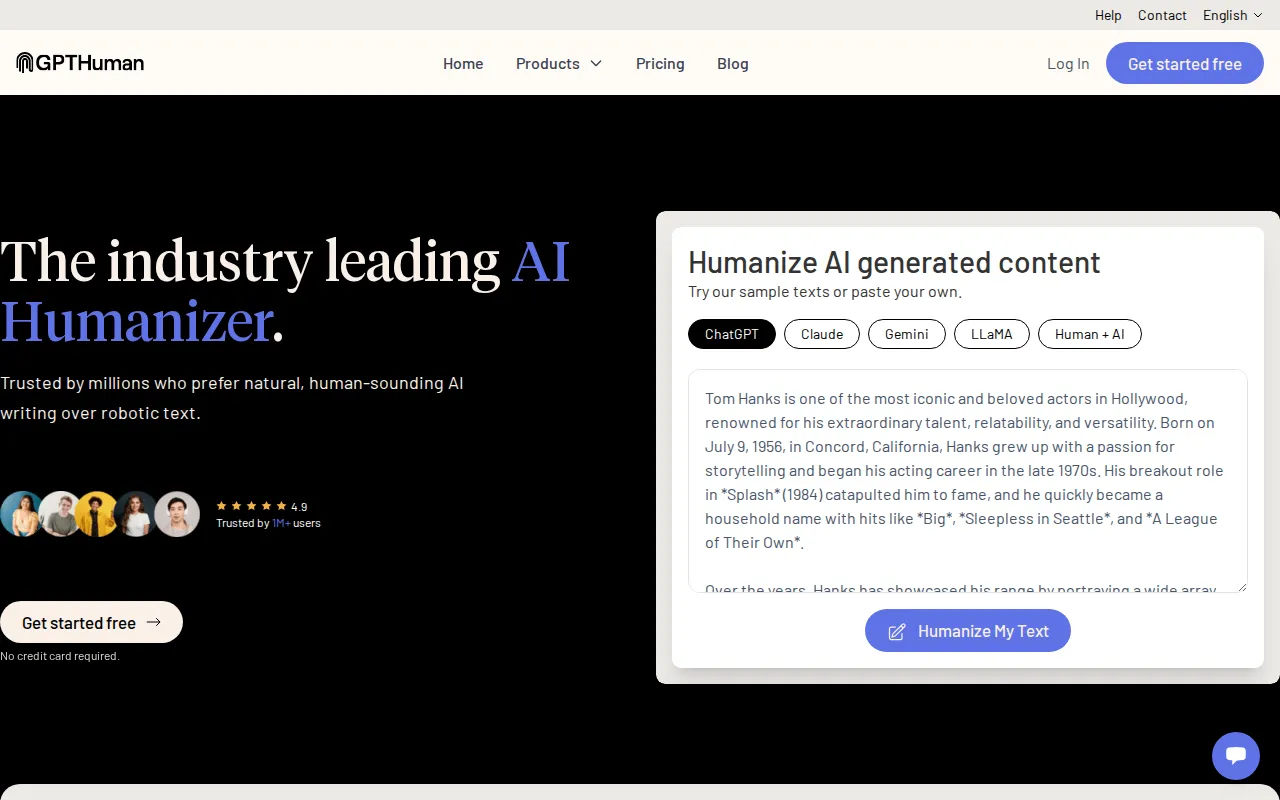
GPTHuman Core Features
Rewrite drafts from ChatGPT, Claude, Gemini, and other language models into natural prose.
Generate new human-sounding content directly from prompts rather than requiring an existing draft.
Adjust writing tone using options such as Standard, College, and PhD.
Select processing modes including Balanced and Enhanced to suit different rewriting needs.
Use multilingual humanization, with official pricing materials advertising more than fifty supported languages.
Assess generated writing through an included AI detector, with limited free access.
Integrate humanization into applications through a documented REST API with dashboard-managed credits.
Receive Shield Guard protection on paid subscriptions alongside larger monthly output allowances.
Who is GPTHuman for?
GPTHuman is aimed at writers, content creators, marketers, and other people who already work with AI-generated text but want a more natural final draft. A freelance writer can use it to revise stiff phrasing, compare a different tone, or turn a rough prompt into an initial passage. The integrated detector makes it possible to assess text within the same product, although a detection score should not replace editorial judgment about clarity, accuracy, or authorship. SEO professionals and marketing teams are another explicit audience on the official website. Their relevant workflows include revising blog drafts, product descriptions, and other publishing material before human review. The available tone settings may help adapt a passage for professional or conversational contexts. Word allowances and per-output limits matter for these users: a team handling longer documents should consider how often text must be split and how much monthly output its selected subscription permits. Students and academic writers are mentioned prominently, but the product's responsible-use policy draws important boundaries. Appropriate uses may include improving a personally written draft, practicing language skills, or preparing ungraded notes where local rules allow assistance. It is not presented in that policy as permission to conceal prohibited AI use, fabricate citations, or submit someone else's work. Institutional requirements and disclosure rules take priority. Developers, SaaS builders, publishers, and localization platforms can instead evaluate the documented API for adding humanization to their own workflows. They should check dashboard credit packages and test their intended language, tone, and document size before adopting it for production.
GPTHuman Use Cases
Revise an AI-assisted blog draft for more natural phrasing before editorial review.
Adapt marketing passages to professional or conversational tones for different audiences.
Generate a first draft from a prompt and refine it manually afterward.
Improve clarity in personally written academic drafts where institutional rules permit assistance.
Practice writing skills by comparing a personal draft with suggested revised wording.
Refine AI-translated passages for more fluent communication across supported languages.
Embed text humanization inside a writing application or publishing workflow through the API.
Assess draft text with the integrated detector while retaining independent editorial checks.
GPTHuman Pros and Cons
Pros
- Combines rewriting, prompt-based generation, and AI detection in the same writing platform.
- Offers a clearly described 300-word free trial without requiring a credit card.
- Publishes monthly and annual prices alongside explicit per-output limits.
- Provides official API documentation for developers building automated humanization workflows.
Cons
- Even Unlimited limits each output to 2,500 words and applies abuse guardrails.
- Official language counts differ: the homepage says 80 while pricing and API pages say 50-plus.
- Detection-avoidance and originality claims are vendor assertions, not independently verified results here.
FAQ About GPTHuman
GPTHuman Pricing
Freemium with a 300-word trial; monthly Starter $15, Plus $25, and Unlimited $49; annual subscriptions cost $99, $168, and $312 respectively, while API credit packages are priced in the dashboard.
Check official pricingFree
300 words of humanizer output, 300 words per output, and limited AI detector use; not an unlimited recurring free allowance.
Starter
25,000 output words monthly, 1,000 words per output, Shield Guard, generator, and AI detector. Annual option: $99/year, advertised as $8.25/month.
Plus
60,000 output words monthly, 1,500 words per output, Shield Guard, generator, and AI detector. Annual option: $168/year, advertised as $14/month.
Unlimited
Unlimited monthly output subject to abuse guardrails, with 2,500 words per output. Annual option: $312/year, advertised as $26/month.
API Credit Packages
Separate credit-based API access; official documentation states one input word equals one credit. Public package amounts are not shown on the subscription pricing page.
GPTHuman Alternatives

EvadeGPT
EvadeGPT is a writing workspace built around an AI humanizer that restructures sentence rhythm, phrasing and paragraph flow so machine-written drafts read more naturally. It adds a built-in AI detector, a multi-model chat, a rubric-aware essay drafter, slide generation and citation lookup on one shared points balance, aimed at marketers, editors and multilingual writers polishing their own drafts.

GPT Humanizer
GPT Humanizer is a browser-based AI writing tool that rewrites drafts from ChatGPT, Claude, Gemini, and other sources for clearer phrasing and smoother flow. Its free Lite model requires no login, while paid plans add Pro and Ultra models, writing styles, multilingual support, and larger requests. Related tools include AI detection, plagiarism checking, translation, and citation support.

Netus AI
Netus AI is a writing and chat platform with two apps on one account. Writer humanizes AI text so detectors such as Turnitin, GPTZero and Copyleaks read it as human, paraphrases, summarizes and generates articles and emails, and includes an unlimited free AI detector. Chat runs models from OpenAI, Anthropic, Google, xAI, DeepSeek, Kimi and MiniMax in one interface, switching mid-conversation without losing context.