
Electron Hub
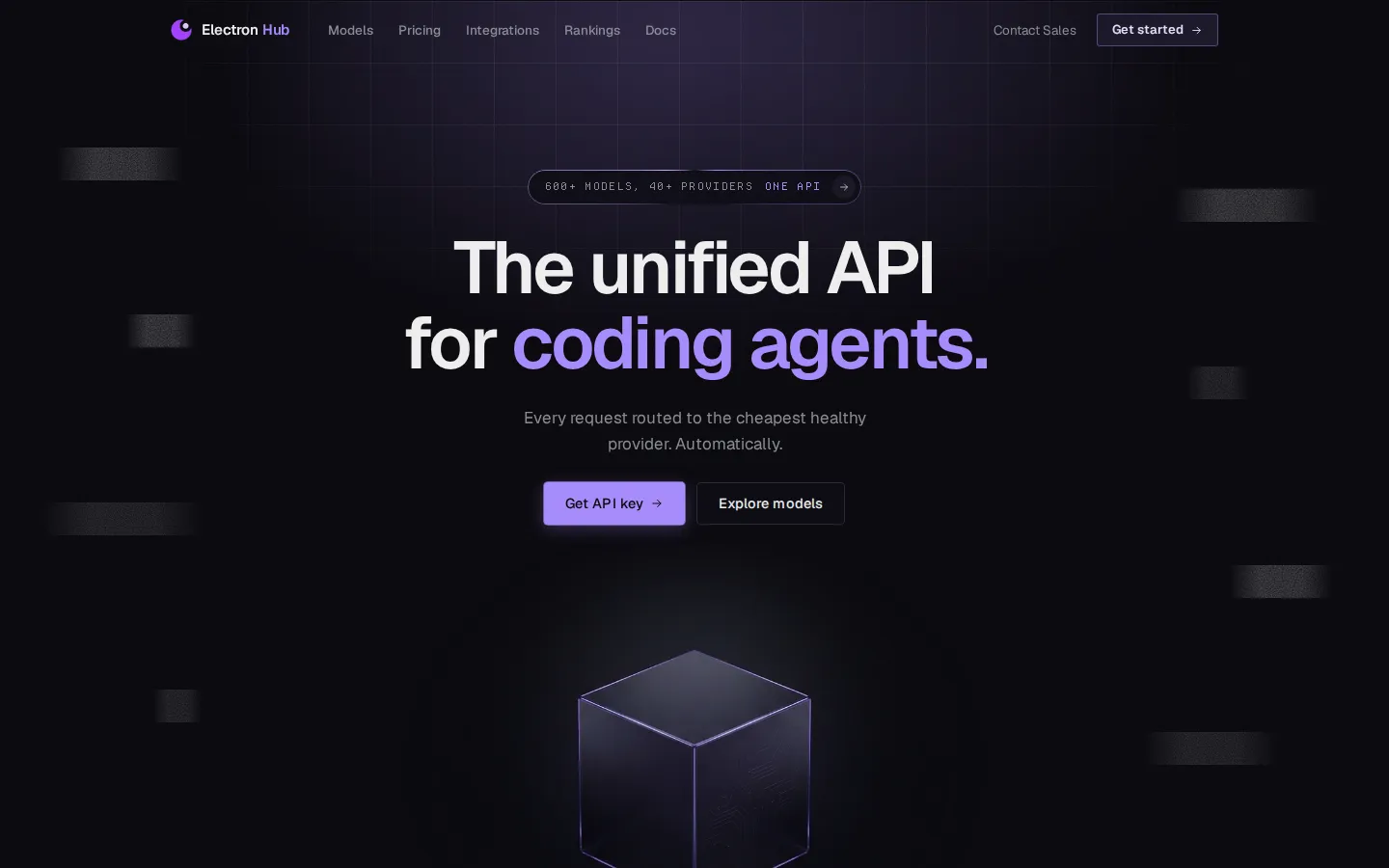
Electron Hub routes a single OpenAI-compatible request to more than 600 language, image, audio and embedding models from over 40 providers. A price-, latency- and health-aware router picks the cheapest healthy upstream, failing over automatically when a provider degrades. Developers get one key, usage-based credit billing, scoped proxy keys, an API console, a playground, an agent runtime and integrations for coding agents such as Claude Code, Cursor and Cline.
What is Electron Hub?
Electron Hub is a unified API gateway for LLM inference that gives developers one OpenAI-compatible endpoint and one API key for more than 600 models drawn from over 40 upstream providers, including OpenAI, Anthropic, Google, Meta, Mistral, xAI, DeepSeek, Qwen, Moonshot, Z.ai, Perplexity and Cohere. Instead of signing up with every vendor, teams point an existing SDK at the base URL https://api.electronhub.ai/v1 and call any supported model by changing a single model string.
The defining feature is the router. Every request is scored on price, latency and provider health before it leaves the platform, and Electron Hub sends it to the cheapest healthy upstream. Because the user-facing model ID stays constant, applications keep working when a provider degrades: traffic fails over to another upstream serving the same model, and those retries stay invisible to the calling application. The platform also advertises warm GPU pools, request-level elasticity with scale-to-zero, continuously health-checked providers, an OpenAI-compatible proxy layer, FP8 quantisation, and capacity spread across ten regions on four continents.
Beyond routing, Electron Hub covers the whole development loop. The model catalog lists live pricing, context windows and capability tags such as function calling, vision, reasoning and web search for each of the 645 catalog entries, and a rankings section tracks model performance. The console manages API keys, proxy keys with individual monthly caps, usage, spend and provider health, with up to 100 scoped proxy keys per account. A browser playground compares models side by side with streaming, tools and vision, an agents mode runs multi-step tool use with inspectable traces, and a visual flow builder chains models, tools and logic into one endpoint.
Pricing is credit-based. A free tier grants $0.25 in weekly credits plus free-model requests through Neutrinos, subscriptions from $10 to $249 per month convert into weekly credits, and pay-as-you-go permanent credits never expire at a base rate of $1 for 2 credits. Per-token prices start at fractions of a cent: the cheapest paid text models in the catalog list $0.005 to $0.03 per million input tokens, while a frontier model such as GPT-5.4 lists $2.50 per million input and $15 per million output tokens.
Electron Hub also bundles production concerns directly into the platform, including inline guardrails for PII redaction, prompt-injection scanning and content policies, optional confidential inference inside Intel TDX and NVIDIA confidential-computing enclaves with signed attestation proofs, and drop-in integrations for Claude Code, Codex CLI, Cursor, Cline, OpenCode and Windsurf. Documentation, billing guides, status and legal pages live on separate subdomains under electronhub.ai.
Electron Hub Core Features
Unified OpenAI-compatible gateway
One base URL and one API key reach 600+ models from 40+ providers, so existing OpenAI SDKs and agent tools work after a base_url swap.
Cheapest-healthy-provider routing
Each request is scored on price, latency and provider health, then sent to the cheapest healthy upstream serving that model.
Automatic failover
Multiple upstreams back each model, degraded providers drop out of rotation, and retries happen without any change to application code.
Model catalog and rankings
645 catalog entries list live per-million-token pricing, context windows and capability tags, alongside ranking data for models.
Guardrails and observability
Inline PII redaction, prompt-injection scanning and content policies run before inference, while tokens, latency and spend are tracked by key, model and day.
Scoped proxy keys
Up to 100 proxy keys per account, each with its own monthly spending cap, so CI runners and staging environments cannot overspend.
Playground, agents and flow builder
Compare models side by side in the browser, run multi-step agents with inspectable traces, or chain models and tools on a canvas.
Confidential inference
Optional Intel TDX and NVIDIA confidential-computing enclaves keep prompts in hardware-encrypted memory and emit signed attestation proofs.
Who is Electron Hub for?
Electron Hub suits developers, startups and platform teams that already build against OpenAI-compatible APIs and want one key, one bill and automatic failover instead of a dozen vendor accounts. It is a strong fit for product engineers shipping chat, RAG, agent or multimodal features who need to move between frontier models such as GPT, Claude, Gemini and Grok and cheap open-weight models such as DeepSeek, Qwen and GLM without rewriting integration code. Teams running high request volumes care most about the cheapest-healthy-provider policy, which can cut spend compared with calling each provider directly, and about the scoped proxy keys with monthly caps that stop a runaway script from draining a card. Operators also get health-checked routing across multiple upstreams per model, which matters when a single provider outage would otherwise take production down. Individual developers and hobbyists get a free tier with weekly credits, free-model requests and a browser playground, so they can evaluate models before paying anything. Coding-agent users of Claude Code, Cursor, Cline, OpenCode, Windsurf and Codex CLI are another natural audience, since an existing agent can be pointed at a different model behind an OpenAI- or Anthropic-style endpoint, or moved onto the flat-rate DevPass coding plan. AI engineers who need image and video generation, text-to-speech, speech-to-text or embeddings alongside chat find those modalities in the same catalog and key. Compliance-sensitive buyers in fintech, healthcare and enterprise settings may value the inline guardrails, audit logs, RBAC, SSO, SCIM provisioning, data-retention controls and hardware-backed confidential inference. Backend and internal tooling teams also use Electron Hub as a fallback layer and as a single place to track tokens, latency and spend per key, model and day.
Electron Hub Use Cases
Consolidate many AI vendor accounts into a single API key and one monthly bill.
Cut inference spend by routing traffic to the cheapest healthy provider for each model.
Keep applications online when an upstream provider degrades, using automatic failover.
Run coding agents such as Claude Code, Cursor or Cline against alternative models.
Compare candidate models side by side in a browser playground before shipping them.
Cap spending per environment with scoped proxy keys and individual monthly limits.
Generate images, video, speech and embeddings through the same endpoint as chat.
Prototype multi-step agent workflows with tool use and inspectable execution traces.
Electron Hub Pros and Cons
Pros
- One OpenAI-compatible endpoint covers 600+ models, so switching models is a one-string change.
- Cheapest-healthy-provider routing with automatic failover reduces both spend and outage risk.
- Free entry tier with weekly credits and free-model requests, and no credit card required.
- Transparent live per-model pricing plus pay-as-you-go credits that never expire.
- Broad tooling around the API: console, playground, agents mode, flow builder and coding-agent integrations.
Cons
- Subscription weekly credits reset every Sunday, and unused value carries over only up to the Flex Wallet cap.
- Model availability, catalog composition and per-token prices depend on upstream providers, so they can shift without notice.
- The flat-rate coding plan is limited to one seat per person with concurrency caps, and custom enterprise terms require contacting sales.
FAQ About Electron Hub
Electron Hub Pricing
Freemium credit-based pricing: a $0 Free tier with weekly credits and free-model requests, subscriptions from $10 to $249 per month, and pay-as-you-go permanent credits at $1 for 2 credits, with per-token model prices starting at $0.005 per million input tokens.
Check official pricingFree
$0.25 weekly credits refilled every Sunday, up to 200 free-model requests daily via ad rewards, access to 600+ models, 5 requests per minute and basic support.
Starter
$8 weekly credits, 150+ premium models including GPT, Claude, Gemini, Grok and DeepSeek, reasoning models, 10 requests per minute and priority support.
Plus
$15 weekly credits, everything in Starter plus image and video generation models such as Flux and Recraft, 20 proxy keys and 15 requests per minute.
Core
$30 weekly credits, multi-provider routing with automatic fallback, basic guardrails and 20 requests per minute.
Pro
$50 weekly credits, early access to new models, 50 proxy keys and 30 requests per minute.
Business
$100 weekly credits, advanced guardrails, SSO and 60 requests per minute.
Enterprise
$200 weekly credits, enterprise SLA, SCIM provisioning, VIP support and 100 requests per minute.
Coding Plan (DevPass)
Flat-rate coding plan for one seat: Lite at $10/month with unlimited tokens, 2 concurrency slots and 8 requests per minute, or Turbo at $40/month with 5 slots and 20 requests per minute.
Pay as you go (permanent credits)
Permanent credits bought by PayPal or cryptocurrency that never expire, with volume bonuses up to 20%. Model usage is billed per million tokens, from $0.005 per million input tokens at the cheapest paid model.
Custom
Custom weekly credits, custom rate limits and proxy keys, compliance and data-retention controls, and a dedicated support channel via support@electronhub.ai.
Electron Hub Alternatives

Ecommerce Data API
Amazon product, keyword, traffic and market research data through a REST API, remote MCP server and Agent Skill for developers and AI workflows.

FastRouter
FastRouter is a unified LLM gateway that gives developers one OpenAI-compatible API for 200+ models from providers such as OpenAI, Anthropic, Google, and xAI. It adds automatic model routing, fallbacks, caching, spend caps, role-based access, guardrails, and per-request observability, while passing provider token prices through with no markup on any plan, including the free tier.

MapGO
How far is this point from the sea? From the nearest border? Which country, region and district are it in? MapGO answers those in one click.