
Design Arena
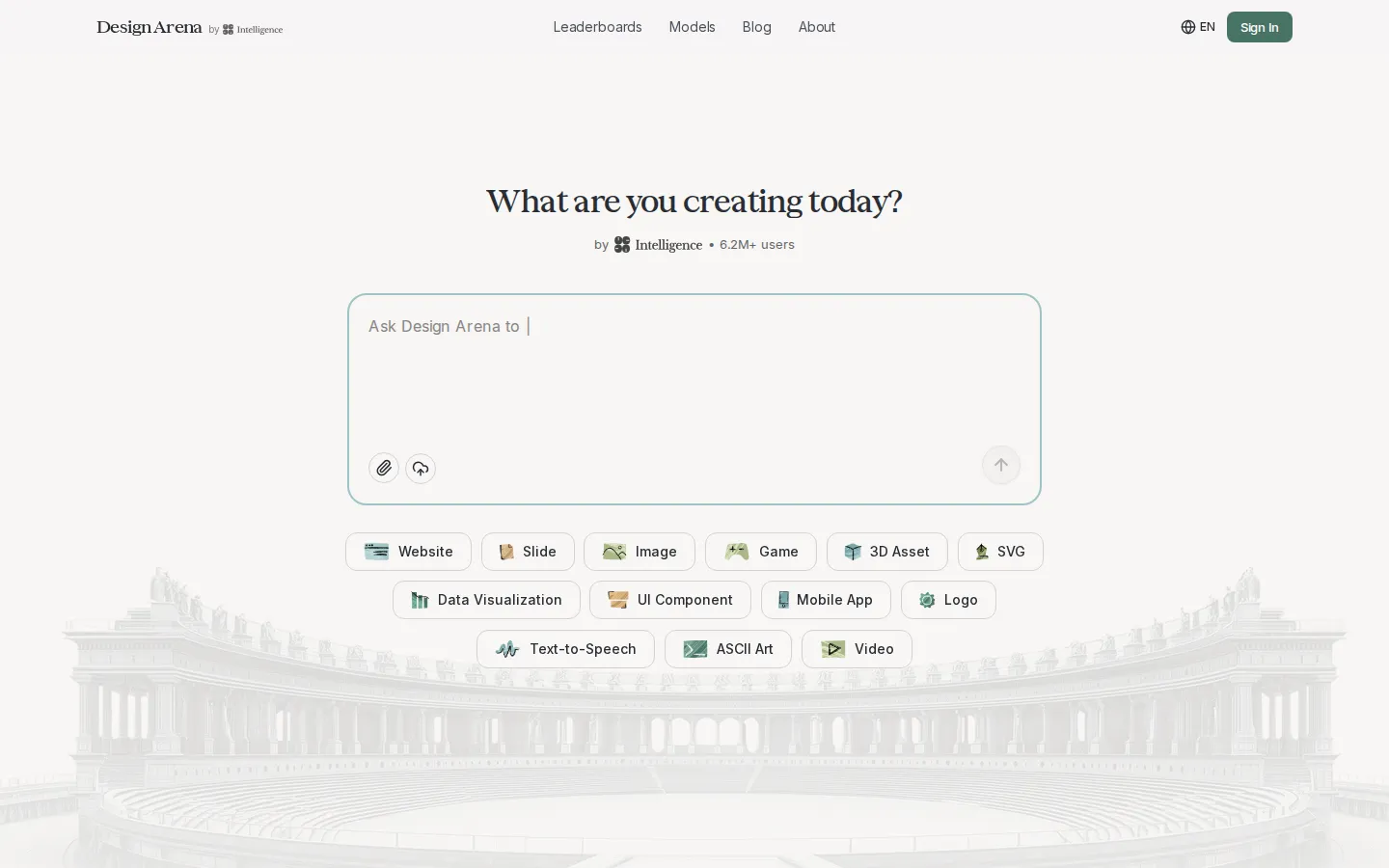
Design Arena is a web platform for creating and evaluating AI-generated designs. Users submit prompts, compare anonymous outputs from multiple models, vote on results, and explore leaderboards covering websites, images, video, games, mobile apps, slides, visualizations, and other formats. It helps users compare alternatives, understand practical strengths, and choose an appropriate workflow before spending time or budget on a larger project.
What is Design Arena?
Design Arena is an AI creation and evaluation platform that lets people explore what leading generative models can produce across many creative formats. Users describe a project such as a website, image, slide deck, game, mobile app, video, logo, SVG, text-to-speech asset, or data visualization, then compare model outputs in an interactive arena. Anonymous head-to-head comparisons reduce the influence of model branding, while community votes and statistical rankings provide a public view of relative performance. The service combines a creation interface with leaderboards, model pages, benchmark categories, and supporting research. Visitors can inspect battle counts, win rates, ratings, and other evaluation context instead of relying only on a vendor’s marketing claims. Design Arena is useful for creators choosing a model, teams testing generative workflows, researchers studying model behavior, and developers evaluating outputs before integrating a model. The platform also documents model information and an API path for approved projects. Results remain model-generated and should be reviewed for accuracy, quality, safety, licensing, and suitability before commercial use. Users should also check the current terms, model-specific restrictions, and data handling policies when submitting prompts or source material. The comparison workflow is especially valuable when a single prompt can be sent to several models and the decision depends on output quality rather than brand reputation. Users can use the available categories to narrow evaluation to the kind of artifact they actually need, compare alternatives visually, and return to leaderboards when a new model or benchmark result becomes relevant. This makes the site both a practical discovery surface and an ongoing reference for generative AI evaluation. The comparison workflow is especially valuable when a single prompt can be sent to several models and the decision depends on output quality rather than brand reputation. Users can use the available categories to narrow evaluation to the kind of artifact they actually need, compare alternatives visually, and return to leaderboards when a new model or benchmark result becomes relevant. This makes the site both a practical discovery surface and an ongoing reference for generative AI evaluation.
Design Arena Core Features
Prompt-based creation across websites, slides, apps, games, images, video, logos, and graphics
Anonymous head-to-head model comparisons designed to reduce brand bias
Community voting that directly contributes to model leaderboard rankings
Bradley-Terry and Elo-based ratings with win rates, battle counts, and error margins
Leaderboards organized by overall performance, modality, category, provider, and model type
Model directory showing providers, arena strengths, token costs, context windows, and output limits
Developer API providing programmatic access to Design Arena leaderboard data
Who is Design Arena for?
Design Arena is for people who want to compare AI models by practical creative performance rather than rely only on benchmark scores or marketing claims. Designers can use it to study how different models handle websites, UI components, images, video, slides, logos, SVG graphics, and other visual tasks. Developers and technical teams can consult model rankings, win rates, Elo ratings, model providers, output costs, context windows, and maximum output tokens when deciding which models to test in their own projects. Product managers, researchers, and AI enthusiasts can follow model performance across specialized categories such as website creation, game development, mobile development, data visualization, 3D design, and text-to-speech. The platform also serves voters and community members who want to influence rankings through direct, anonymous comparisons. Organizations building dashboards, articles, or applications can apply for programmatic access to leaderboard data through the Design Arena API. Because the service evaluates outputs through human preference, it is particularly relevant to users who care about aesthetics, usability, and practical design quality. The Terms of Service state that users must be at least 18 years old and capable of forming a binding contract. Users should also understand the platform's content-license terms before submitting sensitive or proprietary prompts, files, or generated material.
Design Arena Use Cases
Compare AI-generated websites before selecting a model for a web design project
Evaluate image models by community preference across abstract and specialized image categories
Research video model performance, generation speed, quality ratings, and cost tradeoffs
Discover which models perform best for game development, mobile apps, slides, or data visualization
Use public leaderboards to monitor model releases and changing competitive performance
Build dashboards, articles, or applications using approved Design Arena leaderboard API data
Vote on anonymous outputs to help produce community-driven evaluations of AI design quality
Design Arena Pros and Cons
Pros
- Covers many creative formats and specialized design categories in one web platform
- Uses anonymous, pairwise community voting instead of relying solely on curated examples
- Publishes methodology, model details, ranking calculations, and statistical uncertainty
- Provides documented API access for approved projects needing leaderboard data
Cons
- Rankings reflect subjective community preferences and may not predict every project outcome
- Terms grant Arcada Labs broad rights to use, commercialize, and train on submitted user content
- API access requires an application, approval, and visible attribution when data is displayed publicly
FAQ About Design Arena
Design Arena Pricing
Design Arena does not publish a conventional subscription pricing table. Its Terms of Service state that the Services are free unless fees are communicated for certain limited additional features or functionality. API access is application-based, and the application page does not list a price. Model pages display underlying model input and output costs for comparison.
Check official pricingStandard Service
The Terms of Service state that the Services have no fees unless Arcada Labs communicates charges for certain limited additional features or functionality.
API Access
Programmatic leaderboard access requires an application and approval. The API Access page does not publish a subscription price or usage fee.
Design Arena Alternatives

FastRouter
FastRouter is a unified LLM gateway that gives developers one OpenAI-compatible API for 200+ models from providers such as OpenAI, Anthropic, Google, and xAI. It adds automatic model routing, fallbacks, caching, spend caps, role-based access, guardrails, and per-request observability, while passing provider token prices through with no markup on any plan, including the free tier.

RouteMarket AI
RouteMarket AI is a unified creative marketplace for AI models, workflows, provider routing, and developer APIs. It brings 125+ image, video, audio, text, and 3D models from 23+ providers into one workspace, with a model playground, reusable workflows, an OpenAI-compatible API, and BYOK key support. A free Personal tier unlocks every model, and new accounts earn free daily login credits.

Segmind
Segmind is a serverless AI model platform and gateway for image, video, audio and voice generation. It exposes 550+ models from Alibaba, Kling, OpenAI, Google, Black Forest Labs and ElevenLabs through a single REST API, plus PixelFlow, a visual canvas that chains models into reusable workflows and republishes them as production endpoints. Billing is pay-as-you-go credits, monthly subscriptions or dedicated GPUs.