
DeepInfra
DeepInfra runs open models as metered APIs. Developers call text generation, embeddings, reranking, speech recognition, text to speech, image, music and video endpoints, paying per token or per execution time with no contracts or upfront costs. Dedicated GPU deployments, custom model hosting and owned B300 clusters are also offered, all running on DeepInfra's own inference-optimised hardware in US data centers.
What is DeepInfra?
DeepInfra is a serverless inference platform that runs open AI models behind developer-friendly APIs. Rather than provisioning GPUs or operating a model server, a team signs up, adds a payment method and sends requests to the endpoints it needs, while DeepInfra handles scheduling, autoscaling and capacity and bills only for what is consumed. The catalogue spans more than 100 models across ten categories: automatic speech recognition, embeddings, reranker, text generation, text to image, text to music, text to speech, text to video, world model and zero-shot image classification.
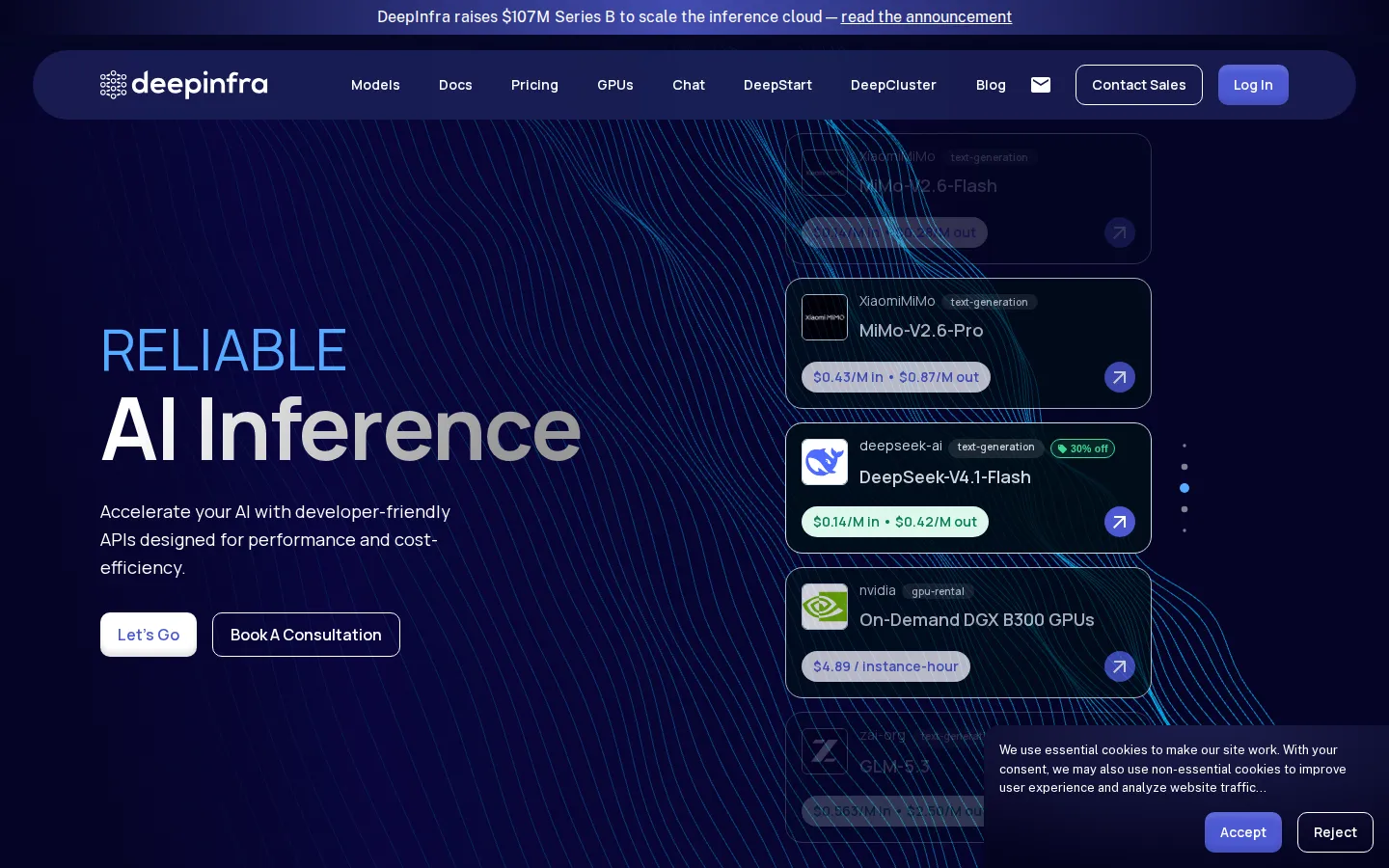
Models are grouped by family too, with hubs for Claude, DeepSeek, Flux, Gemini, Kimi, Llama, Mistral, Nemotron and Qwen, and the homepage highlights recent arrivals such as DeepSeek-V4-Flash, Kimi-K3, Qwen3.8-2.4T-A95B, GLM-5.3 and NVIDIA Nemotron 3 Ultra. Pricing follows the workload. Language models are billed per token, with DeepSeek-V4-Flash-0731 at $0.06 per million input and $0.18 per million output tokens and Meta-Llama-3.1-8B-Instruct-Turbo from $0.02 per million input tokens; embedding models such as bge-base-en-v1.5 cost $0.005 per million input tokens; Voxtral speech-to-text is metered per minute of audio; and image models such as Flux are priced per image with a size and iteration multiplier. The pricing page states there are no long-term contracts or upfront costs and that most non-language models are billed for inference execution time.
Each request can also choose a service tier. Standard is the default best-effort tier at the base price, Priority schedules a request ahead of standard traffic for a faster time to first token at 1.5x base price, and Flex trades slower responses and occasional unavailability for 0.8x base price on asynchronous or non-production work. Only serverless APIs are metered this way; customers who need more can buy dedicated capacity.
Custom LLMs run on dedicated SXM-connected A100, H100, H200, B200 or B300 GPUs, billed per minute and invoiced weekly, from $0.89 per GPU-hour on an A100 up to $4.89 per GPU-hour on a B300. DeepCluster sells owned NVIDIA B300 clusters on five-year terms at $1.98 per GPU-hour with 288GB of HBM3e per GPU, 256 to 5,000 GPUs available and a 99.982% uptime SLA, and dedicated instances and DGX clusters are arranged through sales. On privacy, DeepInfra advertises a zero retention policy, SOC 2 and ISO 27001 certification and its own inference-optimised hardware in US data centers. In May 2026 it announced a $107M Series B co-led by 500 Global and Georges Harik, citing 25x token volume growth since its Series A.
DeepInfra Core Features
100+ model catalogue
text generation, embeddings, reranker, speech recognition, text to speech, text to image, text to music, text to video, world model and zero-shot image classification.
Per-token pricing
language models from $0.02 per 1M input tokens, with cached input rates published for many models and embedding models as low as $0.005 per 1M input tokens.
Service tiers
Standard at 1x base price, Priority at 1.5x for a faster time to first token and Flex at 0.8x for asynchronous or non-production work.
Zero retention
a zero retention policy for inputs and outputs, SOC 2 and ISO 27001 certification and US-based data centers.
Automatic scaling
the platform scales a model onto more hardware as demand grows, with a default limit of 200 concurrent requests per account.
Dedicated GPUs
custom LLMs on A100, H100, H200, B200 and B300 hardware, billed per minute and invoiced weekly from $0.89 per GPU-hour.
DeepCluster
owned NVIDIA B300 clusters at $1.98 per GPU-hour on five-year terms, with 288GB HBM3e per GPU and a 99.982% uptime SLA.
Billing controls
pre-paid or invoiced accounts with a spending limit you can set to avoid surprises.
Who is DeepInfra for?
DeepInfra is built for people who ship software with models rather than train them. Application developers are the core audience: they add one API key to a backend and call text generation, embedding or speech endpoints instead of renting GPUs, managing CUDA images and scaling their own inference servers. Machine-learning and platform engineers use it to stand up production inference quickly, compare open models side by side on price and latency, and avoid maintaining a prediction service that only a few people on the team understand. Startups and small teams gravitate to it for cost reasons. Pay-as-you-go pricing with no contracts or upfront costs means an early product can serve heavy token volume without a reserved spend, and cheaper families such as DeepSeek-V4-Flash-0731 at $0.06 per million input tokens or Meta-Llama-3.1-8B-Instruct-Turbo at $0.02 per million input tokens keep unit economics tight. Teams building retrieval-augmented generation and search features lean on the embedding models at $0.005 per million input tokens, and teams that rely on cached prompts can cut input costs further. Agent builders use the long-context models in the catalogue, such as Kimi-K3 with a 1M-token window and Qwen3.8-2.4T-A95B, to drive coding agents, deep research workflows and multi-tool pipelines. Product teams that need more than text draw on the same platform for text to speech, automatic speech recognition, image generation through the Flux family, reranking for search quality and zero-shot image classification, which keeps several modalities behind one billing account and one set of keys. Enterprises and regulated teams evaluate DeepInfra on compliance and control: the platform advertises zero retention, SOC 2 and ISO 27001 certification and US-based data centers, and accounts can set spending limits. The buyer list published on the homepage includes Salesforce, Hugging Face, Abacus.AI, interface.ai and Requesty. Larger organisations with steady load move up to Priority or Flex scheduling, dedicated A100 to B300 GPU deployments, custom model hosting or an owned DeepCluster, and buyers in that tier typically begin with a sales conversation.
DeepInfra Use Cases
Run a production chatbot on open models without operating your own GPU servers.
Build retrieval-augmented generation pipelines on embedding models priced at $0.005 per 1M input tokens.
Power long-context coding and research agents with 1M-token models such as Kimi-K3 and DeepSeek-V4-Flash.
Generate or edit images with the Flux family and pay per image instead of per GPU-hour.
Transcribe audio with automatic speech recognition and Voxtral models metered per minute of audio.
Batch asynchronous jobs on the Flex tier to cut the token bill by roughly 20% against standard pricing.
Absorb peak-demand traffic on priority scheduling when time to first token matters most.
Host fine-tuned models on dedicated A100 to B300 GPUs from the same account as serverless endpoints.
DeepInfra Pros and Cons
Pros
- Pay-as-you-go with no long-term contracts, no upfront costs and published rates, starting at $0.005 per 1M input tokens for embeddings and $0.02 per 1M input tokens for small language models.
- Over 100 models across ten categories and nine family hubs, spanning DeepSeek, Qwen, Llama, Mistral, Claude, Gemini, Kimi, Nemotron and Flux.
- Zero retention policy with SOC 2 and ISO 27001 certification and US-based data centers, which matters for regulated and enterprise workloads.
- Flexible scheduling: Flex takes 20% off the base price for asynchronous work, while Priority buys a faster time to first token at 1.5x when latency matters.
- Dedicated hardware at self-owned scale: A100 to B300 custom deployments from $0.89 per GPU-hour and DeepCluster B300s at $1.98 per GPU-hour with a 99.982% uptime SLA.
Cons
- There is no free tier: the pricing page says you must add a card or pre-pay before you can use the services, so evaluating the platform costs money from the very first request.
- Spend is hard to forecast because language models bill per token, most other models bill for inference execution time, image models use a size and iteration formula, and service tiers add a 0.8x or 1.5x multiplier.
- Every account is capped at 200 concurrent requests by default, and higher limits, dedicated capacity and custom contracts are gated behind a sales conversation.
FAQ About DeepInfra
DeepInfra Pricing
Pay as you go with no contracts or upfront costs: language models are billed per token from $0.02 per 1M input tokens, embedding models from $0.005 per 1M input tokens, most other models by inference execution time, Priority scheduling at 1.5x and Flex at 0.8x base price, plus dedicated GPUs from $0.89 per GPU-hour; a card or prepayment is required and no free tier is offered.
Check official pricingPay as you go
Cheapest advertised unit price, charged on embedding models such as bge-base-en-v1.5 and all-MiniLM-L6-v2; language models are billed per token from $0.02 per 1M input tokens and most other models by inference execution time.
Priority tier
Requests are scheduled ahead of standard traffic for a faster time to first token during peak demand, at 1.5x the base per-token price; enabled per request with service_tier set to priority.
Flex tier
Lower cost for non-production and asynchronous work at 0.8x the base price, in exchange for slower responses and occasional unavailability; availability varies by model.
Custom LLMs (dedicated GPUs)
Dedicated A100, H100, H200, B200 and B300 GPUs for your own models, billed in minute granularity and invoiced weekly: A100 80GB from $0.89 and B300 270GB up to $4.89 per GPU-hour.
DeepCluster
Owned NVIDIA B300 cluster on a five-year term with 288GB HBM3e per GPU, 256 to 5,000 GPUs, Tier 3 data center and a 99.982% uptime SLA, against $6.50 per GPU-hour on public cloud.
Dedicated instances and clusters
Dedicated instances and DGX H100, B200 and B300 clusters with 3.2Tbps bandwidth, arranged by contacting the sales team.
DeepInfra Alternatives

Ecommerce Data API
Amazon product, keyword, traffic and market research data through a REST API, remote MCP server and Agent Skill for developers and AI workflows.

FastRouter
FastRouter is a unified LLM gateway that gives developers one OpenAI-compatible API for 200+ models from providers such as OpenAI, Anthropic, Google, and xAI. It adds automatic model routing, fallbacks, caching, spend caps, role-based access, guardrails, and per-request observability, while passing provider token prices through with no markup on any plan, including the free tier.

MapGO
How far is this point from the sea? From the nearest border? Which country, region and district are it in? MapGO answers those in one click.