
Deepgram
Deepgram is a voice AI platform for developers and enterprises. Its API covers speech-to-text (Flux STT), text-to-speech (Flux TTS), and a voice agent API built for real conversations, with turn-taking, interruption handling, and conversational context. Pricing is usage-based, starting with a $200 free credit and no credit card.
What is Deepgram?
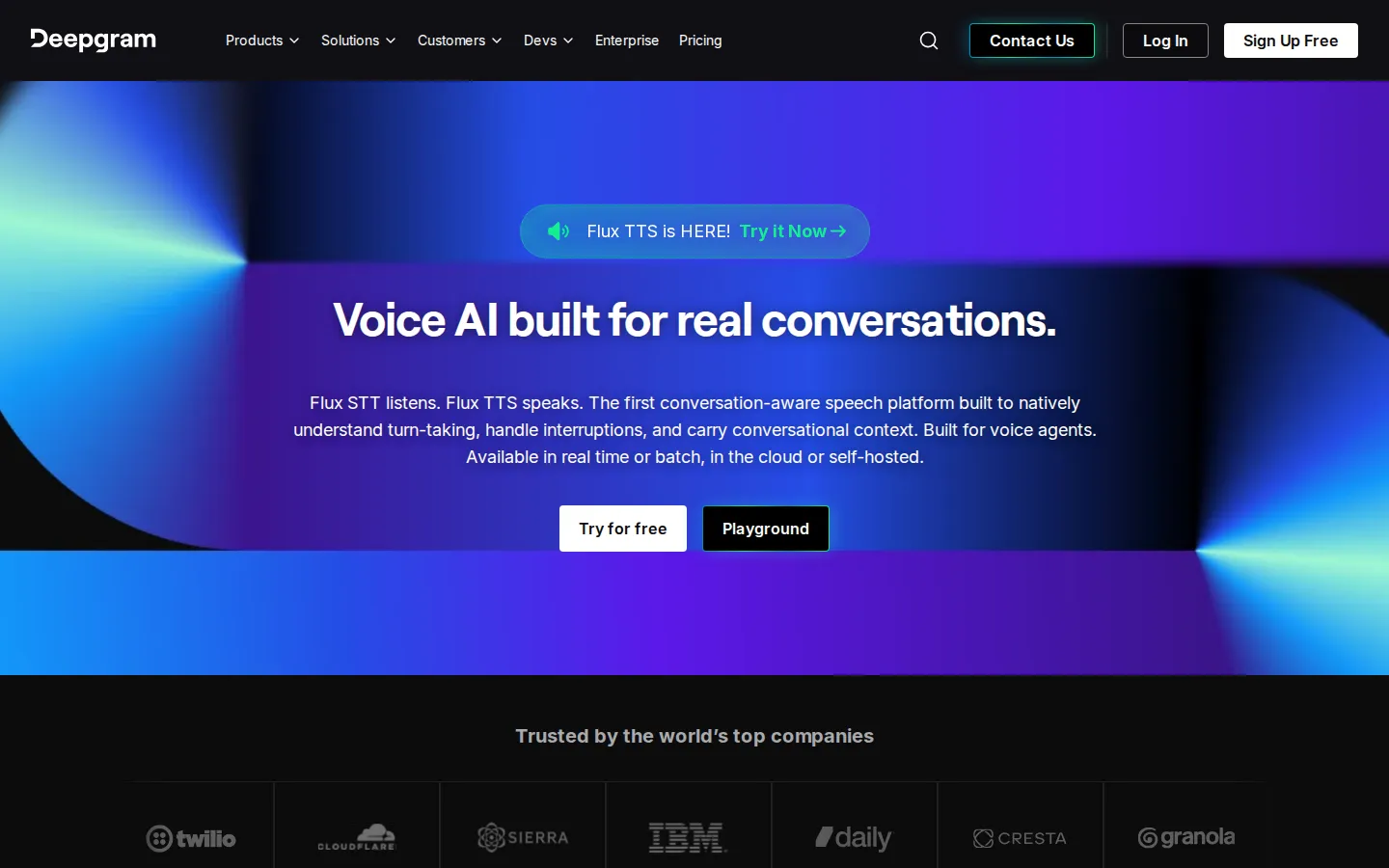
Deepgram is an enterprise voice AI platform that sells speech technology to developers through APIs rather than through a consumer app. Its product line covers the two halves of a spoken interaction: speech-to-text that listens, and text-to-speech that speaks. Deepgram markets its current models as Flux STT and Flux TTS, describing them as a conversation-aware speech platform built to natively understand turn-taking, handle interruptions, and carry context across a conversation, available in real time or in batch and in the cloud.
The speech-to-text side handles streaming audio for live captions and voice agents as well as pre-recorded files for batch transcription, with endpoints for prerecorded audio, streaming WebSocket audio, and a Whisper-compatible cloud option. Batch work suits call analytics, subtitle generation, and searchable archives; streaming work suits live agents and real-time captioning, where the platform's concurrency limits are the practical scaling lever. The text-to-speech side generates speech from text with endpoint options for both REST and WebSocket delivery, so applications can synthesise short responses in a live loop. On top of those, Deepgram offers a voice agent API that stitches listening, reasoning, and speaking together, which is the piece most teams would otherwise assemble themselves.
Pricing is deliberately transparent and usage-based. The public pricing page describes a Pay As You Go tier with no minimums, no expiration, and no credit card required, headlined by a free 200 dollar credit, then per-usage charges. A Growth tier offers pre-paid annual credits that redeem against actual usage with savings of up to twenty percent, and an Enterprise tier adds higher concurrency, committed capacity, and support. Because the tiers differ mainly in concurrency and price rather than in model access, teams can prototype on the free credit and scale without changing the model they tuned against.
Language coverage and deployment breadth are part of the pitch for larger buyers: Deepgram targets industries such as finance, healthcare, and government, and it lists enterprise customers as evidence of production readiness. For engineering teams the integration surface is conventional and well documented, with SDKs and REST or WebSocket access, which lowers the cost of trying it. What Deepgram does not offer is a consumer-facing app, a no-code studio, or a managed agent product with its own dashboard for non-technical users. It is infrastructure: you bring the audio, the UX, and the logic, and Deepgram returns text or speech with the latency budget that real-time conversation demands.
Deepgram Core Features
Flux speech-to-text
Conversation-aware transcription that handles turn-taking and interruptions, available in real time over WebSocket or in batch over REST.
Flux text-to-speech
Generates speech from text through REST and WebSocket endpoints so applications can respond out loud inside a live loop.
Voice agent API
Combines listening, reasoning, and speaking so teams do not have to assemble a conversational stack from separate services.
Real-time and batch modes
The same platform serves live captions and phone agents as well as pre-recorded call analytics and subtitle generation.
Concurrency-based tiers
Pay As You Go and Growth plans differ by throughput and price, letting prototypes scale to production without switching models.
Free 200 dollar credit
Developers can benchmark accuracy on their own audio before committing spend, with no credit card required.
Industry focus
Finance, healthcare, and government are named target sectors, which shapes compliance and support conversations for enterprise buyers.
Who is Deepgram for?
Deepgram is built for teams that ship voice into products, not for people who want a transcription website. Backend and platform engineers are the primary audience: they need real-time streaming transcription and synthesis endpoints that behave predictably under load, and Deepgram exposes REST and WebSocket interfaces with concurrency limits that scale by tier. Product teams building voice agents and phone support automation are a second group, because turn-taking, interruption handling, and context carry are exactly what makes a spoken interaction feel conversational rather than robotic. Contact-centre and CX technology owners use it to transcribe calls, score interactions, and power self-service voice flows, where accuracy on accents and noisy audio directly affects cost per contact. Healthcare, finance, and government teams appear as named target industries, and they typically need compliance posture and enterprise agreements alongside raw accuracy. Developers building meeting assistants, note takers, and call analytics can chain the same API for real-time captions and post-call searchable transcripts. Media and podcast teams use batch transcription for subtitles, show notes, and searchable archives in many languages. Voice-app founders evaluating providers use the free credit to benchmark word error rate against alternatives on their own audio. Marketing and product researchers occasionally use transcription for interviews, though a consumer transcription tool is usually simpler for that job. The platform is not aimed at consumers, since there is no browser app for uploading a file and clicking transcribe, and it is not a no-code product: you need to call an API. It is also a poor fit for teams that want a fully managed voice-agent product rather than building blocks, or for anyone with a strict requirement that all processing happen on their own premises. The best-fit user is an engineering team with voice in the roadmap that wants accuracy, real-time performance, and language coverage through one API provider.
Deepgram Use Cases
Power a voice agent that answers support calls and handles interruptions naturally.
Transcribe contact-centre calls for quality scoring and coaching.
Generate live captions for webinars, streams, or in-product video.
Produce subtitles, show notes, and searchable archives for podcast episodes.
Build a meeting assistant that captures action items from spoken conversation.
Add spoken responses to an app with text-to-speech synthesis.
Benchmark word error rate against a current provider using your own audio.
Deepgram Pros and Cons
Pros
- One provider covers speech-to-text, text-to-speech, and a voice agent API, which simplifies a conversational stack.
- A free 200 dollar credit with no credit card makes it cheap to benchmark accuracy on real audio.
- Usage-based pricing with a pre-paid Growth tier that discounts up to twenty percent for committed spend.
- Real-time streaming and batch processing come from the same models, so prototypes carry into production.
Cons
- Developer-only platform with no consumer app or no-code interface, so non-technical users cannot simply upload a file.
- Growth tier is positioned for annual pre-paid credit commitments in the thousands of dollars, which is steep for hobby projects.
- Because tiers differ mainly in concurrency, high-traffic live voice agents may require enterprise terms rather than a self-serve plan.
FAQ About Deepgram
Deepgram Pricing
Usage-based pricing with a free 200 dollar credit and no credit card on Pay As You Go, pre-paid annual Growth credits with up to twenty percent savings, and enterprise agreements for higher concurrency.
Check official pricingPay As You Go
Free 200 dollar credit, then usage-based rates with no minimums, no expiration, and no credit card required, aimed at developers and startups.
Growth
Pre-paid annual credits that redeem against actual usage, saving up to twenty percent, with higher concurrency limits.
Enterprise
Committed capacity, the highest concurrency limits, and support for organisations in finance, healthcare, and government.
Deepgram Alternatives
Sogni AI
Sogni runs the Supernet, a decentralized GPU network powered by independent workers instead of data centers. The platform brings 200+ frontier image, video, music, and language models under one account, with a free tier for on-device rendering, pay-as-you-go Spark credits, and flat-rate Unlimited plans for credit-free fair-use access, plus SDK and API access for developers.

Mistral AI
Mistral AI is a French frontier AI company that helps organizations build tailored AI systems. Its platform spans Vibe, an AI agent for long-horizon work; Vibe for code; Studio for building and running agents and apps; Forge for training custom models; and Compute, frontier-scale infrastructure for training and inference. Models can be self-hosted, run on Mistral's EU cloud, or accessed through cloud partners.

Venice AI
Venice is a privacy-first AI platform giving unrestricted access to leading AI models across text, image, video, code, and audio generation. Prompts and responses stay in your browser rather than on Venice servers, with anonymized, private, TEE, and end-to-end encrypted modes. A free tier is available, and paid plans add unlimited text prompts, more credits, and higher API limits.