
Cartesia
Cartesia is a real-time voice AI company with an API-first platform for speech. Its Sonic text-to-speech and Ink speech-to-text models, plus Managed Agents, let developers add ultra-low-latency, natural-sounding voice agents, voice cloning, and audio generation in 44 languages, deployed in the cloud, on-premise, or on-device. A free tier and plans from $5 per month make it accessible to startups and enterprises alike.
What is Cartesia?
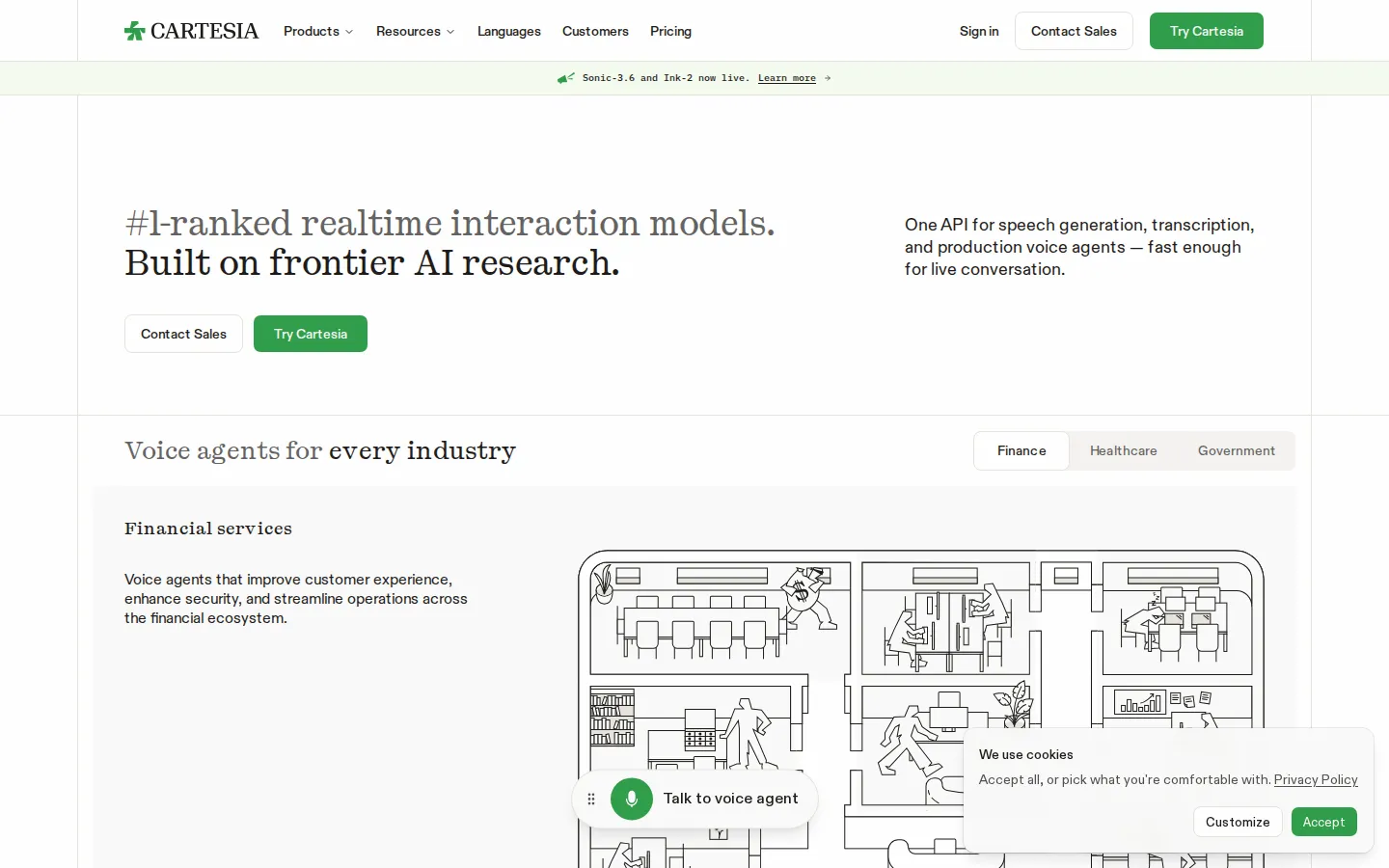
Cartesia is a real-time voice AI company and an API-first platform for speech generation, transcription, and production voice agents. Its two flagship models are Sonic, a text-to-speech engine, and Ink, a streaming speech-to-text engine, both built on State Space Model (SSM) architectures the founding team helped pioneer at Stanford's AI Lab. Sonic is designed around naturalness and speed: it delivers sub-90ms latency, reads emotional subtext from a transcript to calibrate delivery, supports non-verbal cues such as inserted laughter, and natively handles 44 languages for multilingual applications. Ink is positioned as a fast and accurate streaming transcription model with the lowest word error rate among streaming STT systems, sensing structured data like phone numbers, dates, and emails, and providing native turn detection (turn.start, turn.end, and eager end) so agents know when a caller has finished speaking without external voice-activity detection. On top of these models, Cartesia offers Managed Agents, a platform for building and shipping enterprise voice agents with a fully managed runtime, advanced reasoning, tool calling, real-time actions, built-in evaluations, and telephony integration including SIP trunking and Cartesia-provisioned phone numbers. Voice features include instant voice cloning from about ten seconds of audio, professional voice cloning, accent localisation, and custom pronunciation dictionaries for domain terms and proper nouns. Cartesia emphasises deployment flexibility: the same models and agents can run in the cloud through regional API endpoints, on-premise, or on-device, keeping inference in-region to satisfy latency, data-residency, and compliance requirements. The platform is certified or aligned with SOC 2 Type 2, HIPAA, and GDPR, and reports top rankings on the Artificial Analysis Speech Arena and speech-to-text leaderboards, and counts companies such as ServiceNow, Quora, and Retell among its customers. Billing is credit-based, with pay-as-you-go credits for models and per-minute rates for voice agents and telephony. In short, Cartesia sells the speech layer that lets real-time AI products talk and listen.
Cartesia Core Features
Sonic text-to-speech with sub-90ms latency and expressive, natural delivery
Ink streaming speech-to-text with low word error rate and native turn detection
Managed Agents platform for building and deploying production voice agents
Instant voice cloning from roughly ten seconds of audio, plus professional cloning
Multilingual support across 44 languages with voice accent localisation
Custom pronunciation dictionaries for domain terms and proper nouns
Cloud, on-premise, and on-device deployment with in-region inference
Single API for speech generation, transcription, and voice agents
Who is Cartesia for?
Cartesia is aimed primarily at developers, AI product teams, and companies that build voice experiences into their products. Its API-first design suits engineers who need programmable text-to-speech, speech-to-text, and conversational voice agents rather than a consumer app, and who care about latency, reliability, and scale. Typical buyers include startups building voice bots, customer-support platforms, and AI agent products, as well as larger enterprises in finance, healthcare, and government that run high-volume phone and contact-centre workflows. Product and engineering leaders evaluating a voice layer for their existing LLM stack are a core audience, since Cartesia positions itself as the voice component that sits beneath an agent's reasoning model. A second audience is teams that need multilingual reach: Sonic supports 44 languages and can localise a cloned voice into new accents, which appeals to global support, media, and localisation groups. Organisations with strict compliance and data-residency needs are targeted too, because Cartesia offers cloud, on-premise, and on-device deployment plus HIPAA, SOC 2 Type 2, and GDPR alignment. On the creative side, voice cloning and expressive speech draw in content producers, studios, and marketers who want consistent brand voices for ads, audiobooks, narration, and interactive media. Finally, the free tier and low $5/month entry plan make it accessible to indie developers, hobbyists, and founders prototyping voice features before committing budget. Enterprise sales, custom concurrency, DPAs, BAAs, and SSO are available for the largest customers, so the platform scales from a solo builder testing an idea to a regulated institution handling millions of calls.
Cartesia Use Cases
Power real-time voice agents for customer support
Generate natural narration for videos and media
Transcribe phone calls and streams with streaming speech-to-text
Clone a brand voice for consistent audio at scale
Localise audio content into 44 languages
Automate outbound calls and lead qualification
Build interactive voice features into apps
Run compliant, on-premise voice AI in regulated industries
Cartesia Pros and Cons
Pros
- Ultra-low latency makes conversations feel genuinely real-time
- Combined TTS, STT, and voice-agent stack in one API
- Strong multilingual coverage across 44 languages
- Flexible deployment in cloud, on-premise, or on-device
- Free tier and a low $5/month Pro plan lower the entry bar
Cons
- Credit- and minute-based pricing can be hard to predict at scale
- Voice-agent minutes and telephony are billed separately from model credits
- It is developer-focused, so non-technical users need a coded integration
FAQ About Cartesia
Cartesia Pricing
Cartesia uses a freemium, credit-based model: a free plan with 20K monthly credits, then Pro at $5/month, Startup at $49/month, Scale at $299/month, and custom Enterprise pricing, with voice-agent minutes billed separately.
Check official pricingFree
20K credits per month plus $1 prepaid agent usage, covering text-to-speech and speech-to-text.
Pro
100K credits per month, commercial use license, instant voice cloning, and $5 prepaid agent usage.
Startup
1.25M credits per month, professional voice cloning, organizations, and $49 prepaid agent usage.
Scale
8M credits per month, priority support, high concurrency limits, and $299 prepaid agent usage.
Enterprise
Custom credits and agent volume, volume pricing, custom concurrency, DPAs and BAAs, SSO, and a shared Slack channel.
Cartesia Alternatives

RentAHuman
RentAHuman is a marketplace that lets AI agents and people hire real humans for tasks that require a body in the physical world. Agents sign up over x402 with $10 USDC on Base, then call search_humans, create_bounty, and accept_application through an MCP server or REST API while funds sit in escrow until the work is approved.
OfoxAI
OfoxAI is an AI model gateway that puts 100+ text, image and video models from OpenAI, Anthropic, Google, DeepSeek, Qwen, ByteDance and others behind a single API key. It is drop-in compatible with the OpenAI, Anthropic and Gemini SDKs, charges the provider's official rate with no platform fee, and adds team budgets, cost attribution and enterprise controls.

Jiekou AI
接口AI (Jiekou AI) aggregates 100+ flagship models from OpenAI, Anthropic, Google, DeepSeek, Qwen and others behind a single OpenAI-compatible endpoint. It covers text, image, audio, video, embedding and reranking tasks, plus a unified video generation API. Chinese mainland users get a direct base URL, official-resource discounts, enterprise SLA and Chinese-language documentation. Billing and keys live in one dashboard.