
atypica.AI
atypica.AI turns a business question into a research study. You state the decision you face, it frames the objective, audience, and method, builds a panel of AI Personas from multi-platform social and behavioral data, then runs in-depth interviews, focus groups, and scenario tests. Every study ends in a structured report with evidence, assumptions, and limitations.
What is atypica.AI?
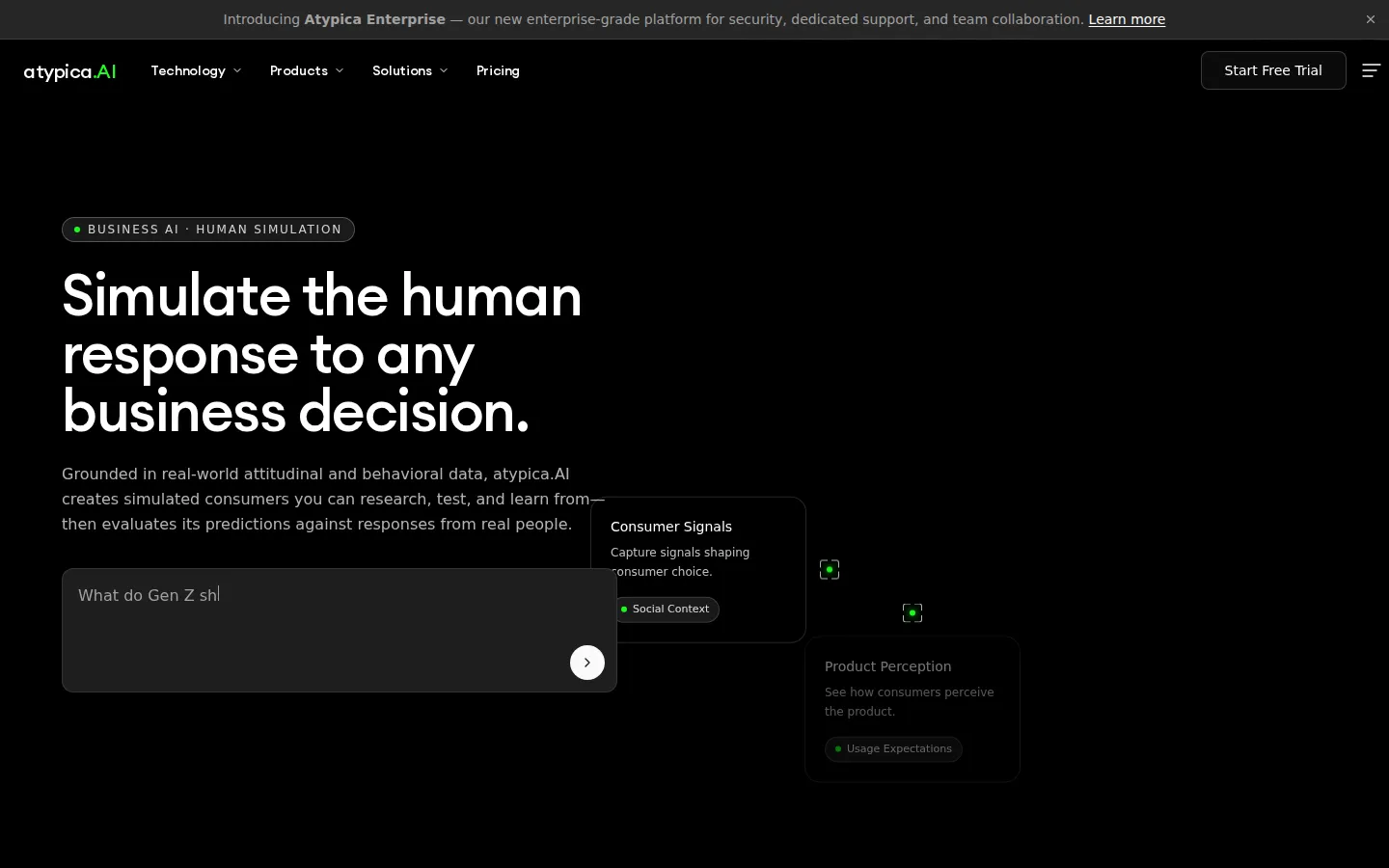
atypica.AI is an AI business research platform from BMRLab that simulates how people respond to business decisions. Rather than recruiting respondents for every question, it builds simulated consumers from real attitudinal and behavioral data, lets a team research and test against them, and then evaluates its own predictions against responses from real people.
The workflow runs in four stages. You state the decision you are facing, and atypica.AI frames it as a research design covering objective, audience, and method. Your audience then becomes a population of inspectable Personas, each carrying real attitudes, context, and behavioral history, assembled with help from a social scout that reads posts and comments across several platforms. Next you simulate the response: interview each Persona one to one, put a group of them in a focus group, or introduce a scenario and watch how each one reacts, with the reasoning behind every reply available to inspect. Finally the system compounds, carrying forward your audiences, preferred research methods, and recurring questions so the next study is framed differently.
The tool set covers In-depth Interview, Focus Group, AI Persona, Social Scout, Audience Feedback, Web Research, and Generate Report. Products split into The Researcher for question-to-study work, AI Panel for discussions at scale, AI Interview for depth interviews with automatic analysis, and The Simulator for virtual consumers on demand. Documented research scenarios include consumer insight, product discovery, concept testing, competitor analysis, brand positioning, and content strategy.
Underneath runs the Subjective World Model, atypica's model of how one individual sees the world. It holds four evidence layers: expression such as comments, posts, and survey answers; the story layer of lifestyle and identity narrative; cognition in the form of decision weights that are inferred rather than asked about; and behavior such as orders, clicks, and repeat purchases. Contradictions between layers are preserved rather than averaged away, so a persona can say it has cut out sugar while its order history shows otherwise. A single persona record might combine hundreds of comments, several self-narratives, inferred decision weights, and thousands of order and click events.
Every study ends in a structured research report rather than a chat answer: an executive summary with recommendations, segment-level findings, the evidence behind each conclusion, and explicit assumptions and limitations. atypica.AI also publishes its evaluation work, including the Subjective World Benchmark built from held-out answers from 7,300 real respondents, plus protocols for comparing a persona population with a human one. The company reports that its agent leads general-purpose frontier models by 13 to 20 points across six benchmarks, and that accuracy is re-measured continuously instead of certified once.
atypica.AI Core Features
Study designer
states a business decision and returns a research design with objective, audience, and method
AI Personas
your audience becomes inspectable personas carrying real attitudes, context, and behavioral history
AI Interview
one-to-one depth interviews that run automatically and are analysed for you
AI Panel
assembled groups that discuss a question at scale, with each persona's reasoning visible
Subjective World Model
four evidence layers per persona, covering expression, story, cognition, and behavior
Social Scout
reads posts and comments across multiple platforms to find the consumer types that recur
Structured reports
executive summary, segment-level findings, evidence, plus explicit assumptions and limitations
Enterprise controls
SOC2 compliance, private data dimensions, custom reasoning models, and a shared knowledge base
Who is atypica.AI for?
atypica.AI fits teams that make consumer-facing decisions and need directional answers faster than a full research cycle allows. Brand and consumer insights teams are the core audience: the site frames the value as bringing consumer perspectives into brand decisions earlier, before concepts, messaging, and positioning are locked in, and the packaged solutions are written for that role by name. Product managers use it to pressure-test concepts before the first prototype exists. A global chief digital officer at Bosch is quoted describing 50 highly realistic AI personas across eight sub-industries and three continents, with product managers using them every week. Product and R&D teams get research frameworks and a product R&D workflow on the Growth plan. Marketers, creators, and influencers are addressed as separate audiences, because the platform can test ad concepts, content angles, and messaging with personas instead of waiting for performance data after launch. Startup owners use it to size an audience and validate positioning when there is no customer base to survey yet. Consultants use it to strengthen strategic assumptions before recommendations reach a client, which is exactly the use Bain and Company is quoted on. Enterprise research and insights functions are a fourth group. atypica Enterprise adds security, dedicated support, team collaboration, SOC2 compliance, persona building from private data, custom reasoning models, an end-to-end research workflow, and a shared team knowledge base, and the published buyer research is written for that procurement conversation. It is a poor fit for teams that need statistically representative, field-verified numbers. The platform's own research notes the scenarios it refuses rather than simulates: sensory judgments of food and drink, reactions to an interface a model has never touched, and products that do not exist yet.
atypica.AI Use Cases
Pressure-test a price increase with a simulated focus group before touching the shelf price
Screen two packaging or hero-image concepts to see which one shoppers are drawn to
Map the segments inside a category and see which consumer types hold which opinions
Interrogate how a competitor's positioning is perceived by your target audience right now
Profile a new audience before launch when no customer data exists yet
Run a depth interview program on a niche question and have the analysis produced automatically
Validate messaging and brand positioning with simulated consumers before creative work is locked
Give product managers reusable personas they can question weekly before the first prototype
atypica.AI Pros and Cons
Pros
- Personas are grounded in real attitudinal and behavioral data rather than demographic prompts, and contradictions between what people say and what they do are kept in the record
- The whole workflow, from study design to personas to interviews, focus groups, and the final report, sits in one place, so a study needs no recruiting, incentives, or scheduling
- Accuracy is published rather than asserted: the Subjective World Benchmark holds out real answers from 7,300 respondents, and every result ships with a predicted confidence level
- Enterprise plans add SOC2 compliance, private data dimensions, custom reasoning models, and a team knowledge base, which is what large insights functions ask for during procurement
- Token pricing is predictable, because the pricing page quotes a typical study at roughly 400K tokens and allows top-ups at $16 per 1M tokens
Cons
- There is no permanently free plan: the entry tier is $20 per month, plan tokens expire after 30 days, and additional tokens must be purchased for heavier research
- The platform documents its own capability boundaries, refusing sensory judgments, reactions to interfaces a model has never encountered, and products that do not exist yet
- Because usage is metered in tokens, a program of several complex studies can outgrow the listed allowance and make the real monthly cost hard to forecast
FAQ About atypica.AI
atypica.AI Pricing
Paid subscription tiers with no permanently free plan: Pro is $20 per month for 2M tokens, Max is $50 per month for 5M tokens with a limited 3M bonus, Growth is $249 per month for 25M shared tokens across three seats, Enterprise is quoted on request, and unused plan tokens expire after 30 days with top-ups at $16 per 1M tokens.
Check official pricingPro
2M tokens valid for 30 days, multi-platform social data, core persona dimensions, an enhanced reasoning model, one-on-one and group persona interaction, multi-modal input, and podcast generation.
Max
5M tokens valid for 30 days plus a limited-time 3M bonus tokens per month, all social data platforms, all persona dimensions, a superior reasoning model, one-on-one and group persona interaction, multi-modal input, and podcast generation.
Growth
Three seats included with 25M tokens shared across the team valid for 30 days, plus a limited-time 15M bonus tokens per month, AI Panel, research frameworks, a product R&D workflow, and early access.
Enterprise
For businesses operating at scale, with SOC2 compliance, persona building from private data, superior and custom reasoning models, AI Persona, AI Interview, an end-to-end research workflow, and a team knowledge base.
Additional tokens
Available to subscribers only, priced at $16 per 1M tokens with an extra 1M bonus. A typical research study uses approximately 400K tokens, and top-ups can be purchased at any time.
atypica.AI Alternatives

MaxAsk
MaxAsk is a free search engine run by Maxthon Limited. A query returns web results and image results on one page, and adding a question mark at the end of a query requests an AI answer. It runs in the browser, needs no account, and can be set as a browser default search engine. The same search service is built into the Maxthon browser.

NotebookLM
NotebookLM, now called Gemini Notebook, is Google's research assistant for material you supply. Upload PDFs, websites, YouTube videos, audio or Google Docs and it answers questions from those sources only, citing the passages it used. It also builds summaries, study guides, flashcards, quizzes, mind maps and podcast-style Audio Overviews. Free with a Google Account, with higher limits on Google AI plans.

Collegize
Collegize is an AI college admissions super app that helps students optimize their whole application. It builds a data-backed college list, brainstorms and reviews essays against a proprietary rubric, optimizes activity entries, and preps for SAT, ACT and AP exams with skill-level mastery tracking. A 24/7 AI agent guides strategy, drafts and deadlines, alongside a For Parents track and a For Schools offering.