
AI Video API
AI Video API is an all-in-one API hub for AI-generated video, delivering RunwayML Gen-4-powered text-to-video and image-to-video generation through a single integration. It promises 3x cheaper pricing, 99.9% stability, fast queues, privacy-by-default storage, videos up to 36 seconds long, dual video/GIF output, webhook alerts, and official SDKs for Python, Node.js, JavaScript and PHP.
What is AI Video API?
AI Video API is an all-in-one API hub for AI-generated video, marketed as '3X Cheaper, Easier and Robust.' The platform's headline capability is text-to-video generation: you describe your vision in a few words and the API returns a generated video. It also supports image-to-animated-video, where uploaded pictures are transformed into animated clips, and the documented API reference includes video-to-video generation and video extension endpoints. Videos can run up to 36 seconds long, which the site says is 8x the current industry standard. Every generation produces dual output, a high-quality video plus an optimized GIF, so results can be shared across platforms. The API exposes endpoints such as /runway/generate/text, /runway/generate/image, /runway/generate/imageDescription, /runway/generate/video, /runway/extend and /status for checking task status. Real-time alerts are delivered through robust query and callback webhook support, and integration is supported via official SDKs for Python, Node.js, JavaScript, PHP and more. Under the hood, the RunwayML engine, including the Gen-4 model that the site recently announced as live, powers generation, and the MEGA plan lists OpenAI Sora, StableAI, Pika Labs and Luma Labs as coming soon, so multiple engines will be accessible through the same hub. The company highlights three differentiators: 99.9% stability, privacy by default (videos stored securely and accessible only by you), and a fast queue that returns videos in minutes. Pricing starts with a free plan and scales through ULTRA and MEGA tiers, with over-quota per-video fees. The service is available directly at aivideoapi.com and is also listed on RapidAPI (as RunwayML by fortunehoppers) with the same Starter, Ultra and Mega pricing. A browser playground lets users test generation with their API key, with RunwayML live and Pika Lab, OpenAI Sora and Luma Labs currently disabled. Developers can integrate the API into SaaS products, marketing tools, and content platforms, and the service is designed to abstract the complexity of individual video models behind a consistent interface with predictable pricing per request.
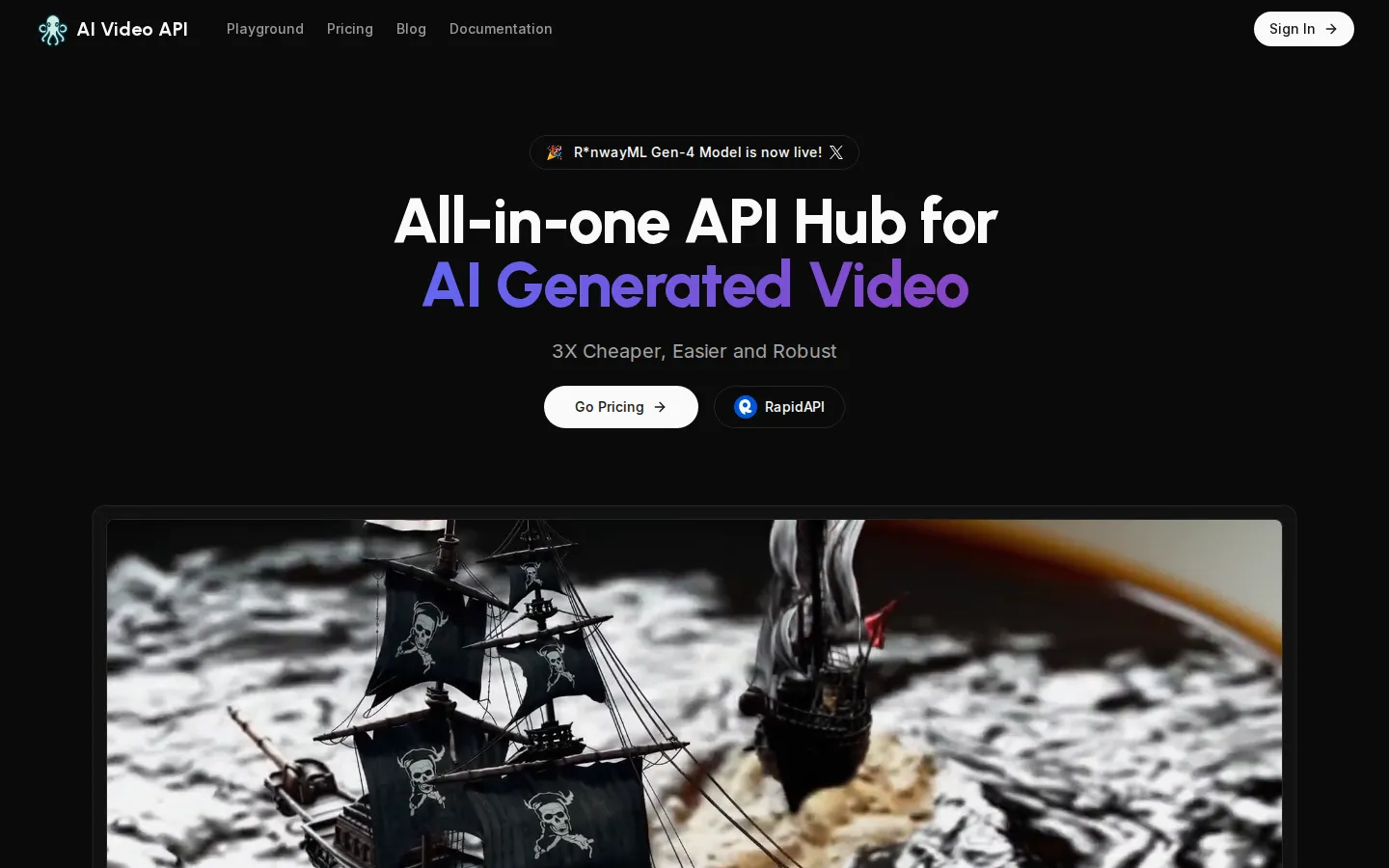
AI Video API Core Features
Text-to-video generation — describe your vision in a few words and the AI does the rest.
Image-to-animated-video — upload any picture and transform it into an engaging animated video.
Extended video length — generates up to 36 seconds of video, 8x the industry standard.
Dual output — delivers high-quality videos and optimized GIFs for cross-platform sharing.
Real-time alerts — robust query and callback webhook support keeps you updated on requests.
Seamless integration — official SDK support for Python, Node.js, JavaScript, PHP and more.
Multi-engine access — RunwayML Gen-4 live now; Sora, StableAI, Pika Labs and Luma coming soon.
Privacy by default — your videos are securely stored and accessible only by you.
Who is AI Video API for?
AI Video API is built for developers and product teams who want to add AI-generated video to their own applications without building video-generation infrastructure themselves. Full-stack and mobile developers can integrate text-to-video and image-to-video generation through REST endpoints and official SDKs for Python, Node.js, JavaScript and PHP, making it a fit for SaaS startups shipping video features fast. Hobbyist developers who want to experiment with AI video can start with the free plan's five generations or the on-site playground. Product teams and agencies use it to produce marketing clips, social media content and special effects, with dual video and GIF output for cross-platform sharing. Creative directors and freelance digital artists can centralize AI video management in one API and keep costs low compared with individual model subscriptions. The company positions the service as 3x cheaper than alternatives, which appeals to bootstrapped startups that need to scale video generation without breaking the bank. Client testimonials on the homepage mention full-stack developers who centralized AI video management, senior developers whose apps gained customer traction after adding the API, hobbyist developers who got video generation running quickly, and a creative director whose team creates, reviews and finalizes videos in one seamless process. Since the higher tiers list OpenAI Sora, StableAI, Pika Labs and Luma Labs as coming soon, teams planning to switch between multiple video models in the future can consolidate on a single integration point. It is also suited for developers already on RapidAPI, where the same API is listed and can be subscribed to directly.
AI Video API Use Cases
Embed text-to-video generation directly inside SaaS and mobile apps via one API.
Produce marketing and social media clips with optimized GIF output for sharing.
Turn product and still images into animated videos for e-commerce and portfolios.
Create high-quality special effects faster in video and film production workflows.
Add video generation features to apps to drive customer traction and engagement.
Generate short-form content in minutes thanks to the fast queue turnaround.
Centralize AI video management across projects with a single integration point.
Power custom GPTs and AI tools with video generation via the RunwayML API.
AI Video API Pros and Cons
Pros
- Positioned as 3x cheaper than alternatives, with a free 5-video plan to start.
- Videos up to 36 seconds long — about 8x the industry standard duration.
- Privacy by default: videos stored securely and accessible only by you.
- Official SDKs for Python, Node.js, JavaScript and PHP speed up integration.
- Dual video and GIF output plus webhooks suit cross-platform sharing workflows.
Cons
- Only the RunwayML engine is live; Sora, StableAI, Pika Labs and Luma are still coming soon.
- Free tier is limited to 5 videos with no priority access and limited support.
- Over-quota usage adds per-video fees ($0.20 on ULTRA, $0.15 on MEGA).
FAQ About AI Video API
AI Video API Pricing
Pricing starts with a free $0/month Starter plan (5 videos), then ULTRA at $39.90/month ($33.25/month billed annually at $399/year) for 250 videos and MEGA at $99.90/month ($83.25/month billed annually at $999/year) for 750 videos, with over-quota videos at $0.20 and $0.15 each respectively.
Check official pricingStarter
Free 5 AI video generations; RunwayML engine only; no priority access to new features; limited customer service.
Ultra
Up to 250 monthly video generations; RunwayML engine only with Minimax AI backup; $0.20 per video beyond quota; $399 charged annually at $33.25/month.
Mega
Up to 750 monthly video generations; RunwayML plus OpenAI Sora, StableAI, Pika Labs and more coming soon; 24/7 business customer support; $0.15 per video beyond quota; $999 charged annually at $83.25/month.
AI Video API Alternatives

CoAnimator
CoAnimator is the agentic animation studio where an AI agent becomes your co-animator, building product demos, launch videos, and tutorials while you watch.

Maxfusion
Maxfusion is an AI creative layer for brands and agencies that ship winning ads at scale. It combines competitor research from the Meta Ad Library, TikTok trend analysis, AI image and video generation, and ad compositing in one platform, with MaxFlows canvas automation and MCP connectors for Claude, ChatGPT, and Cursor. Its RIZZ model creates UGC-style videos with realistic emotion. Pro starts at $199 per month.

Magic Hour
Magic Hour is an all-in-one AI video and image platform trusted by over 3.6 million creators. It packs 100+ free tools into one subscription, including face swap, lip sync, talking photos, text-to-video, image-to-video, AI image editing, upscaling, and templates. Free daily credits require no sign-up wall, credits roll over and refund on errors, and a REST API with SDKs supports production workflows for developers and agencies.