
Agent One
Agent One is an AI agent platform for creating SEO-friendly agent pages that learn from your website, docs, or uploaded files. Each agent answers visitor questions, captures leads, and can be embedded or published as a standalone page. As teams grow, higher plans unlock marketing analytics, live chat, human handoff, and image-to-video content tools. Starter pricing begins at $8 per month with a 7-day free trial.
What is Agent One?
Agent One is a platform for launching AI agent pages that are built for search engines and trained on your own content. You connect a website URL or upload files such as PDFs, docs, and text files, and Agent One creates an interactive page where visitors can ask questions and get answers grounded in that material. The pages are SEO-friendly, so they can rank on Google and capture organic demand while also collecting leads through built-in lead capture and embedded chat. Users can publish the agent as a standalone page or embed it anywhere with zero friction. The platform supports multi-source training, blending files and URLs for more accurate responses, and behavior control so the tone and personality match the brand voice. Agents can be public for search visibility or private for internal team use. On growth plans, Agent One adds marketing analytics that show which pages, questions, and conversations create demand, plus image-to-video tools that turn prompts into content. Pricing is simple, starting with one agent page on the Starter plan at $8 per month with a 7-day free trial, and scaling through Basic and Standard plans that add more message credits, advanced analytics, live chat, human handoff, and unlimited agents and sites. The platform is designed so that non-technical users can get a working agent live in minutes, while developers and agencies retain control over embedding, domains, and branding. Agent pages are indexed like normal web pages, giving businesses a durable search asset rather than a chat widget that disappears. Training data stays the source of truth for answers, which keeps responses grounded in the business's own material. The Starter plan is meant for testing one page, while Basic and Standard are built for teams that need volume, analytics, and support workflows. This makes Agent One equally useful for public-facing pages and internal knowledge agents.
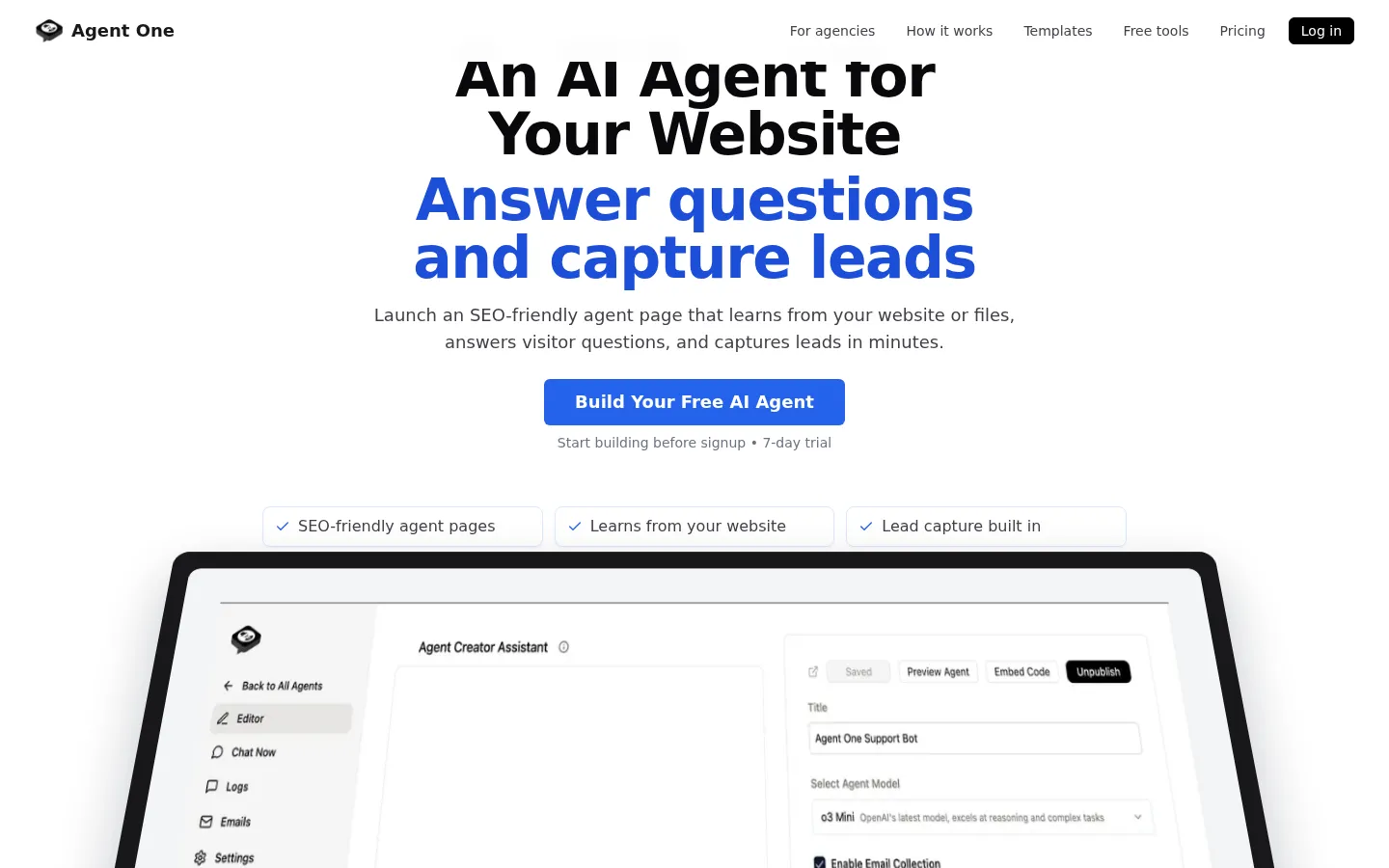
Agent One Core Features
SEO-friendly agent pages
Launch AI agent pages that can rank in search and capture organic demand.
File upload training
Drag-and-drop PDFs, docs, and text files to teach your agent instantly.
URL training
Turn any public URL into an interactive agent page that answers and captures demand.
Lead capture built in
Collect leads through the agent page and embedded chat without extra tooling.
Marketing analytics
See which pages, questions, and conversations create demand on growth plans.
Multi-source training
Blend files and URLs for richer, more accurate responses.
Behavior control
Fine-tune tone and personality to match your brand voice.
Live chat and human handoff
Route conversations to your team with intelligent handoff on higher plans.
Who is Agent One for?
Agent One serves marketers, founders, and small business teams who want to turn their website content into an interactive AI page that ranks in search and answers customer questions. Marketing teams use the analytics on growth plans to see which pages and questions create demand, then feed those insights into new content. Founders and solo operators deploy an agent on their domain to capture leads around the clock without building a chatbot from scratch. Support teams use live chat and intelligent human handoff on higher plans to route conversations when the agent needs backup. Agencies building client websites can spin up multiple agents per site, remove Agent One branding, and use custom domains for a white-labeled experience. Content teams benefit from the content flywheel, using visitor questions and image-to-video prompts to produce follow-up material. Teams that need internal answers can also create private agents visible only to their organization. Sales teams can embed an agent on product pages to qualify visitors with questions about features, pricing, and use cases before a human follows up. Recruiters and HR teams can publish private agents that answer internal policy questions for employees. Educational content creators can deploy an agent trained on their course material so learners get instant answers at any hour. In every case, the setup path is the same: connect content, tune the agent, publish, and review the questions and leads that come back.
Agent One Use Cases
Answer website visitor questions around the clock with an agent trained on your docs and pages.
Capture leads from organic search with an SEO-friendly agent page on your custom domain.
Create internal support agents for your team using private pages with your knowledge base.
Turn visitor questions and conversations into follow-up content with the content flywheel.
White-label agent pages for client websites by removing branding on higher plans.
Use image-to-video prompts on growth plans to produce marketing videos from your content.
Agent One Pros and Cons
Pros
- Fast setup with drag-and-drop file training and URL training from existing content.
- SEO-friendly agent pages help capture organic traffic, not just embedded chat.
- Simple pricing that starts at $8 per month with a 7-day free trial.
- Built-in lead capture, analytics, and branding removal for growing teams.
Cons
- Message credits cap usage on lower plans, which may limit high-traffic sites.
- Advanced analytics, live chat, and human handoff require the more expensive plans.
- Limited to trained website and file content, so answers outside that knowledge need expansion.
FAQ About Agent One
Agent One Pricing
Paid: Starter $8/month (500 credits), Basic $50/month (5,000 credits), Standard $150/month (15,000 credits), with a 7-day free trial.
Check official pricingStarter
7-day free trial, 500 message credits, 1 SEO-friendly agent page, website and file training, lead capture, custom domain.
Basic
5,000 message credits, advanced analytics, videos from images and prompts, 100 agents, remove branding, priority support.
Standard
15,000 message credits, live chat, intelligent human handoff, unlimited agents and sites, team support workflows.
Agent One Alternatives

Devin
Devin is an AI software engineer built by Cognition that plans, codes, debugs, and ships software tasks autonomously. It combines Devin Desktop for local work, cloud agents powered by the SWE 1.7 model, Tab completions, and inline edits across major IDEs. Plans range from a free tier to Pro at $20 per month, Max at $200, and Teams with centralized billing.

Manus
Manus is an AI agent platform that goes beyond answering questions to execute real tasks, automate workflows, and extend human reach. Users describe a goal and Manus plans and completes it across browsers, computers, and code. It offers Agent Mode with Manus 1.6 models, Chat Mode for conversation, and Team plans for collaboration, with free and paid memberships.

Polsia
Polsia is an AI platform that runs companies on autopilot. Built on agent SDKs and MCP integrations, Polsia plans roadmaps, ships code, runs ads, replies to customers, and posts content around the clock without human intervention. Founded by Ben Cera and operated by Polsia, Inc., it is free to start with no credit card required and subscription billing via Stripe.