
Viktor
Viktor is an AI employee platform that works inside Slack and Microsoft Teams. It connects to more than 3,200 tools to handle outreach, pipeline updates, integrations, automations, reports, and code tasks, acting like a hire rather than a chatbot. Pricing is credit-based with a free plan that includes up to $100 in credits, and team plans add shared monthly credits with rollover.
What is Viktor?
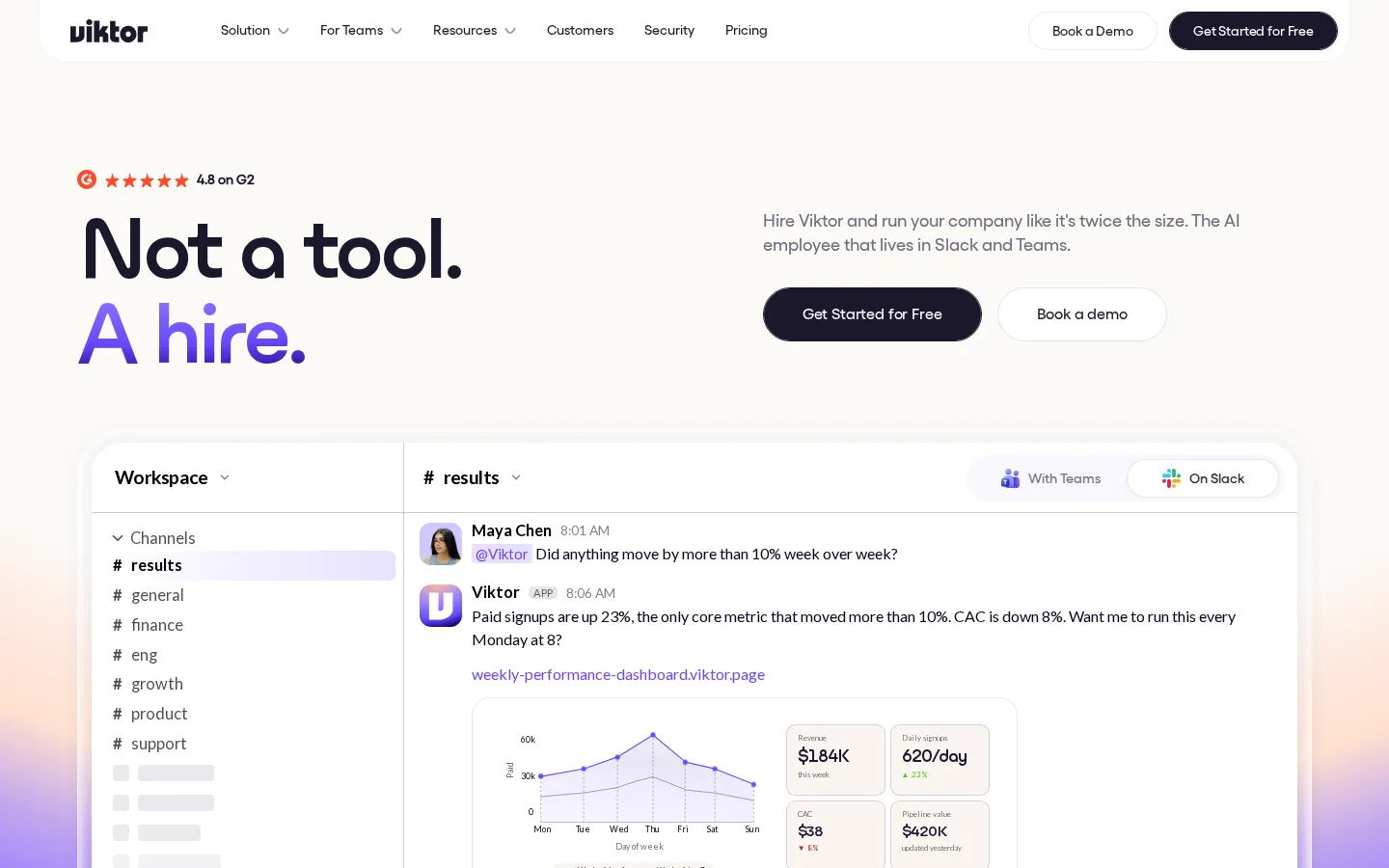
Viktor is an AI employee platform that positions itself not as a tool but as a hire, an autonomous worker that lives inside Slack and Microsoft Teams and gets things done across a company's existing stack. The core idea is that instead of asking an assistant to write drafts or answer questions, teams delegate actual work: Viktor monitors channels, summarizes threads, updates CRM records, drafts follow-ups, changes websites, builds internal apps, and posts results back where the team already communicates. The platform connects to more than 3,200 tools through integrations, and it uses frontier models from Anthropic, OpenAI, and others to execute multi-step tasks. Viktor's capability areas include outreach, pipeline management, integrations, automations, reports, code, organization, and ads, and it can handle both quick tasks such as summarizing a sales thread and complex workflows such as updating a pricing page or building a discount-approval app that pulls live data from HubSpot and Stripe. Work is priced in credits that map to real model usage: quick tasks consume about 100 to 300 credits, complex workflows about 500 to 1,500 credits, and full projects around 2,000 to 5,000 credits, with smart caching that reuses context so repeated workflows cost less. The free plan includes up to $100 in credits that never expire, no credit card required, and access to every feature and integration. The Team plan adds 40,000 shared credits per month with rollover and auto top-ups, and Enterprise adds per-user spend caps, volume discounts, invoicing, and security review support. Viktor is marketed to sales, operations, and engineering teams that want an always-on worker handling follow-ups and repetitive execution, with the site reporting 50,000-plus teams using it. Deployment is straightforward: teams install Viktor into their Slack or Microsoft Teams workspace, connect their existing tools, and start assigning tasks in natural language from the app at app.viktor.com. The product documentation includes an API reference for teams that want to extend Viktor programmatically, and the research section shares how the company builds agents. The site's worked examples show the full range, from a sales thread summary with a drafted HubSpot follow-up to a website change completed with a preview ready for review, and a deal-desk application built and shipped in minutes, illustrating the autonomy the platform aims for.
Viktor Core Features
AI employee in chat
Viktor lives in Slack and Microsoft Teams and executes work where teams already communicate.
3,200+ integrations
Connects to the tools a company already uses for outreach, CRM, code, and reporting.
Multi-step task execution
Handles complex workflows from website updates to building internal apps.
Credit-based pricing
Credits map to real model usage with quick tasks from 100 to 300 credits.
Smart caching
Reuses context across tasks so repeated workflows cost fewer credits.
Free credits
Up to $100 in credits on the free plan, no credit card, and credits never expire.
Team credits with rollover
40,000 shared monthly credits, top-ups on demand, and auto-topup caps.
Enterprise controls
Per-user spend caps, volume pricing, invoicing, DPA, and security review support.
Who is Viktor for?
Viktor is built for revenue, operations, and engineering teams that work in Slack and Microsoft Teams. Sales teams use it to summarize threads, flag deals that need follow-up, and draft CRM updates, effectively giving every rep an analyst. Revenue operations teams delegate pipeline hygiene, discount approvals, and reporting to Viktor so data stays current without manual entry. Marketing teams use it to update websites, generate campaign reports, and coordinate content across tools. Customer success teams automate onboarding check-ins and account health summaries. Engineering teams delegate small code changes, deployments of internal tools, and status reporting. Agency owners use Viktor to cut overhead per client by automating recurring deliverables. Finally, operations leaders at companies using 3,200-plus connected tools use Viktor as a shared worker that every department can assign tasks to, with per-user spend caps on Enterprise keeping budgets controlled. Founders and operators at small companies use Viktor as their first hire for repetitive digital work instead of adding headcount. Sales directors delegate pipeline hygiene and follow-up drafting to keep reps focused on calls. Customer success managers automate account health summaries and renewal reminders. HR teams use it for onboarding task coordination, and finance teams for report assembly and data pulls. Agencies serving multiple clients use the per-workspace deployment to standardize deliverables while keeping client data separated.
Viktor Use Cases
Summarize a sales thread in Slack and flag deals that need follow-up today.
Draft and send a CRM follow-up in HubSpot after a demo call.
Update a website pricing page and preview the change for review.
Build an internal discount-approval app that reads live HubSpot and Stripe data.
Generate weekly pipeline and revenue reports automatically.
Automate outreach sequences across 3,200+ connected tools.
Post status updates and task results back to the team channel after execution.
Viktor Pros and Cons
Pros
- Executes real work rather than just generating text, with results posted where teams already collaborate.
- Very broad integration surface of more than 3,200 tools.
- Generous free plan with up to $100 in credits and no expiry, no credit card needed.
- Transparent credit economy with smart caching that lowers repeat-task costs.
Cons
- Credit costs for large projects can add up quickly on the free allowance.
- Value depends on integration quality with each of the 3,200 tools.
- Positioning as an autonomous hire requires trust in AI execution for sensitive tasks.
FAQ About Viktor
Viktor Pricing
Freemium: Free $0 with up to $100 in credits that never expire; Team $100/month with 40,000 shared credits, rollover and auto top-ups; Enterprise custom with per-user spend caps and volume pricing.
Check official pricingFree
Up to $100 in credits, every feature and integration, credits never expire.
Team
40,000 shared credits monthly, rollover, top-ups on demand, auto-topup caps.
Enterprise
Per-user spend caps, volume pricing, invoicing, DPA, and security review support.
Viktor Alternatives

Polsia
Polsia is an AI platform that runs companies on autopilot. Built on agent SDKs and MCP integrations, Polsia plans roadmaps, ships code, runs ads, replies to customers, and posts content around the clock without human intervention. Founded by Ben Cera and operated by Polsia, Inc., it is free to start with no credit card required and subscription billing via Stripe.

skills.sh
skills.sh is an open directory of reusable agent skills built by Vercel Labs. Developers browse thousands of skills across topics like React, Next.js, testing, and agent workflows, then install them with a single command into Claude Code, Cursor, Codex, Copilot, and other agent runtimes. The platform is free, open source, and includes security audits, packs, and an API.

Sollo
Sollo is an all-in-one AI platform that combines AI agents, automation workflows, and business tools in a single command center. Users deploy specialized AI employees for marketing, sales, customer support, and operations that work around the clock. Built for solo entrepreneurs, Sollo replaces an entire AI stack with one platform and includes access to GPT, Claude, Gemini, and Sollo's own models.